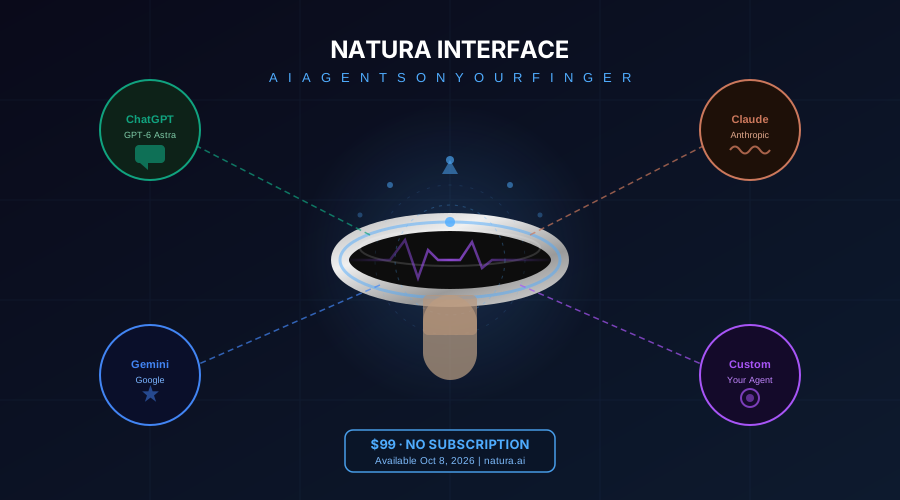
A new startup called Natura launched a $99 smart ring this week that does something no piece of jewelry has done before: it turns the tap of your finger into a direct command line to your AI agents. The device, called the Interface, went on sale October 8, 2026, and it represents a new bet on where the AI interface wars are heading — away from screens entirely, and onto your body.
A Ring That Routes to Your Agents
The Natura Interface looks, from the outside, like any other titanium smart ring. It tracks your heart rate, blood oxygen, sleep stages, and activity throughout the day. But the part that’s turning heads is what happens when you press your finger — a short press, a long press, or a double-tap — against your thumb.
Each gesture fires a voice request to a personally configured AI agent. Out of the box, the Interface ships with support for ChatGPT, Claude, and Google Gemini. You pick which agent handles which gesture, open the companion app, speak your request, and the response plays back through your phone’s speaker or whatever audio device you have paired.
Think of it as a wearable shortcut layer on top of AI agents you’re already paying for. The ring itself isn’t doing the inference — it’s an input device that removes the activation step of unlocking your phone, opening an app, and holding a button. The Interface makes the friction of talking to AI roughly equivalent to the friction of tapping your finger.
That is a deceptively large behavioral shift. If talking to AI feels like operating an app, most people will treat it like one — something they use consciously and occasionally. If talking to AI feels like a reflex, like knocking on a table, the relationship changes. Natura is betting that the missing ingredient in mass AI adoption isn’t capability; it’s the gesture.
The Price That Changes the Math
The smart ring market has existed in a strange middle zone. Oura Ring, the category pioneer, sells for $299 and charges a $5.99 monthly subscription. Samsung’s Galaxy Ring launched in 2024 at $399. Both are premium, friction-laden purchases that appeal to quantified-self enthusiasts and early adopters.
At $99 — with no subscription — Natura is making a different argument: that the AI agent interface layer is more valuable than the health analytics layer, and that pricing it like consumer electronics rather than a medical wearable will unlock a much larger market.
The Interface still has health sensors. It measures heart rate, SpO2, skin temperature, and sleep stages, and that data flows into the Natura app. But the company isn’t positioning it as a replacement for Oura or Samsung. It’s positioning it as the input layer for a world where AI agents handle your questions, your reminders, your quick research, and your ambient daily tasks — and where reaching for your phone to access them is already starting to feel old.
Why Wearables and AI Are Colliding Now
This launch follows a pattern that’s been building across the wearables industry in 2026. Meta’s Ray-Ban glasses added AI voice responses last year. Amazon Echo Frames have gotten smarter. Apple’s Vision Pro spawned a wave of thinking about where computation sits relative to the body. But all of those devices are either expensive, conspicuous, or both.
A ring is different. It is the most inconspicuous computing surface on the human body. You can tap it during a meeting, standing in line, cooking dinner, or mid-conversation without anyone noticing. The act of querying an AI agent becomes genuinely ambient.
The Natura Interface also reflects a broader shift in how AI is being deployed. As agents — persistent, task-capable AI systems with access to your calendar, email, files, and web — become more common, the bottleneck moves from model capability to interface latency. The question isn’t whether your AI agent can book a restaurant reservation; it’s how quickly you can tell it to.
A ring on your finger, always present, zero-latency to activate, is a plausible answer to that question in a way that a phone screen is not.
The Competition Waiting in the Wings
Natura isn’t alone in noticing this. At CES 2026, Spark Ring debuted as a product designed for “instant thought capture,” capturing voice notes and AI queries via a ring form factor. Dreame, the Chinese appliance manufacturer, announced an AI-enabled smart ring this year. The category is filling up fast.
But Natura has a first-mover advantage in the specific niche of multi-agent routing — the ability to configure different gestures to different AI services. That’s a meaningful differentiator for the growing share of users who have subscriptions to multiple AI platforms and want context-specific agents for different use cases: one tap for research, another for personal tasks, a third for work systems.
The company faces real challenges. Battery life on smart rings is measured in days, not weeks, and any additional processing or Bluetooth connection frequency tends to eat into that. The Interface advertises a four-day battery life, which is competitive with Oura but lower than some rivals. Health sensor accuracy will also face scrutiny — a device that bundles AI control with health data carries more trust weight than a simple remote.
There’s also the AI subscription fragmentation problem. The Interface requires that users already have active accounts with whatever AI agents they configure. At $99, the ring itself is cheap. At $20 to $30 per month across two or three AI services, the ongoing cost stacks up.
What the $99 Price Point Signals
Beyond the product itself, the $99 launch price of the Natura Interface is a statement about where AI hardware is going. The premium AI hardware layer — whether it’s a phone, a ring, or a pair of glasses — is rapidly commoditizing. The value is in the agent, not the edge device.
That has implications for every company selling AI hardware with premium margins. If a $99 ring can be a credible entry point to the AI agent world, the $299 ring selling primarily on brand and health analytics is in a more complicated position. So is the $499 earpiece, and the $2,000 mixed-reality headset.
Natura has made a $99 bet that the future of AI interaction is ambient, physical, and dumb-cheap on the device side. The smart money says they’re probably right about the direction. Whether they’re the ones who get there first is the more open question.
The Interface is available now at natura.ai for $99, with free shipping on orders placed before October 31.


