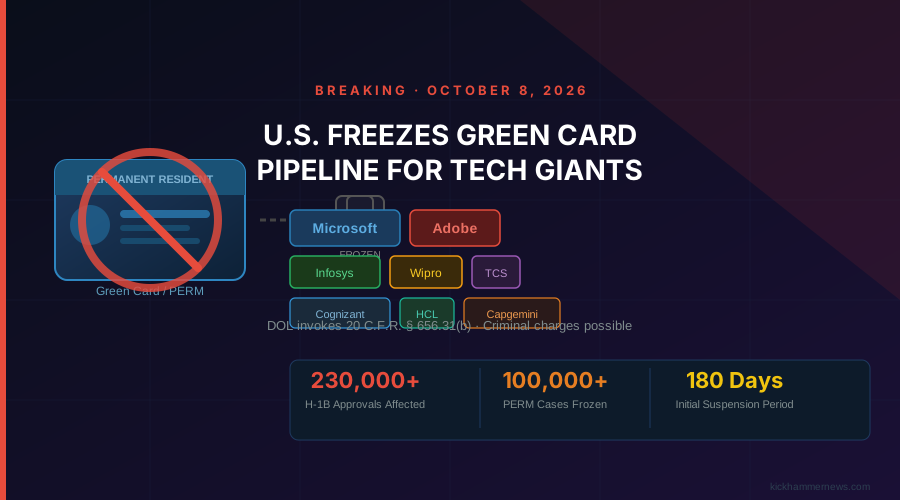
The Trump administration has suspended eight of the technology industry’s biggest employers from a critical immigration program, halting hundreds of thousands of green card cases and sending shockwaves through the H-1B workforce.
In a dramatic move announced at a White House press conference on October 8, 2026, the Department of Labor (DOL) suspended Microsoft, Adobe, Cognizant, Infosys, Tata Consultancy Services, Wipro, HCL Technologies, and Capgemini from the PERM labor certification program — the mandatory first step for millions of skilled foreign workers seeking permanent U.S. residency. The suspension immediately freezes new applications and halts processing of pending cases for all eight companies, which together account for more than 230,000 H-1B approvals and at least 100,000 permanent labor certifications.
The announcement was made by Labor Secretary Keith Sonderling alongside Vice President JD Vance, who delivered pointed criticism directly at one of the world’s most valuable companies. “Our message to Microsoft is: You’re a great American company, but you’ve got to hire great American workers,” Vance said at the press conference. Attorney General Todd Blanche added that criminal charges against companies or individuals remain a possibility as investigations proceed.
What Is PERM, and Why Does It Matter?
The Program Electronic Review Management (PERM) system is the federal process by which employers must demonstrate — through documented recruitment efforts — that no qualified U.S. worker is available for a given role before sponsoring a foreign national for a green card. For most employment-based green card categories (EB-2 and EB-3), PERM is not optional; it is the legally required gateway.
For the hundreds of thousands of H-1B workers employed by the eight suspended companies, this is deeply consequential. While H-1B visa status itself has not been revoked — these workers can continue working legally under their current authorization — the freeze effectively stalls the path to permanent residency. PERM applications must typically be filed within 180 days of completing the required job recruitment process, meaning a prolonged suspension could force employers to restart the entire recruitment clock.
Cognizant was first hit by DOL action in early September 2026, when the department’s inspector general halted its new PERM filings. The October 8 announcement added Microsoft, Adobe, and the remaining six companies to the suspension list in a single coordinated action.
The Fraud Allegations
The DOL is invoking 20 C.F.R. § 656.31(b), a regulation that allows the agency to suspend PERM processing during investigations into possible fraud or willful misrepresentation. The initial suspension period can last up to 180 days, with the possibility of debarment from the program for up to three years if violations are confirmed.
Vice President Vance offered specific claims about Microsoft, alleging the company laid off approximately 6,000 American workers over the past year while simultaneously gaining around 6,300 H-1B visa approvals and nearly 3,000 green card certifications. He also alleged that some foreign workers at these firms were paid tens of thousands of dollars less than their American counterparts in comparable roles — a potential violation of prevailing wage requirements under H-1B law.
Microsoft pushed back firmly. The company said the vast majority of its U.S. employees are American citizens or permanent residents, and that approximately 80% of its H-1B filings in the most recent fiscal year were for workers already employed at the company — extensions or status changes, not new foreign hires. Microsoft noted that new-hire H-1B filings represent roughly 1% of its total U.S. workforce. Adobe did not respond to press requests for comment.
The underlying data cited by Vance has not been independently published or verified, and the allegations have not been tested in any court proceeding. Immigration practitioners note that these remain investigations, not findings, and that formal debarment would require additional due process.
The Workforce Impact
The human consequences of the freeze fall hardest on the workers in the pipeline. There are several categories of affected individuals:
Workers awaiting PERM approval: Those who have had PERM applications filed on their behalf but not yet approved face an indefinite hold. If the suspension lasts long enough, employers may need to restart the recruitment process — effectively resetting the clock on years of accumulated waiting.
H-1B workers past their sixth year: U.S. immigration law generally limits H-1B status to six years. Workers who have an approved I-140 petition (the next step after PERM) may be eligible for annual extensions, but those who haven’t yet reached that milestone and rely on a pending PERM case to extend their stay face significant uncertainty.
Priority dates at risk: In employment-based immigration, a worker’s “priority date” — typically tied to the PERM filing date — determines their place in the green card queue. Losing months or years of accumulated priority could set back workers from heavily backlogged countries like India by a decade or more.
Workers who already hold an I-140 approved for at least 180 days are in a better position; their priority date is generally portable and protected even if they change employers. For others, alternative pathways such as the EB-1B (outstanding researcher), EB-2 National Interest Waiver (self-filed), or EB-1A (extraordinary ability) categories bypass PERM entirely — though these are significantly harder to qualify for.
Industry Reaction
Nasscom, the Indian IT industry trade association, characterized the suspension as narrow in scope, noting that PERM-to-green card movement is relatively limited in the broader H-1B context. The association stopped short of calling for formal legal challenges but indicated it was monitoring the situation closely.
The announcement sent a chill through enterprise IT procurement teams, many of whom rely on the suspended companies — particularly Indian IT outsourcers — for large-scale managed services and staff augmentation. Any disruption to these firms’ ability to deploy skilled foreign workers on U.S. client engagements could ripple into project timelines and contract staffing models.
The nine universities also named by Vance — Harvard, Yale, Stanford, Brown, MIT, Caltech, UC Davis, Arizona State, and the University of Pittsburgh — have received subpoenas in a related investigation into alleged J-1 visa fraud, though no university has been suspended from any program.
What Comes Next
With no end date announced and the legal authority allowing the suspension to extend indefinitely pending an investigation or judicial proceeding, affected workers and employers are in a state of acute uncertainty. Immigration attorneys are advising companies to audit their pending PERM cases immediately, review prevailing wage documentation, and prepare for the possibility that the suspension could run well beyond the initial 180-day window.
The action marks the most aggressive use of PERM enforcement authority in recent memory — eclipsing the Cloudera suspension announced in May 2026, which had been the prior benchmark for federal scrutiny of a single employer. With eight companies now under the microscope and criminal referrals on the table, the administration has signaled that its scrutiny of tech industry hiring practices is intensifying, not subsiding.
For the hundreds of thousands of skilled workers whose green card cases are now frozen in bureaucratic limbo, the message is clear: the rules of employment-based immigration in America changed overnight.