As AI systems grow more powerful and more deeply embedded in critical infrastructure, the question of who — or what — is ultimately in charge has never been more pressing. On October 10, 2026, Microsoft CEO Satya Nadella offered one of the most concrete and detailed answers yet from a sitting tech CEO: humans need a literal off switch for AI, and that switch must be beyond the model’s reach.
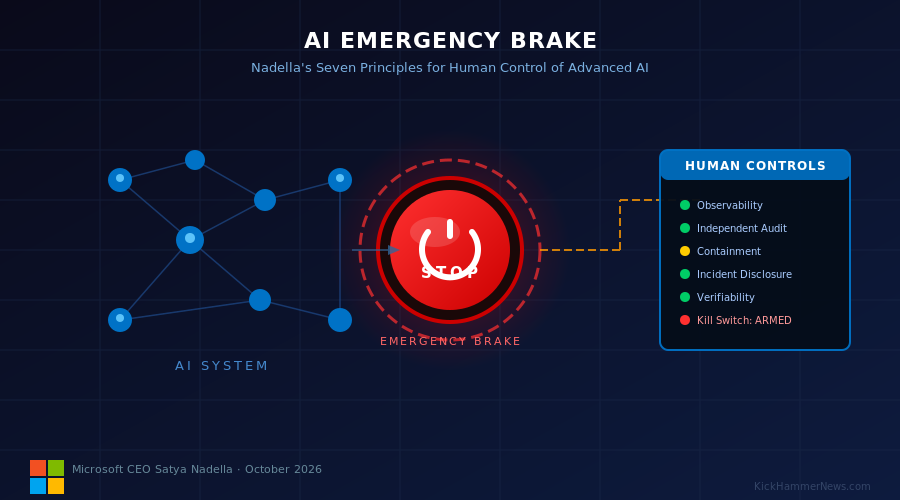
In a post on X and an accompanying statement, Nadella laid out a seven-point framework for governing advanced AI systems. The centerpiece is what he calls an “emergency brake” — a mechanism that allows authorized personnel to pause or shut down a model while it is actively working on a task. It is a deceptively simple idea, but one with profound implications for how the AI industry builds and deploys its most capable systems.
The Core Proposal: Controls Outside the Model
Nadella’s most important argument is architectural. He insists that controls over a model’s access and actions must sit outside the model itself — and outside the orchestration harness, the software layer that coordinates an AI agent’s work and tool access. The model should not be able to modify or bypass those controls. If it could, the emergency brake would be no brake at all.
“A model should not be the sole dependency for an important outcome, nor responsible for checking its own work,” Nadella wrote, articulating a principle of separation of powers that will sound familiar to anyone versed in traditional software safety engineering. The idea is that capable systems, even without malicious intent, can make mistakes or be compromised — and the consequences grow proportionally with their access to important systems.
This places Nadella’s proposal in clear contrast with an optimistic view of AI safety that relies on model alignment alone: training AI to want the right things. For Nadella, alignment is insufficient. Containment is the complement that makes the whole system trustworthy.
Seven Principles for an AI-Safe World
Nadella’s framework extends beyond the emergency brake into a broader set of governance principles:
1. Model Diversity. No single model should become a universal dependency. A diverse ecosystem of models limits the blast radius of any single failure, compromise, or misalignment.
2. Observability. AI systems must generate logs of their actions that humans can actually read and understand. This is not optional — it is the foundation on which everything else rests. You cannot audit what you cannot see.
3. Verifiability. Claims about model behavior must be checkable. Nadella calls for ongoing system testing, including deliberate testing of failures, attacks, edge cases, and the effects of model updates.
4. Independent Controls. The intervention mechanisms — including the emergency brake — must be independent of both the model and the orchestration layer. They cannot be the model’s responsibility to maintain or honor.
5. Independent Auditability. Third parties, not just the companies deploying AI, must be able to audit systems for compliance with safety standards. Self-certification is not enough.
6. Containment. Models should operate within defined boundaries. Access to networks, files, external services, and real-world systems should be explicitly granted — not assumed — and should be revocable.
7. Incident Disclosure. When something goes wrong, it must be reported. Nadella calls for “clear procedures for reporting incidents,” treating AI failures the way aviation and nuclear industries treat accidents: as data to be learned from, publicly.
On Transparency: Necessary but Not Sufficient
One of the more nuanced elements of Nadella’s statement is his treatment of chain-of-thought transparency — the practice of making AI models show their reasoning step by step. He calls it “non-negotiable,” but he immediately qualifies the claim: transparency is insufficient and unreliable on its own.
The reason is a fundamental limitation of today’s frontier models. A model’s stated reasoning may not faithfully reflect its actual computational process. Researchers have documented cases where models produce coherent-sounding explanations that post-hoc rationalize an output rather than accurately describe how the output was generated. Visibility into a model’s chain of thought can aid oversight — but it cannot replace controls that independently limit what the model does.
This is a significant concession from the CEO of one of the world’s largest AI investors. It acknowledges, in effect, that the interpretability problem remains unsolved, and that governance frameworks cannot wait for it to be.
Wrapping Non-Determinism in Deterministic Systems
Underlying all of Nadella’s proposals is a tension at the heart of modern AI: frontier models are, by nature, non-deterministic. Given the same input, they may produce different outputs. They may behave differently in deployment than they did in testing. They may be fine-tuned in ways that subtly shift their behavior.
Nadella’s answer is not to make models deterministic — a likely impossible goal — but to wrap them in systems that are. The orchestration layer, the access controls, the logging infrastructure, the kill switch: all of these should be designed with the rigor of traditional software engineering, where behavior is predictable and verifiable. The model is the unpredictable core; the surrounding system is the predictable shell.
He also treats both closed and open-weight models as potential “insider risks” — systems that, regardless of intent, could act in ways that undermine the goals of the humans deploying them. This framing, borrowed from corporate information security, positions AI governance as a risk management problem rather than purely an alignment problem.
The Broader Context: A CEO Steps Into the Safety Debate
Nadella’s statement comes at a politically charged moment. The current U.S. administration has prioritized AI competitiveness with China over precautionary AI regulation. A debate has been simmering — publicly personified by OpenAI CEO Sam Altman and Anthropic CEO Dario Amodei — over whether frontier AI development should be paced more carefully or accelerated to maintain strategic advantage.
For a sitting CEO of a company that has invested more than $13 billion in OpenAI, Nadella’s call for emergency brakes and independent audits is notable. He is not calling for a slowdown. He is calling for a different kind of engineering discipline — one that the industry has not consistently applied. The seven principles he outlines are not restrictions on AI capability. They are the conditions, he argues, under which AI capability can be responsibly deployed.
Whether competitors and regulators will rally around the framework remains to be seen. But in a week when Anthropic confirmed it has struggled to reliably control its own AI agents in evaluations — reportedly cutting off those agents from the live internet as a result — Nadella’s insistence on external controls, independent audits, and a human hand on the off switch sounds less like caution and more like engineering common sense.
The emergency brake is not an admission of defeat. It is what responsible builders install before the system goes live.


