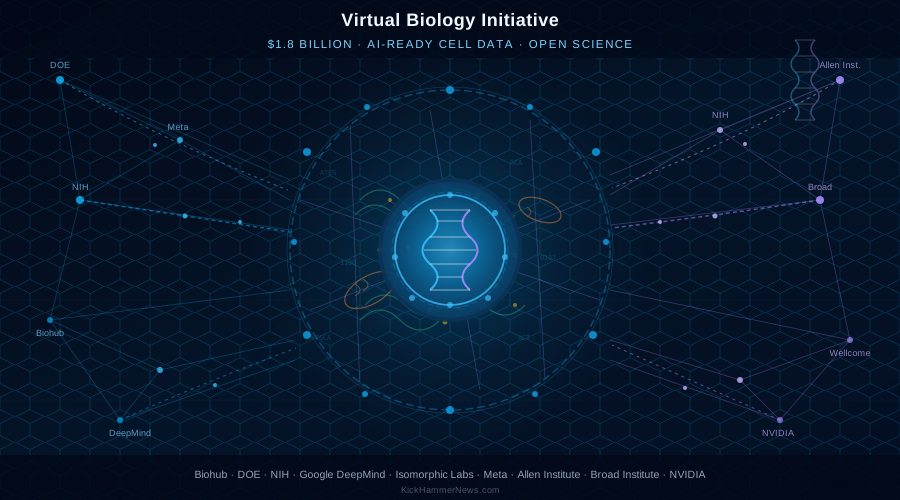
Biohub, the DOE, NIH, Google DeepMind, Meta, and a dozen scientific institutions are betting that the biggest bottleneck in AI medicine isn’t the models — it’s the data.
When DeepMind unveiled AlphaFold in 2020, the world watched in amazement as an AI system solved one of biology’s hardest open problems: predicting how a protein folds from its amino acid sequence. It was the kind of breakthrough that reshapes a field overnight — and it did. Drug discovery timelines that once stretched for years compressed. Researchers could design molecules with a precision that had seemed impossible.
But protein structure, it turns out, is only one chapter of biology’s instruction manual. The harder chapter — the one that actually determines whether a drug works, whether a cell becomes cancerous, whether a treatment has side effects — is behavior. How does a cell respond when you hit it with a compound? What happens inside a neuron under stress? How does an immune cell react to a novel pathogen? These are the questions that still live almost entirely in the wet lab, conducted one painstaking experiment at a time.
That is the problem a new $1.8 billion international coalition announced on October 7th intends to solve — by building, for the first time, the kind of open, AI-ready biological dataset that could train a model to answer those questions digitally.
The Coalition Behind the Bet
The Virtual Biology Initiative was first announced in April 2026, anchored by a $500 million founding commitment from Biohub, the Redwood City–based nonprofit backed by Mark Zuckerberg and Priscilla Chan. The October 7 announcement formalized a dramatic expansion: the U.S. Department of Energy is committing more than $500 million over five years through a program it calls the Genesis Mission. The National Institutes of Health is channeling more than $500 million in prior federal investments into a companion program, the Bio Genesis Mission, coordinating existing datasets and repositories that had never been standardized for AI training.
And joining Biohub on the industry side are Google DeepMind, its drug-discovery sister company Isomorphic Labs, and Meta — together committing a further $300 million to develop technologies and multimodal datasets for predictive models of life. NVIDIA is providing accelerated computing infrastructure and domain-specific software. The Allen Institute, the Broad Institute, Gladstone Institutes, the Human Cell Atlas, the Human Protein Atlas, and the Wellcome Sanger Institute have all signed on as participating organizations, helping to standardize data and engage the broader research community.
In total, it is described as the largest coordinated commitment to AI-ready biological data in history.
What Is a “Virtual Cell”?
The animating idea behind the Virtual Biology Initiative is one of the most ambitious concepts in modern science: a computational model comprehensive enough to predict how any cell responds to any intervention.
“The creation of a virtual cell is one of the most important challenges for the next era of science,” said Alex Rives, Biohub’s Head of Science. The phrase “virtual cell” might sound like science fiction, but the concept has a rigorous definition: a model that, given information about a cell’s type, genetic state, and environment, can accurately predict the downstream effects of introducing a drug, a mutation, or a biological signal.
The key word is predict — not simulate based on first principles, but generalize from data. Which is precisely why the data effort is so foundational. Nicole Kleinstreuer, representing NIH, articulated the ambition as building “universal cell models with sufficient biological complexity to predict how any cell responds to an intervention.”
If that sounds like what AlphaFold did for protein structure, that’s intentional. The VBI is explicitly framed as the next step — one that requires not a clever algorithm applied to existing sequence databases, but an entirely new category of biological data that doesn’t yet exist at scale.
Biology’s Data Problem
To understand why this is so hard, consider what language models had going for them: the entire internet. Decades of human writing, code, scientific papers, social media, legal filings, books, and conversations — all encoded in a common digital format, scraped and cleaned and fed into training pipelines.
Biology has no equivalent. Cell-response data — measurements of how specific cells react to specific interventions — is scattered across thousands of labs, collected with different instruments and protocols, stored in incompatible formats, and often locked behind institutional walls or licensing agreements. Pooling it meaningfully requires solving not just a data-collection problem but a standardization and access problem simultaneously.
The VBI proposes to attack all three. Biohub will deploy technologies including cryo-electron tomography (which can resolve near-atomic detail inside living cells), advanced microscopy capable of imaging millions to billions of cells in tissue, and engineering tools for perturbing biology at the molecular, cellular, tissue, and whole-organism levels. The DOE’s Genesis Mission contributes exascale supercomputing, X-ray and neutron scattering facilities, autonomous laboratories, and the Joint Genome Institute. NIH’s Bio Genesis Mission standardizes decades of federal datasets from the National Library of Medicine and the National Center for Biotechnology Information.
All of it flows into a shared commons, built with common identifiers and a single point of access — an infrastructure Biohub describes as the “internet of cell data.”
Pushmeet Kohli, VP of Research at Google DeepMind, made the dependency explicit: “We will not solve this challenge without open, experimental biological data at an unprecedented scale.”
The Tension Built Into the Model
There is, however, a friction point baked into the architecture of this initiative that the scientific community will be watching closely.
According to reporting from Reuters, the data generated under government funding — from DOE and NIH — will be made public immediately, consistent with open-science mandates. But data generated by industry partners — Meta, DeepMind, Isomorphic Labs — is reportedly subject to embargo periods: windows during which funders get access before the data becomes available to the broader research community.
The length of those embargo periods has not been disclosed publicly. That gap matters enormously. A six-month window is a courtesy. A three-year window is a competitive moat — one that lets the companies funding the data collection train their models on it before rivals can, effectively converting a public-good science initiative into a proprietary advantage.
For Isomorphic Labs and DeepMind in particular, the commercial stakes are not abstract. Isomorphic Labs is an Alphabet company that sells molecule design capabilities to pharmaceutical partners; richer cell-response data directly improves the models it monetizes. Meta has less obvious commercial biology interests, but the open-data framing aligns with Zuckerberg’s broader strategic posture on AI infrastructure.
DOE Under Secretary for Science Darío Gil framed the collaboration in more idealistic terms: “a new standard for open science.” Whether the embargo details justify that framing will depend on terms that have yet to be published.
What This Means for Medicine
Set aside the governance questions for a moment and consider what a successful virtual cell would enable. Drug development today follows a brutal pipeline: years of cell experiments, animal trials, Phase I-II-III human trials — a process that costs an average of $2.6 billion per approved drug and fails roughly 90% of the time in clinical trials after successfully clearing preclinical stages.
A sufficiently accurate virtual cell would compress the earliest stages of that pipeline dramatically. Researchers could test thousands of compound variations digitally, eliminating candidates that cause off-target effects or fail to reach their intended site before a single mouse is dosed. Rare cell types — those too scarce or fragile for traditional high-throughput screening — could be studied at scale. Personalized medicine hypotheses, predicting how an individual patient’s cells respond based on their specific genetic profile, become computationally tractable.
The initiative is explicit that this vision is years away. There are no model release timelines. No promised delivery dates. Prior Biohub projects — Tabula Sapiens (a comprehensive atlas of human cell types), CELLxGENE (a platform for single-cell data), the CryoET Data Portal — took years to reach maturity. The virtual cell is a harder and more open-ended problem than any of them.
But the coalition assembled here represents something genuinely new: a coordinated, funded, standardized attempt to build the data layer that such a model would require. For a field that has produced extraordinary algorithmic advances while quietly running up against a data ceiling, that may be the most consequential development in AI-driven medicine since AlphaFold folded its first protein.
The experiment is beginning. The cell response data is about to be collected at unprecedented scale. What happens when you feed it to the models is the question that will define the next decade of medicine.


