The Silicon Valley quantum computing firm has demonstrated the world’s fastest quantum interconnect, a milestone that could unlock the modular quantum data centers of tomorrow.
Quantum computing took a significant leap forward this week when IonQ announced it had achieved entanglement rates above 1,000 events per second — more than four times any previous trapped-ion record — between a trapped-ion qubit and a solid-state quantum memory using a photonic interconnect. The company is calling it the fastest quantum interconnect rate between qubits on any platform, and researchers say it addresses one of the field’s most stubborn bottlenecks: getting quantum systems to talk to each other quickly enough to be useful.
The announcement, made October 9, 2026, comes with a technical preprint posted to arXiv (2610.10705) and marks a new chapter in IonQ’s bid to become the backbone of distributed quantum computing infrastructure.
What IonQ Actually Did
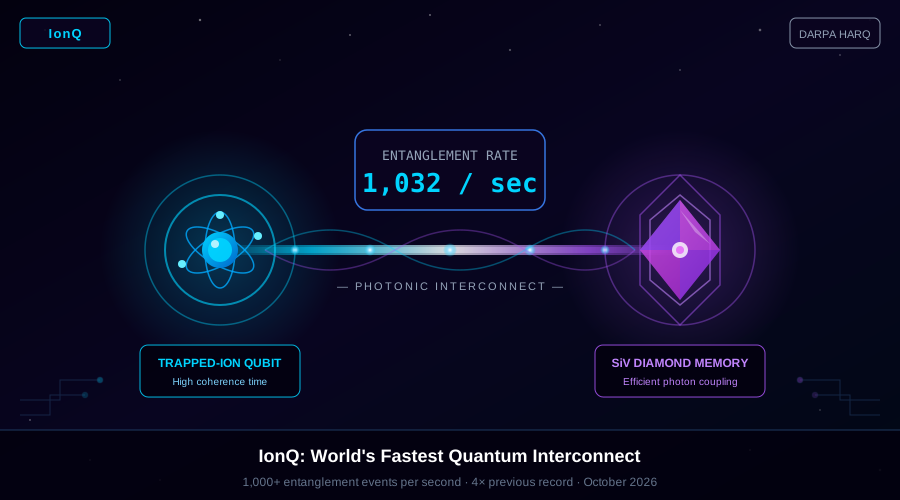
At the heart of the breakthrough is a clever pairing of two very different qubit technologies. On one side: a trapped-ion qubit, the kind IonQ has long specialized in, prized for its exceptional coherence time — how long it can hold quantum information before noise destroys it. On the other side: a silicon-vacancy (SiV) qubit embedded in a diamond crystal, part of IonQ’s SiV quantum memory platform, which excels at coupling efficiently to light.
The two systems were linked by a photonic interconnect, a channel that uses individual photons to transfer quantum states between the ion and the diamond memory. In a real hardware test of an end-to-end link, IonQ’s team recorded more than 1,032 entangled pairs per second — a number that lands well above the 1 kHz threshold and obliterates the previous trapped-ion record set by a research group at Duke University, which is also a collaborator on the paper.
The previous benchmark, cited from Physical Review Letters (133, 090802, 2024), was set by the same Chris Monroe who now serves as IonQ’s Chief Scientist. That Monroe’s former group held the record his current company just shattered is a fitting bit of quantum-computing irony.
Why Interconnect Speed Matters
For most of quantum computing’s history, the central challenge has been making individual quantum processors better — more qubits, fewer errors, longer coherence. But as those processors have matured, a new constraint has emerged: getting them to work together.
A single quantum chip, no matter how powerful, faces fundamental physical limits on how many qubits it can host before thermal noise, electromagnetic interference, and engineering complexity conspire to degrade performance. The obvious solution — link multiple chips together into a larger network — runs directly into the interconnect problem. A link that is too slow, or too lossy, creates a bottleneck that negates the advantages of distributed architecture altogether.
This is exactly the problem IonQ says it has now addressed.
“Moving qubits through photons will be necessary in any large-scale quantum computer,” said Chris Monroe, IonQ’s Chief Scientist, in a statement accompanying the announcement. “This is the foundation for future progress.”
CEO Niccolo de Masi drew a direct parallel to classical computing’s own architectural evolution: “IonQ has crossed a pivotal milestone for memory-enhanced quantum interconnects. Think of how classical data centers connected specialized processors, memory, and networks. We are laying the same modular foundation for the quantum era.”
A Platform Built to Scale
What sets this result apart from a pure research demonstration is the architecture’s claimed breadth. IonQ says the photonic interconnect design is compatible not just with trapped ions but with other leading qubit types, including neutral atoms and superconducting qubits — provided the latter use transducers to convert their native microwave signals into light. That would make IonQ’s memory-and-interconnect stack a potential glue layer for a heterogeneous quantum computing ecosystem.
Mihir Bhaskar, Senior Vice President at SkyWater Technology — a key manufacturing partner for IonQ’s SiV platform — put it plainly: “This work shows that a photonic quantum interconnect need not be a bottleneck for distributed quantum computing.”
The demonstration also feeds directly into IonQ’s work under DARPA’s HARQ (High-Speed And Reconfigurable Quantum interconnects) program, a Defense Advanced Research Projects Agency initiative aimed at developing high-speed quantum interconnects that work across multiple qubit modalities. For a company with considerable government contract exposure, landing a performance milestone of this caliber on a DARPA-adjacent program is no small thing.
From Lab to Customer
The result isn’t purely theoretical. IonQ announced its first commercial sale of the memory-and-interconnect platform back in April, to the University of Maryland — an institution with deep ties to Monroe and IonQ’s founding. A second sale to SDT, a South Korean quantum technology firm, followed in September.
Those commercial deployments mean real institutions are already building with this hardware — a sign that the technology has crossed from proof-of-concept into something closer to a product.
Context: The Modular Quantum Race
IonQ’s announcement lands in a competitive landscape. IBM, which recently reported that its first modular cryogenic systems — the hardware layer required to link quantum chips at the hardware level — are now connected and operating, has its own roadmap targeting a machine with at least 1,000 programmable qubits in 2027. Microsoft, Google, and a wave of startups are each pursuing their own approaches to the interconnect and error-correction problems that stand between today’s “noisy intermediate-scale quantum” era and tomorrow’s fault-tolerant machines.
But the photonic interconnect route has a distinct appeal: light travels fast, loses relatively little in transit compared to electrical signals, and can be routed across longer distances, meaning modular quantum data centers don’t necessarily need to be monolithic room-sized installations.
What Comes Next
The preprint at arXiv is currently undergoing peer review. Closer observers of the quantum industry will want to watch how independently the 1 kHz entanglement-rate claim holds up under scrutiny — the figures come from IonQ itself, and as of this writing no independent verification has been published.
Still, the convergence of a credible technical result, active government program participation, and live commercial deployments gives the announcement unusual weight. The question of whether quantum computers will scale as modular, networked systems has just gotten a meaningful data point in its favor.
For the broader industry, the message is becoming clearer with each passing quarter: the quantum computing future won’t be built on monolithic chips alone. It will be networked — qubit by photon, at one thousand entanglements per second and rising.
Sources: IonQ investor release, October 9, 2026; The Quantum Insider; HPCwire; arXiv preprint 2610.10705