For years, Nous Research was best known in machine learning circles as the team that released better fine-tuned models for free and asked for nothing in return. The group built its reputation through open weights, transparent training methods, and a stubborn insistence that frontier-quality AI didn’t have to sit behind a corporate API. That reputation just became a $1.5 billion business.
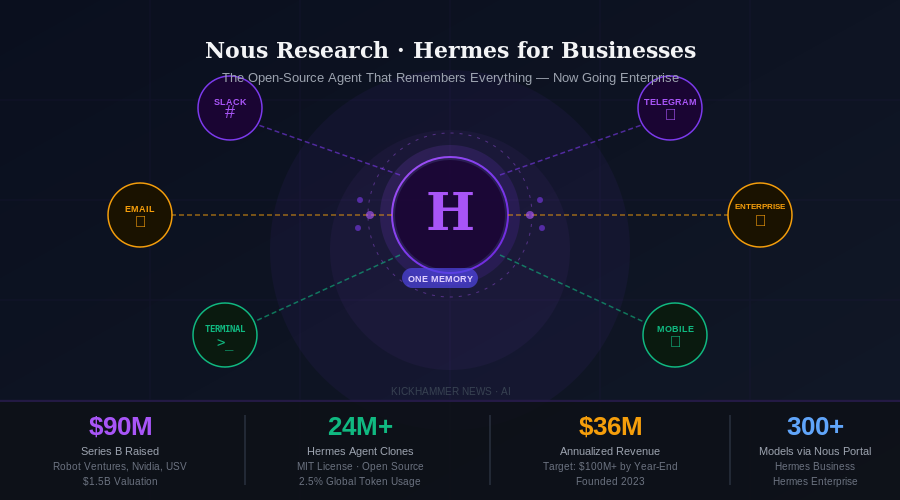
On October 7, 2026, Nous Research announced it had closed a $90 million Series B, led by Robot Ventures, with participation from Nvidia, Union Square Ventures, Menlo Ventures, Samsung, 1789 Capital, Microsoft’s M12, and Y Combinator. Total funding now stands at roughly $158 million, following a $50 million Series A led by Paradigm in April 2025. The new capital will be used to expand Hermes for Businesses — an enterprise layer built on top of Hermes Agent, the company’s open-source AI agent that has quietly become one of the most-used agents on the internet.
The Unlikely Unicorn
Nous Research was founded in 2023 by Jeffrey Quesnelle, Karan Malhotra, Ryan Teknium, and Shivani Mitra. The team’s early work — post-training open models and techniques like YaRN for long-context handling — attracted a devoted developer following. Hermes Agent, the MIT-licensed agentic layer built on top of that research, shipped in February 2026 and spread fast. The company says it has been cloned more than 24 million times and claims it drives approximately 2.5 percent of global AI token usage, though Nous acknowledges the latter figure is an internal estimate without independent verification.
What drove that scale wasn’t hype — it was utility. Hermes Agent is a persistent agent with a single memory that follows you across every channel you use: Telegram, Slack, email, a command-line terminal, or native desktop apps for macOS, Windows, and Linux (released June 2026). Start a research task on your phone and pick it back up in your CLI with the same context intact. That continuity is the core product, and it is something no major cloud AI assistant currently delivers.
By mid-September 2026, Nous’s annualized revenue was approximately $36 million — a number that surprised even close industry observers for a company that gives its core software away. The target for year-end is above $100 million. That growth is what prompted this round, and what convinced backers including Nvidia and Microsoft to write checks.
What Hermes Actually Does
Hermes Agent is best understood as a persistent personal agent that lives in your existing tools and gets smarter over time. Its key capabilities include:
Unattended automation. You schedule tasks in plain English — a morning news brief, a weekly competitive analysis, a nightly data backup — and Hermes runs them on its own, notifying you when finished.
Subagent delegation. For large jobs, Hermes spawns isolated subagents, each with its own conversation, terminal, and Python scripting environment. They run in parallel, return results, and are then discarded — a design that keeps the main agent’s memory clean.
Built-in tools. Web search, browser automation, vision, image generation, and text-to-speech come out of the box, with code executed in sandboxed Docker, SSH, Singularity, or Modal backends rather than directly on your machine.
Self-improvement. This is the piece that has drawn the most attention. Hermes saves solutions to problems as reusable skills, refines them when similar tasks recur, and gradually builds a model of how you work. It stops asking questions you’ve already answered by searching its own past conversations. Over weeks and months, the agent becomes noticeably more effective for its specific user — a property no stateless chatbot can match.
Access to models is handled through Nous Portal, which bundles more than 300 models under one account and bill. Pricing runs from free (pay-as-you-go) to $200 per month for the Ultra tier, with each tier including a matching monthly usage credit.
Hermes for Businesses: The Red Hat Bet
The enterprise product has two tiers. Hermes Business gives a company a single shared credit balance in Nous Portal, with per-member spending caps and a shared skills library where employees’ accumulated automations become internal tooling — essentially a growing private knowledge base of how the company’s teams work. Hermes Enterprise lets a company run the full stack on its own infrastructure or private cloud, with single sign-on and access controls. Nous says Hermes Enterprise is already deployed inside some large companies, though it hasn’t named them.
The model is, explicitly, Red Hat for AI agents. The core agent stays open-source and MIT-licensed — anyone can run it for free. Nous makes money on deployment, compliance, privacy, and the organizational layer that turns individual agent use into institutional capability. Dillon Rolnick, who wrote the company announcement, framed it as letting companies “choose models by price and goal, keep AI use private, and own their institutional knowledge.” A mobile app for Hermes Agent is also in development, with no launch date announced.
The strategic question is the same one has faced every open-core business that has tried this: will enterprises pay for the support layer when the core is free? Red Hat’s answer — now a $34 billion IBM acquisition — took decades to prove. The AI cycle compresses that timeline. Nous went from zero revenue to $36 million annualized in about 18 months, without a sales force, through developer adoption alone. The enterprise product now has to show it can close deals with procurement teams, not just pull requests.
Why Nvidia and Microsoft Are Both In
The investor list tells its own story. Nvidia’s participation makes sense in light of the company’s broader push to fund open-weight model development — a strategy that drives demand for GPU compute regardless of which vendor wins the model race. Microsoft’s M12 arm is more striking. Microsoft is simultaneously one of OpenAI’s largest investors and one of Nous’s newest backers, a positioning that reflects how thoroughly the AI model layer has commoditized: the software giant is betting on the agent layer and the enterprise tools that sit above the models, not on any single model provider.
Union Square Ventures, whose portfolio has historically skewed toward developer-first platforms with network effects, sees Hermes’s 24-million-download community as the kind of distribution that can underpin a durable business. The community creates the skills, the institutional knowledge, and the integrations that make the enterprise product worth buying.
Nous’s Psyche network — which coordinates GPUs across the internet for model training, using Solana for coordination — gives the company a decentralized training infrastructure that no other enterprise AI vendor currently operates at scale. Whether that infrastructure advantage translates into better models, or merely cheaper ones, remains to be seen.
What Comes Next
Nous Research enters this next phase with three structural advantages: a distribution network most AI startups spend years trying to build, a self-improving agent that gets measurably better over time, and an open-weight credibility that lets enterprise customers inspect what they’re running. The risks are equally clear. The company has to convert developer enthusiasm into signed contracts, prove that 2.5 percent of global token usage actually represents sticky user relationships rather than one-time clones, and navigate an enterprise sales motion it has never run before.
The $90 million gives it runway to find out. At $1.5 billion, the bet is that the agent which lives in your Slack, your terminal, and your phone — and remembers everything — is more valuable than the chatbot that forgets you the moment you close the tab.


