Apple took the stage at Cupertino this morning to unveil its long-awaited smart home hardware lineup — and for a company that invented the modern smartphone, pioneered the smartwatch, and built the dominant music player, the announcement carried an unusual weight: Apple had been late. Very late. While Amazon has sold tens of millions of Echo Show units and Google Nest Hub Max has occupied kitchen countertops and bedroom nightstands since 2019, Apple spent years watching the smart home hub category grow without it. Today, with the “Welcome Home” event, that wait ended.
The centerpiece of the lineup is the HomePad — Apple’s first screen-equipped smart home hub, years in the making and reportedly delayed multiple times by the slow readiness of Apple’s AI stack. Alongside it came a second-generation HomePod mini and a refreshed Apple TV 4K. Taken together, the three products represent the most significant investment Apple has ever made in the connected home. The common thread running through all of them: Siri AI, Apple’s rebuilt intelligent assistant, is now the engine powering the household.
The Hardware: An iMac G4 for Your Kitchen Counter
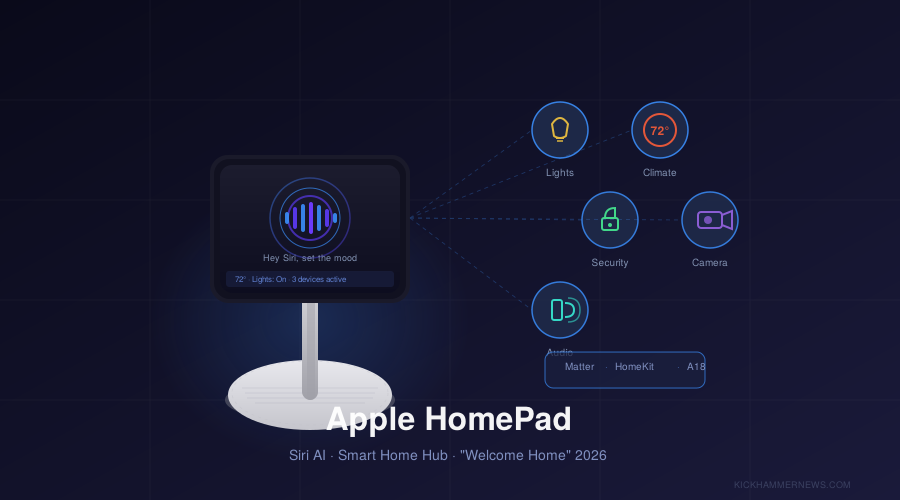
Apple’s HomePad borrows its design language from one of the company’s most beloved industrial moments. Like the 2002 iMac G4 — the “sunflower” Mac with its floating screen suspended above a hemispherical base — the HomePad places its touchscreen display on an adjustable arm mounted atop a fabric-covered speaker base. The result is a device that feels unmistakably Apple: sculptural, intentional, with a single piece of hardware doing the work of several.
The display is a 7-inch Liquid Retina panel, bright enough for kitchen glancing, responsive to touch and gestures, and set at an angle designed for counter-height viewing. The base houses the same high-fidelity audio array as the full-sized HomePod, which means the HomePad is not just a smart home controller but a legitimate speaker — something Amazon and Google’s equivalent devices have never fully cracked. Under the hood, Apple has reportedly fitted the HomePad with an A18 chip, the same silicon powering this year’s iPhone lineup, which puts it in a class well above any ambient display device on the market.
Starting at a rumored $349 — a price point Apple confirmed at the event — the HomePad positions itself above the Amazon Echo Show 15 ($249) and Google Nest Hub Max ($229), a premium that Apple is betting its ecosystem can justify.
The AI Story: Siri Finally Gets a Home
The HomePad’s most significant feature isn’t the display, the speaker, or even the chip. It’s what’s running on that chip: a rebuilt Siri AI, shaped by Apple Intelligence, Apple’s on-device AI framework introduced at WWDC 2025 and now reaching its most ambitious hardware expression yet.
Apple’s HomePad represents the first time the company has shipped a device where Apple Intelligence — not the app ecosystem, not iCloud, not even the hardware itself — is the primary value proposition. Every interaction is designed to flow through Siri. You ask it to dim the lights and it understands context (“in here” meaning the kitchen you’re standing in). You ask it to start your morning routine and it sequences your smart plugs, your calendar readout, your preferred streaming playlist, and your thermostat adjustment without a second prompt.
This represents a fundamental shift in how Apple has historically approached voice assistants. For years, Siri lagged competitors on reliability, contextual awareness, and follow-up reasoning — the three pillars that made Amazon Alexa and Google Assistant dominant in the home. The new Siri AI, rebuilt with large language model foundations but optimized to run entirely on-device, is Apple’s answer to that gap. Queries that would have previously required cloud round-trips now resolve in milliseconds, with no data leaving the device — a privacy story Apple hammered repeatedly during the presentation.
The Ecosystem Lock-In Play
Where Apple has always had the advantage in smart home is its control of the full stack. The HomePad ships with support for HomeKit — Apple’s smart home framework — as well as Matter, the cross-platform standard that lets devices from different manufacturers interoperate. That means a HomePad owner can control a Google-certified smart bulb, an Amazon-partnered thermostat, or any of the thousands of Matter-compatible devices shipping from manufacturers this year, all from a single unified interface.
This is significant because Apple is not entering a fragmented market — it’s entering a consolidating one. Matter, which Apple helped develop, is quickly becoming the common language of the smart home. Apple’s ability to be both the best Matter hub and the deepest HomeKit hub simultaneously gives it a position no other player can replicate. Google can offer better search. Amazon can offer faster delivery of replacement bulbs. Apple can offer both of them talking to each other on a single screen that costs you $349.
The Ecosystem: HomePod mini 2 and Apple TV 4K Join the Fleet
The HomePad wasn’t the only announcement at the “Welcome Home” event. Apple also unveiled a second-generation HomePod mini — smaller, cheaper, and now capable of serving as a secondary Matter hub in rooms without a full HomePad. The new mini ships with updated internals and tighter Siri AI integration, making it the distributed node to the HomePad’s central command role.
The new Apple TV 4K rounds out the lineup with a processor upgrade and deeper HomePad interoperability. When a HomePad is on the network, the Apple TV can function as a room-specific Siri AI interface, extending the ambient intelligence of the system into the living room without requiring a second HomePad purchase.
The Challenge: Amazon and Google Have Seven Years of Data
For all of Apple’s hardware elegance and ecosystem depth, the smart home AI race ultimately comes down to training data, device partnerships, and developer momentum — all areas where Amazon and Google hold commanding leads. Amazon Alexa has processed billions of smart home interactions. Google Assistant learns from the world’s most-used search engine. Siri, for all its rebuilt foundations, is starting from a smaller data well in the home-specific domain.
The HomePad will tell you the weather, control your lights, and identify who’s at the door. What it won’t do — at least not yet — is anticipate that you usually want the thermostat at 68 when you arrive home on Tuesday evenings, or notice that you’ve been running the dishwasher later since the new electricity rates kicked in. That kind of ambient, learned intelligence is what Amazon and Google have been building quietly for years, and it is not something a chip upgrade solves overnight.
What It Means
Apple is not trying to win the smart home AI race by outbuilding the competition. It’s trying to win by making the smart home feel like Apple: private, premium, beautiful, and deeply connected to the devices you already own. The HomePad is not the most powerful smart home hub available. It may not be the most capable AI device in your house. But it is, almost certainly, the one with the most seamless path from unboxing to actually working — and for the 2 billion people already in Apple’s ecosystem, that may be all the argument it needs.
The smart home has spent a decade waiting for someone to make it feel finished. Apple’s answer, as always, is to make it feel inevitable.
The Apple HomePad, HomePod mini 2, and new Apple TV 4K are available for order today via Apple.com and Apple retail stores, with deliveries beginning this week.


