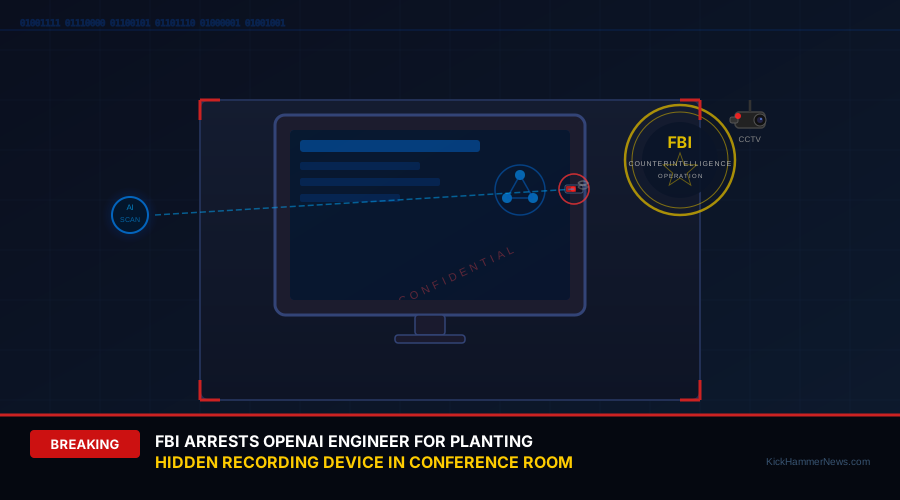
The arrest of a Saudi national at OpenAI for allegedly planting a hidden recording device reveals a new front in the battle over AI supremacy — one fought not with code, but with physical surveillance.
When OpenAI staff discovered a small, encrypted audio recorder plugged into the back of a television in an executive conference room at its San Francisco headquarters on September 30, 2026, it triggered one of the most striking corporate espionage cases the technology industry has ever seen. Two weeks later, the suspect — Abdulrahman Alfozan, a 35-year-old Saudi national who had been working as an OpenAI engineer since July 2025 — made his first appearance in federal court.
The case, which federal prosecutors unsealed Monday, marks a new inflection point in how the world’s most powerful AI labs are perceived not just as technology companies, but as strategic national security assets worthy of foreign intelligence attention.
The Device in the Conference Room
According to the criminal complaint, Alfozan allegedly installed the recording device on or around September 28, 2026. He concealed it inside a wad of toilet paper tucked into the USB port on the back of a meeting room television — a location unlikely to be noticed during a routine cleaning. The device itself was no ordinary consumer recorder: OpenAI described it in its public statement as “sophisticated,” equipped with strong encryption, audio monitoring capabilities, and a data-transfer method specifically designed to evade network monitoring.
The company says it found the device two days after its alleged installation. OpenAI then did something remarkable: it used its own AI models to analyze the device and correlate internal data — badge access logs, building movement records, calendar entries — to identify who had most likely planted it. The investigation pointed to Alfozan, and the company referred the case to the FBI on October 1.
Alfozan was arrested on October 9. He was charged with using or attempting to use a device to intercept oral communications, a federal offense carrying a maximum sentence of five years in prison, a $250,000 fine, and three years of supervised release.
A Pattern of Premeditation
What distinguishes this case from a simple act of recklessness is the level of alleged preparation. Federal prosecutors say Alfozan did not act impulsively. In the days before the alleged installation, he reportedly used an internal company productivity tool to systematically gather information: building addresses, conference room capacities, executive locations, and calendar schedules. This reconnaissance, prosecutors allege, gave him precise knowledge of which room would host the most sensitive strategy discussions.
More striking still is what emerged from a chatbot account linked to his spouse. Prosecutors allege that between September 24 and September 30, the account sent a series of queries about how to build, install, and conceal a covert audio recording device. The timing aligns almost exactly with the alleged planting of the recorder.
On October 5 — days after the device was found but apparently before Alfozan knew he was suspected — CCTV footage allegedly shows him checking behind the television where the device had been hidden. He is also alleged to have left a bag unattended in another room that day. When investigators examined it, they found a second recording device, along with his wallet and personal identification.
What Was — and Wasn’t — Captured
OpenAI has been careful in its public statements, saying it has “no indications” that Alfozan “inappropriately accessed or exfiltrated model weights, source code, or customer data.” That language, notably, speaks to digital data rather than spoken conversations. The company has not said what, if anything, the device recorded during the roughly two days it was allegedly in place — a silence that has fueled significant speculation in the security community.
The executive conference rooms at AI labs like OpenAI are precisely the places where competitive advantage crystallizes into spoken word: strategy sessions about model roadmaps, discussions of safety red lines, negotiations with chip suppliers, arguments about deployment timelines. None of that intelligence necessarily lives in model weights or code repositories. It lives in conversations.
The FBI’s AI Counterintelligence Priority
FBI Director Kash Patel was unusually direct in his public comment on the case. “Protecting American AI innovation is one of our highest counterintelligence priorities,” he said in a statement released alongside the criminal complaint. That framing — counterintelligence, not merely criminal enforcement — signals that the federal government views AI labs through the same lens as defense contractors and national laboratories.
The framing is not coincidental. The race to develop artificial general intelligence, and the economic and military advantages that may flow from it, has drawn direct analogies to Cold War-era competition. The United States and China have been locked in an escalating battle over AI chip access, model export restrictions, and talent recruitment. Whether Alfozan was acting on behalf of a foreign government, a competitor, or purely on his own remains publicly unconfirmed, and prosecutors have not alleged a specific state sponsor in the complaint. However, the Saudi angle has prompted immediate scrutiny: Saudi Arabia’s Public Investment Fund has made billions of dollars in AI investments, and the kingdom has been aggressively recruiting AI talent to support its Vision 2030 national transformation agenda.
A New Threat Model for AI Labs
For the broader AI industry, the OpenAI case arrives as a stark reminder that the most valuable intellectual property a lab holds is not always the kind stored on servers. The conversations that happen before code is written — the discussions about what to build, who to partner with, which safety corners to cut, and when to deploy — may be just as valuable to a sophisticated adversary.
Most AI security discourse focuses on digital threats: model extraction attacks, prompt injection, API abuse, data poisoning. Physical security has been a secondary concern, largely managed through standard corporate protocols: key cards, visitor badges, security cameras in public areas. The OpenAI case suggests that those measures may be insufficient when facing a sophisticated insider threat.
Competitors including Anthropic, Google DeepMind, Microsoft, and xAI can expect enterprise and government customers to begin asking harder questions about the security of their executive spaces. Physical sweep protocols — the kind of routine counter-surveillance measures long practiced by intelligence agencies and defense contractors — may soon become standard practice in AI boardrooms.
OpenAI, for its part, appears to have responded faster and more effectively than many organizations would have. The use of its own AI systems to trace the device to a specific individual within days of discovery is a notable operational achievement. But the company must also reckon with the uncomfortable fact that someone with legitimate access, a product team badge, and fifteen months of employment was allegedly able to plant a surveillance device in the room where its most sensitive conversations took place.
The Broader Stakes
Alfozan’s federal court appearance on October 13 was the opening act of what may be a months-long legal proceeding. No trial date has been set, and no plea has been entered. Prosecutors will need to establish not just that the device was placed, but that Alfozan was the person who placed it — a case they appear to believe the AI-assisted investigation and CCTV footage can support.
What is already clear is that the AI industry has entered a new phase of maturity — one in which its laboratories are not merely places where brilliant engineers build the future, but targets in a global competition that extends from server halls to conference rooms, from export control lists to the hidden space behind a meeting room television.
The race for artificial general intelligence is being fought on many fronts. The front that most frightens governments, it turns out, may not be the one where machines threaten humans — but the one where humans threaten each other in the shadow of machines.
Sources: TechCrunch, The Hacker News, tech-insider.org, NBC News, The Washington Post, The Hill