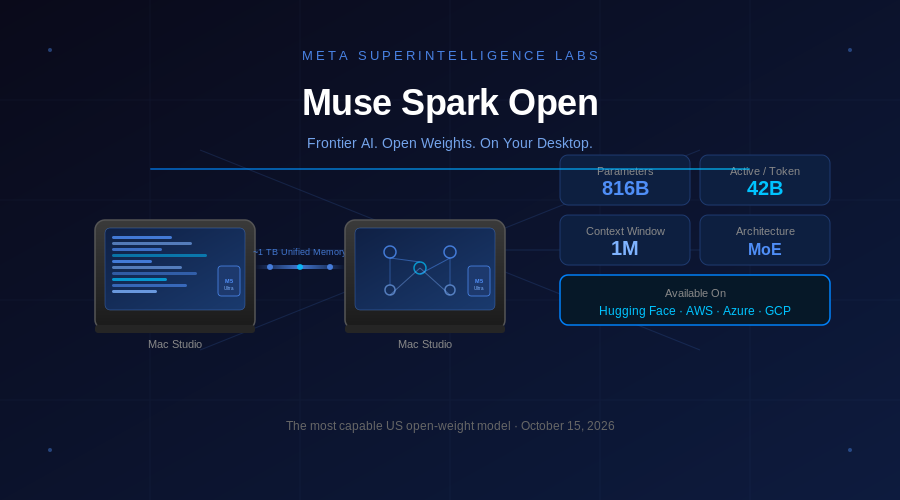
When AI researchers talk about “frontier” models, the image that usually comes to mind is a cluster of thousands of GPUs humming in a remote data center — hardware that costs hundreds of millions of dollars and consumes electricity at city-block scale. On October 15, 2026, Meta rewrote that mental image entirely. The company launched Muse Spark Open, a fully open-weight AI model packing 816 billion parameters, and demonstrated it running locally on two Apple Mac Studio desktops sitting side by side on a workbench. No cloud bill. No API rate limits. No corporate intermediary standing between a developer and the raw weights.
The announcement, made by Meta Superintelligence Labs, lands at a pivotal moment. The open-source AI ecosystem has been playing a long game of catch-up against the proprietary giants — OpenAI, Google DeepMind, and Anthropic — and Muse Spark Open is the most direct challenge yet. Meta says it is “the most capable US open-weight model to date,” a claim the company backs with a detailed benchmark methodology report while promising full evaluation results shortly.
What Muse Spark Open Actually Is
At its technical core, Muse Spark Open is a Mixture-of-Experts (MoE) architecture: 816 billion total parameters, but only 42 billion active per token. That design is significant. A conventional dense model at 816B would require staggering amounts of memory and compute just to generate a single word. MoE selects a small subset of “expert” sub-networks for each token, keeping active compute tractable even at enormous scale. The result is a model that punches at heavyweight while moving like a middleweight.
The context window stretches to one million tokens — enough to ingest an entire software repository, a long film script, or a year’s worth of engineering logs in a single pass. The model is natively multimodal, capable of reasoning over text, code, and images within the same conversation.
Meta built Muse Spark Open explicitly around coding and long-horizon agentic work. In its own demonstrations, the model — guided by Muse Code, Meta’s AI coding terminal — fixed bugs in an iOS app, added new features to the open-source Mastodon client Ice Cubes, and edited footage directly inside DaVinci Resolve. These are not toy demos. They represent the kind of multi-step, tool-calling, environment-interacting workflows that enterprise engineering teams actually care about.
The Mac Studio Moment
The headline detail of the launch is, without question, the Mac desktop angle. Meta demonstrated Muse Spark Open running on two Apple M5 Ultra Mac Studios networked together using Apple’s MLX framework. Here is why that matters technically.
Each M5 Ultra Mac Studio ships with up to 512 GB of unified memory and delivers approximately 1.2 terabytes per second of memory bandwidth. With two machines lashed together, you effectively have close to one terabyte of unified memory available to the model — enough to hold the full 816B-parameter weight set. Because the MoE architecture only activates 42B parameters per token, the chip’s remarkable memory bandwidth means those active weights can be fetched fast enough for interactive inference.
Meta describes this as “the first model in its class to run on a desktop.” That framing is carefully chosen — no other model at this scale has publicly demonstrated on-device inference on consumer-grade hardware. It signals something deeper than a product stunt: the silicon industry has now produced chips capable of running what, just two years ago, required a private data center.
The engineering on the inference side matches the ambition. Meta built custom auto-tunable Helion GPU kernels for SGLang that deliver kernel-level speedups ranging from 1.03× to 3.95× on NVIDIA and AMD GPUs, with a 3% end-to-end speedup on AMD MI350. Muse Spark Open runs across a wide inference stack — SGLang, vLLM, TensorRT-LLM, Hugging Face Transformers, llama.cpp, Unsloth, and Apple MLX — and across hardware from Apple, AMD, Intel, and NVIDIA.
Open Weight, Open Questions
The “open-weight” label carries freight. Meta is releasing the model weights on Hugging Face under the `meta-models/Muse-Spark-Open-816B-A42B` repository. The model is simultaneously available through API providers including Baseten, Fireworks AI, Groq, Modal, Nebius, OpenRouter, and Together AI, and via cloud model gardens on Amazon SageMaker AI, Google Cloud, and Microsoft Foundry. Developers who want to fine-tune can do so with PyTorch, including TorchTitan.
However, “open-weight” is not the same as “open-source.” Meta’s Muse Model License comes with limited commercial terms. Most individual developers can use the weights free of charge, but large commercial deployments will face restrictions. The model card is available now, and Meta has promised a full evaluation report — including specific benchmark scores on standard tests — soon.
On safety, Meta says Muse Spark Open received additional post-training because of the unique risks that open-weight models present. Unlike a closed API, once weights are in the world, they cannot be recalled. Meta says the model met its internal Meta Superintelligence Scaling Framework thresholds before release, though the full details of that framework and those evaluations have not yet been published.
Why This Matters for the Industry
The release of Muse Spark Open accelerates three trends that have been building throughout 2026.
Democratizing frontier capability. Until now, the most capable AI models were accessible only through APIs, with pricing that put serious experimentation out of reach for independent researchers and small teams. Open weights mean developers can run Muse Spark Open in their own infrastructure, for any purpose, without per-token costs accumulating on a credit card.
On-device AI at a new scale. Apple’s M5 Ultra was already the most powerful chip available in a consumer desktop. Muse Spark Open demonstrates that the company’s bet on unified memory architecture — radical when the M1 launched in 2020 — now pays dividends at frontier scale. That is a meaningful competitive pressure on cloud providers.
Raising the stakes for proprietary labs. OpenAI, Google, and Anthropic all operate behind APIs with closed weights. Every time an open-weight model matches their flagship capabilities, the rationale for paying API prices weakens. Meta’s strategy has been consistent: give the model away to build the ecosystem, monetize through hardware (Ray-Ban smart glasses, Quest headsets) and enterprise infrastructure. Muse Spark Open is the sharpest version of that strategy yet.
What Comes Next
Meta has signaled that Muse Code — the agentic coding terminal paired with Muse Spark Open — will continue to evolve in lockstep with the model. The combination of a locally runnable frontier model and a purpose-built agentic interface could reshape how software is written, especially for developers who have privacy requirements that prohibit sending code to external APIs.
The requirement for two M5 Ultra Mac Studios means that “running it on a desktop” is currently a $20,000-plus proposition — accessible to well-funded startups and research labs, but not to individual hobbyists. That will change. Model quantization techniques, next-generation Apple silicon, and growing community optimization efforts on llama.cpp and Unsloth will steadily push the hardware threshold down. The trajectory is clear: what requires two high-end desktops today will likely run on a single laptop within a few chip generations.
For now, though, the image that lingers is two Mac Studios on a workbench, running a model that would have required a private supercomputer two years ago. The frontier has arrived on the desktop.