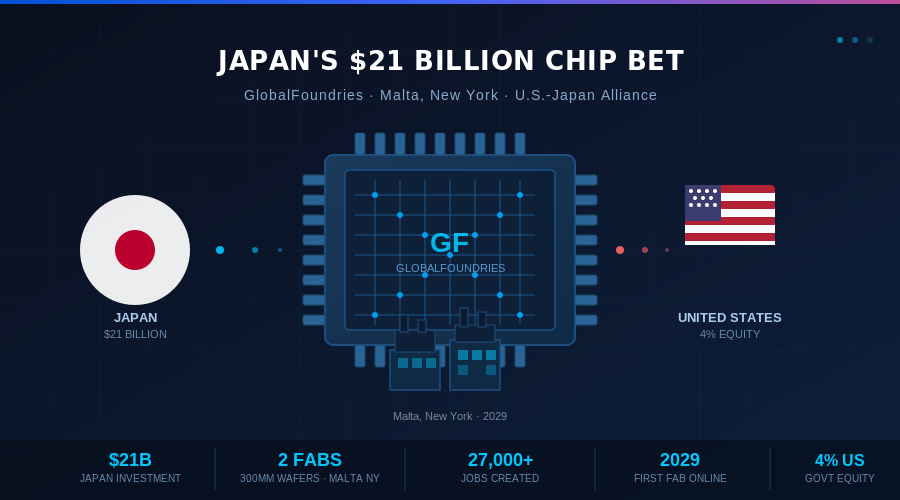
In a deal that underscores how dramatically the geopolitics of semiconductors have shifted in just a few years, Japan announced it will invest up to $21 billion to fund two new chip factories in upstate New York — factories that will be operated by GlobalFoundries and supply chips to some of the most recognizable names in American industry, including Apple, General Motors, and Renesas.
The announcement, made October 14, marks one of the largest foreign investments in U.S. semiconductor manufacturing in history, and it carries a message that no trade negotiator could deliver as clearly: the era of chip manufacturing concentrated in East Asia is over, and a new, allied model of distributed semiconductor production is taking shape.
From Adversaries to Allies on Silicon
It was not long ago that the global semiconductor industry operated on a simple, if fragile, premise: let whoever makes chips most cheaply and efficiently make them. That meant Taiwan’s TSMC dominated leading-edge manufacturing while companies like GlobalFoundries competed for specialty and mature-node work, doing it across Germany, Singapore, Vermont, and New York.
Then came COVID-19, the resulting chip shortages that paralyzed automakers and electronics companies alike, and finally a blunt realization in Washington: the United States had allowed itself to become strategically dependent on a handful of fabs located in geopolitically precarious locations.
The CHIPS and Science Act of 2022 began reversing that trend. But the legislation alone was never going to be enough to rebuild decades of lost domestic capacity. What was needed was allied capital — and that is precisely what the U.S.-Japan trade and investment framework delivered.
Under the terms announced this week, Japan will provide approximately $10 billion to accelerate construction of a first 300mm fab at GlobalFoundries’ Malta, New York campus — a shovel-ready site that has hosted semiconductor operations since 2009. A second $10 billion tranche will fund an adjacent second factory. In total, the two fabs are expected to add roughly 1.8 million wafers of annual production capacity to U.S. output.
What the U.S. Gets — and Gives
The deal’s structure is striking for the directness of its terms. In exchange for facilitating the Japanese investment, the U.S. Department of Commerce will receive approximately a 4% equity stake in GlobalFoundries — a government ownership position in a commercial chip foundry that echoes a similar stake the Trump administration has taken in Intel.
“This is transformational,” said Commerce Secretary Howard Lutnick at the announcement, framing the deal as evidence that trade agreements can generate tangible American industrial assets. “These are high-paying jobs in a strategic industry, and the United States government now has equity in the company producing them.”
GlobalFoundries is redirecting $955 million of its existing CHIPS Act award — money it had already been allocated — toward silicon photonics, silicon-germanium (SiGe), and advanced packaging work at the Malta and Burlington, Vermont facilities. That capital restructuring frees the new Japanese investment to focus entirely on expanding raw wafer capacity.
Groundbreaking on the first factory is expected before the end of 2026, with production targeted for 2029.
A Who’s Who of American Industry
What makes the GlobalFoundries deal particularly significant is the roster of companies who have already signed on as customers or partners — and what their participation reveals about the strategic depth of American semiconductor demand.
Apple is perhaps the most symbolically important name on the list. The Cupertino giant’s COO Sabih Khan said GlobalFoundries is a “partner in building advanced U.S. chip manufacturing,” and GF is an inaugural member of Apple’s American Manufacturing Program — a $600 billion U.S. investment commitment the company announced earlier this year. Apple produces certain chips for its products at GlobalFoundries’ existing New York facilities, and the new fabs are expected to deepen that relationship.
General Motors has a direct automaker-to-foundry supply agreement tied to its autonomous driving, centralized compute, and Super Cruise driver assistance technologies. GM President Mark Reuss called the upstate New York fab capacity “a decisive step forward for American manufacturing” — language that would have seemed fanciful in Detroit just five years ago.
Renesas, Japan’s largest chipmaker and a global leader in automotive and industrial semiconductors, plans to treat the Malta facilities as an extension of its own production footprint. CEO Hidetoshi Shibata said the new capacity supports stable, long-term supply for electrification, connectivity, AI, and data center applications — essentially all of the fastest-growing segments of the semiconductor market.
Cirrus Logic, a specialist in high-precision mixed-signal chips used widely in audio and consumer electronics, gains domestic access to manufacturing technologies critical to next-generation product development.
The Geopolitical Subtext
Japan’s decision to commit $21 billion to American soil is not simply a commercial transaction — it is a geopolitical statement. Japan has been navigating its own semiconductor strategy with intense focus since the Biden administration began organizing allied chipmaking efforts, eventually co-investing in a TSMC fab on Kyushu. Japanese equipment giant Tokyo Electron has been a GlobalFoundries partner for years, and CEO Tony Kawai used the announcement to highlight the value of U.S.-Japan technological collaboration — a pointed contrast to the relationship both countries have with China.
The United States has spent years pressuring allied nations and companies to limit chip exports and manufacturing partnerships with China. Japan has largely complied, introducing its own semiconductor export controls. The Malta investment can be read partly as Japan’s answer to the question of where its chip capital should go instead.
For GlobalFoundries, the deal represents a vote of confidence from exactly the right quarter. CEO Tim Breen was characteristically blunt at the announcement: “GF was selected because fabs of this scale require more than capital.” The implication was clear — technology, operational expertise, and execution matter as much as money, and GlobalFoundries, with its existing Malta infrastructure and proven manufacturing record, had all three.
What Comes Next
The road to 2029 is long, and semiconductor projects at this scale have a well-documented history of delays, cost overruns, and geopolitical complications. GlobalFoundries’ own forward-looking statements flag risks including shifting tariffs, policy changes, and delayed or withheld funding — the kind of hedging language that acknowledges just how contingent these agreements remain on political continuity.
But for the 27,000 construction and ecosystem workers who are expected to work on the project, and the more than 1,000 skilled manufacturing employees who will eventually staff the fabs, the announcement represents something more immediate: the clearest sign yet that a generation of semiconductor jobs is returning to the United States — and that America’s allies are helping to pay for it.
The chip war with China is far from over. But in Malta, New York, the groundwork for the next phase of that contest is being poured in concrete.


