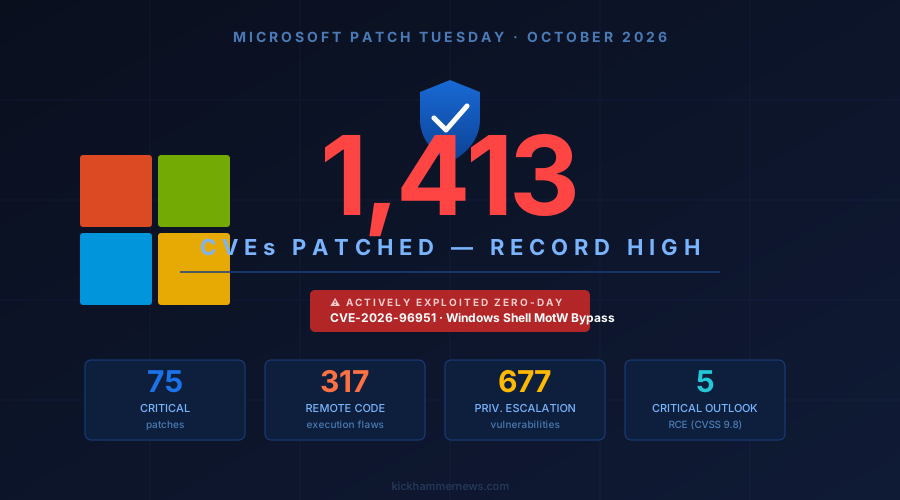
Microsoft’s October 2026 Patch Tuesday, released on October 13, has shattered every previous record for a single monthly update, delivering fixes for 1,413 Common Vulnerabilities and Exposures (CVEs). To put that in perspective: this one update addressed more vulnerabilities than Microsoft patched in all of calendar year 2025. The release has sent security teams scrambling to prioritize and deploy, while one of the flaws — a Windows Shell zero-day already weaponized by attackers — has earned immediate federal attention.
The Numbers Behind the Record
Security research firms counted slightly differently depending on methodology. CrowdStrike tallied 1,413 CVEs; BleepingComputer counted 1,411, a discrepancy attributed to which advisory types and components each organization includes. Either way, it is the largest single Patch Tuesday in Microsoft’s history by a wide margin.
The breakdown by product tells its own story: 1,102 patches landed in Windows alone, with another 134 in Microsoft Office, 61 in developer tools, and 36 in SharePoint Server. Exchange Server, Azure services, Microsoft Defender, and a long tail of additional products rounded out the rest. By severity, Microsoft and CrowdStrike flagged 75 patches as Critical, while BleepingComputer’s count puts the Critical figure at 70. By category, the dominant classes were elevation-of-privilege flaws (677), remote code execution (317), and information disclosure (254).
Security researchers and Microsoft alike have pointed to AI-powered vulnerability discovery as a major driver of the surge. Automated scanning tools trained on code semantics can now surface classes of bugs — use-after-free conditions, integer overflows, authentication bypasses — at a rate that far outpaces human auditing. Microsoft’s own security engineering teams and external researchers have adopted these tools broadly in 2026, and the cumulative effect is visible in the numbers: the year-to-date CVE count for Microsoft products now exceeds 4,000, already far ahead of any prior full year.
The Zero-Day You Need to Patch First
Of the three zero-days bundled into this release, one stands out as the most urgent: CVE-2026-96951, a Windows Shell security feature bypass with a CVSS score of 8.8. The vulnerability targets Mark of the Web (MotW), the mechanism Windows uses to flag files downloaded from the internet. When MotW identifies a file as having come from an untrusted zone, it triggers defensive measures: Microsoft Defender SmartScreen shows a warning, and Microsoft Office opens the file in Protected View, a sandboxed mode that restricts macro execution.
CVE-2026-96951 lets an attacker craft a file that evades MotW tagging entirely. Once a victim opens such a file — delivered via email, instant message, or a malicious download link — it executes without triggering SmartScreen or Protected View. Microsoft confirmed the flaw is being actively exploited in the wild, though it has not disclosed specific details about threat actors or victims. The bug was reported by researchers at Fujitsu, Anthropic, and an independent expert, suggesting it had been identified through coordinated security research before exploitation was confirmed.
The Cybersecurity and Infrastructure Security Agency (CISA) moved quickly, adding CVE-2026-96951 to its Known Exploited Vulnerabilities (KEV) catalog and directing US federal civilian agencies to remediate it by October 16 — just three days after the patches dropped. For organizations outside the federal government, the message is equally clear: this one should go to the top of the queue.
The other two zero-days — CVE-2026-108398, a Windows Defender Application Control (WDAC) bypass, and CVE-2026-92707, a denial-of-service vulnerability in the MessagePack-CSharp component used by Visual Studio and .NET — were publicly disclosed before patches became available but have not been observed in active exploitation. Microsoft rates the likelihood of exploitation for the WDAC bypass as low, and the DoS flaw has not been assessed. Both warrant attention, but neither carries the same urgency as CVE-2026-96951.
Outlook and Office: A Wave of Critical Remote Code Execution
Beyond the zero-days, security analysts have flagged a significant cluster of critical remote code execution vulnerabilities in Microsoft’s productivity suite. Five critical Outlook RCEs, each carrying a CVSS score of 9.8, were included in the October batch. Two of them — CVE-2026-70291 and CVE-2026-88156 — are particularly alarming: according to CrowdStrike’s analysis, both can be triggered without authentication or user interaction, simply by processing a specially crafted email in Outlook’s Reading Pane. An attacker does not need the victim to click anything; receiving the email may be sufficient.
Microsoft Office more broadly saw 20 critical RCE flaws spanning Excel, PowerPoint, Visio, and Word. Six of these list the Preview Pane as an attack vector — in Word and PowerPoint, previewing a malicious document in Windows Explorer could trigger code execution without the user opening the file. The other 14 (in Excel and Visio) do not carry that preview-pane risk but are still rated Critical. Additionally, critical RCE flaws were patched in Microsoft’s QUIC network protocol implementation and in a PostScript printer driver, both of which could expose networked infrastructure depending on an organization’s configuration.
Microsoft Introduces “Risk Cohorts” for Prioritization Help
With a release of this scale, Microsoft acknowledged the obvious challenge: no security team can thoroughly assess 1,413 CVEs in the days immediately following a release. As part of October’s update, Microsoft debuted an experimental framework called risk cohorts — a system that groups CVEs sharing a similar risk profile even when they lack a common root cause or identical CVSS score.
Microsoft was careful to describe risk cohorts as a starting point rather than a replacement for individual CVE assessment. Organizations are still expected to check each flaw for active exploitation status, attack vector, scope of impact, and product-specific deployment guidance. The cohort system is intended to help teams quickly cluster “assess together” batches, not to eliminate the need for judgment. Still, the introduction signals Microsoft recognizes that raw CVE counts have become unwieldy, and that operational guidance needs to evolve alongside the volume.
Why 2026’s Patch Volume Looks Like This
The October record is not an isolated anomaly. It is the latest peak in a year-long escalation. Microsoft’s 2026 CVE filings — now north of 4,000 year-to-date — track closely with the broad adoption of AI-assisted code auditing across the security research community. Tools that use large language models to reason about code paths, identify edge cases in memory management, and surface subtle authentication logic errors have made individual researchers dramatically more productive. What a skilled engineer might find in weeks of manual review, an AI-assisted workflow can surface in hours.
The trend raises a strategic question for enterprise security teams: is the spike in disclosed vulnerabilities evidence that software is getting worse, or that auditing is getting better? The answer is almost certainly the latter. Microsoft’s codebase did not become dramatically more buggy between 2024 and 2026. What changed is the density of the lens examining it. The practical consequence, however, is the same either way — more patches, more frequently, requiring better-organized triage workflows and, increasingly, automated patch deployment infrastructure.
Lifecycle Notes Attached to This Release
Microsoft bundled several end-of-support milestones with the October 2026 Patch Tuesday. Windows 11 24H2 Home and Pro editions reached end of servicing on October 13, 2026 — the same day the patches dropped — meaning those builds will no longer receive security updates. Enterprise and Education editions of 24H2 remain supported until October 12, 2027. Additionally, Windows 10 Enterprise LTSB 2016 officially ended support on October 13. Paid Extended Security Updates (ESU) are available for organizations that need continued coverage, but prerequisites KB5122874 and KB5123099 (or later) must be in place first.
A separate known issue — not introduced by this Patch Tuesday — affects systems with Administrator protection enabled after installing KB5124010 or later: non-administrator users may encounter Remote Desktop failures with error 0xC000000D. Microsoft’s current workaround, disabling Administrator protection, weakens a security safeguard and should be treated as a temporary measure only.
What Security Teams Should Do Now
The October 2026 Patch Tuesday demands a clear triage hierarchy. Start with CVE-2026-96951 — the Windows Shell MotW bypass. It is actively exploited, has a federal remediation deadline already past for government agencies, and its social-engineering delivery path means phishing-based exploitation is likely. Next, address the critical Outlook RCEs, particularly the two Reading Pane vulnerabilities that require no user interaction beyond receiving an email. Then work through the Office RCE cluster, paying particular attention to the six flaws exploitable via the Windows Explorer Preview Pane.
For infrastructure teams, the QUIC and PostScript printer driver patches deserve review depending on exposure. The WDAC bypass and MessagePack DoS should be patched but can follow standard monthly timelines in most environments. Across the entire release, risk cohorts can help batch the remaining patches, but active exploitation status remains the most reliable triage signal.
At 1,413 CVEs, October 2026 is a stress test for every patching process. Organizations that have invested in automated deployment, continuous vulnerability scoring, and clear ownership models will weather it more easily than those still relying on manual workflows. For the rest, this month’s record is as good a reason as any to accelerate that work.


