The silicon chip has powered modern computing for six decades. But as the tech industry drowns in e-waste, grapples with rare-earth mining crises, and scrambles to cool increasingly power-hungry data centers, a quietly radical research paper out of Ohio State University is asking a provocative question: what if the next generation of computer memory grew in a petri dish?
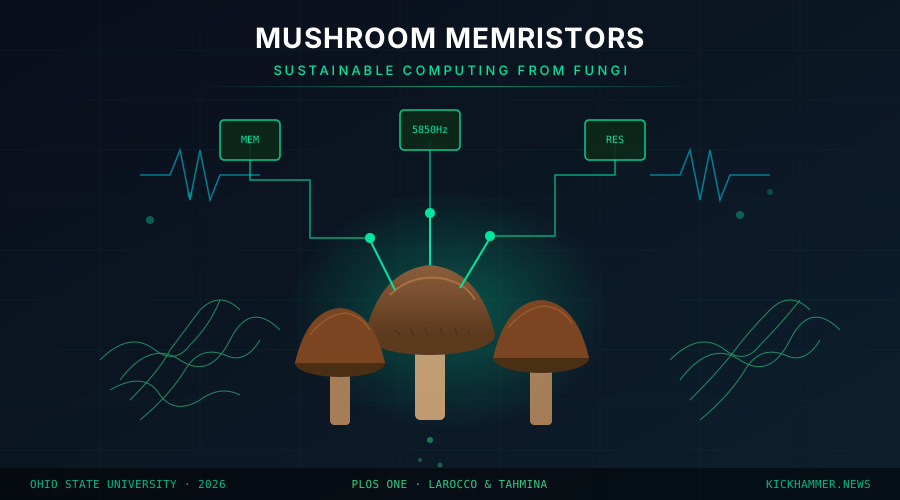
Researchers at Ohio State have successfully engineered common grocery-store mushrooms — shiitake and button varieties — into functional memristors, a type of circuit element capable of storing and processing information. The study, published in *PLOS One*, demonstrates that fungal mycelium, the root-like network that runs beneath mushroom caps, can switch between electrical states up to 5,850 times per second, achieving roughly 90 to 95 percent signal retention. It’s early-stage science, but the implications ripple far beyond the lab.
What Is a Memristor, and Why Does It Matter?
To understand why fungi as memory chips is significant, you first need to understand what a memristor actually does.
A memristor — short for “memory resistor” — is a fourth fundamental circuit element alongside the resistor, capacitor, and inductor. Its defining property is that its electrical resistance changes based on how much current has flowed through it historically. In practical terms, it “remembers” its past electrical states, making it a natural building block for both non-volatile memory and neuromorphic (brain-inspired) computing architectures.
Conventional memristors are built from metal oxides and silicon, requiring rare-earth minerals, high-temperature manufacturing, and energy-intensive fabrication processes. The result is a component tied to a supply chain plagued by environmental damage, geopolitical tension, and a growing e-waste crisis — the world generated over 62 million metric tons of electronic waste in 2025, less than 23 percent of which was formally recycled.
Fungal mycelium sidesteps nearly all of those problems.
Growing Circuits at Room Temperature
The Ohio State process, led by research scientist John LaRocco of the College of Medicine and co-authored by electrical engineering professor Qudsia Tahmina, is disarmingly simple compared to conventional semiconductor fabrication.
The team cultured shiitake and button mushroom mycelium on organic substrates in petri dishes at room temperature. Once the mycelium grew into a dense mat, the samples were dehydrated to preserve their internal network structure. Electrodes were then attached to different regions of the fungal caps and stems, connecting the biological material to conventional electronic circuits.
What happened next was remarkable: when voltage was applied across frequencies ranging from 10 Hz to 5,850 Hz, the fungal network began behaving like an organic memristor. Different regions of the mycelial structure exhibited distinct electrical properties — a feature the researchers say could be exploited for specialized computing tasks.
After two months of testing as RAM, the mushroom memristors maintained switching behavior with 90 to 95 percent accuracy at lower frequencies, falling as frequency increased. The team notes that connecting additional fungal samples to a circuit can compensate for frequency-related accuracy drops, suggesting a path to scaling.
The Neuromorphic Connection
Beyond memory storage, what excites the researchers most is the architectural parallel between mycelium and the human brain.
Mycelium is, in a very real sense, a natural neural network. It forms three-dimensional, self-repairing, adaptive networks that can reconfigure based on environmental signals. When the Ohio State team linked multiple mushroom samples together, they found the networked system behaved “somewhat like neural pathways” — exhibiting patterns of activity that loosely mirror how biological neurons communicate.
This positions fungal memristors not just as a green alternative to silicon RAM, but as a potential platform for neuromorphic computing — a paradigm that processes information using spike-based, brain-like logic rather than traditional binary operations. Neuromorphic chips require far less energy during standby than conventional chips, which matters enormously as AI inference workloads push global data center power consumption to unprecedented levels.
“The authors argue that neural-inspired chips could draw little power in standby, which they see as a major computational and economic advantage,” the team wrote. The global data center industry consumed an estimated 415 terawatt-hours of electricity in 2025 — roughly the annual output of the United Kingdom — and that figure is rising sharply with AI demand.
Why This Isn’t Just a Party Trick
Some critics, and even early readers of the published paper, have questioned whether fungal memristors are little more than a scientific novelty. The accuracy figures (90–95%) mean error rates are non-trivial by semiconductor standards, and the devices have not been miniaturized to nanometer scales where modern chips operate. There are no published benchmarks comparing fungal circuits to silicon devices on energy consumption, durability, or throughput.
Those are fair criticisms. But they miss the broader context in which this research sits.
The semiconductor industry is approaching fundamental physical limits on silicon transistor miniaturization. Intel, TSMC, and Samsung have all encountered significant challenges pushing below the 2-nanometer barrier, with each new process node demanding exponentially more energy and infrastructure investment. Meanwhile, AI compute demands have outpaced Moore’s Law for three consecutive years.
Against this backdrop, bio-inspired computing — including carbon nanotube transistors, DNA data storage, photonic chips, and now fungal memristors — has moved from the fringe to a genuinely competitive field of research. No single alternative is expected to wholesale replace silicon, but researchers increasingly believe future computing will be heterogeneous, deploying different physical substrates for different tasks.
Fungal memristors are well-suited to edge computing scenarios where power consumption is severely constrained: biosensors, wearables, environmental monitoring nodes, remote aerospace instruments. In those applications, a cheap, biodegradable chip that you can compost when it fails is not a party trick — it’s a paradigm shift.
Sustainability as a Hard Requirement
Professor Tahmina has linked the Ohio State work explicitly to “growing public concern about environmental protection,” and the timing is apt. The EU’s Right to Repair regulation, California’s SB 2489 e-waste expanded producer responsibility law, and a United Nations framework on sustainable electronics have all come into force or advanced significantly in 2026.
Fungal mycelium checks nearly every sustainability box: it grows at room temperature (zero high-energy fabrication), needs no rare-earth elements, is inherently flexible and three-dimensional, is self-repairing in its living state, and is fully compostable at end of life. Growing costs are negligible — shiitake mushroom cultivation substrate costs pennies per kilogram. The devices are not yet competitive with silicon on performance, but on total lifecycle cost and environmental footprint, they already win by a wide margin.
What Comes Next
The Ohio State team has outlined a clear roadmap. The immediate challenge is developing cultivation techniques that produce more uniform mycelial networks — right now, different parts of the fungal mat have different electrical properties, which complicates integration into larger circuits. The next step is miniaturization: finding ways to grow or pattern mycelium at scales small enough for real-world device integration.
Longer term, LaRocco and Tahmina see potential in combining fungal memristors with living biological components — the mycelium remains metabolically active even in its dehydrated state under certain conditions — to create truly self-repairing circuits that could heal micro-fractures the way living tissue does.
It is a vision that would have sounded like science fiction a decade ago. Today, with the global semiconductor supply chain under geopolitical stress, e-waste regulations tightening, and AI power consumption threatening to overwhelm existing grid infrastructure, a compostable memory chip that grows in a petri dish sounds less like fantasy and more like necessity.
The mushroom memristor is not going to replace your smartphone’s RAM next year, or the year after. But it may represent the first compelling proof that the future of computing does not have to cost the Earth — literally.
Sources: PLOS One (LaRocco & Tahmina, Ohio State University); TechSpot; New Atlas; Interesting Engineering; All About Circuits


