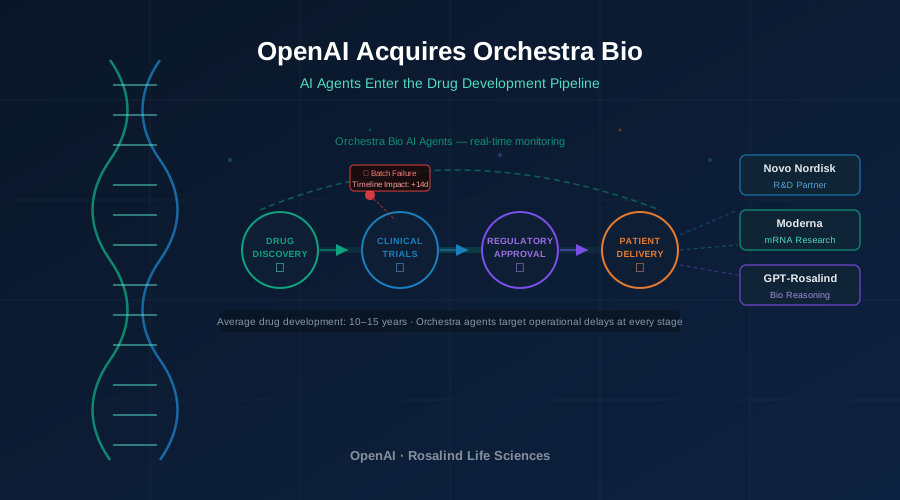
Drug development is one of the most expensive, slow, and failure-prone processes in all of human industry. It takes an average of 10 to 15 years for a compound to travel from laboratory discovery to a U.S. pharmacy shelf. Roughly nine out of ten drugs that enter clinical trials never make it to market. And the coordination overhead — the endless handoffs between research teams, clinical operations, regulatory affairs, manufacturing, and external partners — is a major reason why.
OpenAI thinks AI agents can fix that. And on Tuesday, October 20, 2026, it moved to prove it by acquiring Orchestra Bio, a four-year-old San Francisco startup that builds AI agents specifically designed to keep drug development programs on track.
What Orchestra Bio Actually Does
Founded in 2022 by CEO Ashoka Rajendra, Orchestra Bio launched publicly in August 2025 with $20 million in backing from Andreessen Horowitz, 8VC, and Insight Venture Management. The company’s core product isn’t a chatbot or a model that predicts molecular interactions. It’s an operational layer — a platform that monitors the sprawling, multi-departmental, multi-partner process of running a drug development program and alerts human decision-makers when something is about to go wrong.
Here’s how it works in practice. Imagine a failed manufacturing batch that threatens to delay a Phase II clinical trial. Without Orchestra, that failure might take days to propagate through a company’s systems before the right people understand the full downstream impact — which trial sites are affected, which timelines slip, what the regulatory implications are, and what the response options look like. With Orchestra’s agents in place, that analysis happens in real time. The agents identify which activities and timelines are at risk, gather the relevant information, and surface a set of options for scientists and program leaders to evaluate. Humans make the call. The agents handle the information logistics.
That’s an important distinction — and one that separates Orchestra’s approach from more ambitious claims of AI autonomy in drug discovery. This isn’t a model claiming to design novel molecules or predict clinical outcomes. It’s a coordination layer that makes human scientists faster and less likely to be blindsided by problems hiding inside disconnected systems.
OpenAI’s Rosalind Ambition
Orchestra’s team and technology are being folded into Rosalind, OpenAI’s growing life sciences platform. Rosalind launched as GPT-Rosalind in April 2026, a specialized reasoning model trained to work through problems in biology and drug discovery. Since September, it has been available beyond research preview through a trusted-access program that includes eligibility review and organizational approval — the equivalent of OpenAI treating this as dual-use technology requiring oversight.
The Rosalind suite includes Rosalind Workbench, a tool that connects GPT-Rosalind’s reasoning capabilities to scientific data sources and laboratory tools, letting researchers pose complex biological questions and receive experiment plans rather than just text answers.
With Orchestra added, the picture becomes more complete. GPT-Rosalind can reason about the science. Rosalind Workbench can translate that reasoning into experimental workflows. And Orchestra’s agents can now monitor the execution of those programs in the real world — flagging problems, tracking finances, and managing the clinical operations complexity that tends to swallow pharmaceutical programs alive.
OpenAI reports performance benchmarks for GPT-Rosalind across four life sciences evaluation suites: 53.7% gains on Genebench, 18.0% on Medchem Bench, 19.6% on Labworkbench, and 4.42% on LifeSci Bench. These are self-reported figures from OpenAI’s product pages and have not been independently verified by third parties.
Novo Nordisk and Moderna Are Already In
OpenAI has already signed on two of the most prominent names in pharma as Rosalind partners: Novo Nordisk and Moderna.
Novo Nordisk — the Danish pharmaceutical giant behind blockbuster GLP-1 drugs Wegovy and Ozempic, and one of the highest-valued companies in Europe — is using Rosalind to try to turn its scale and scientific expertise into faster R&D execution while maintaining regulatory governance. For a company whose pipeline has to move efficiently across dozens of ongoing programs, the promise of AI agents that catch operational problems before they cascade into trial delays is not abstract.
Moderna’s use case is slightly different. Moderna’s scientists are using GPT-Rosalind to turn insights from complex biological data into experimental workflows — essentially using the model to bridge the gap between a research finding and the concrete next steps a lab team needs to execute. Given Moderna’s track record of moving fast with mRNA technology, the bet is that AI can further accelerate the research-to-program pipeline.
Neither company disclosed specifics about which programs they’re using Rosalind for, or any measured productivity outcomes. But the fact that OpenAI is naming them publicly — and that both have agreed to be named — suggests these are genuine enterprise deployments, not pilot arrangements.
The Biotech AI Arms Race
OpenAI’s acquisition of Orchestra Bio is not happening in a vacuum. The race to own AI infrastructure in drug development has intensified sharply in 2026.
In January, OpenAI acquired Torch Health, a medical records company, to build out ChatGPT Health. In April, Anthropic made a much larger move, acquiring Coefficient Bio for approximately $400 million — a price that signaled serious conviction that AI models fine-tuned for biological reasoning represent strategic assets, not just research tools.
What makes the current moment notable is the architectural convergence happening across labs. The leading AI companies aren’t just building foundation models and waiting for pharma to build applications on top of them. They’re acquiring the application layer — the specialized software that turns general AI capabilities into workflows that fit inside how pharmaceutical companies actually operate.
Orchestra Bio’s value wasn’t primarily its funding or its team size. It was the domain-specific knowledge encoded in its agents: which operational problems actually arise in clinical trials, how companies categorize and escalate issues, what information needs to surface and to whom when a program goes sideways. That kind of tacit operational knowledge is hard to rebuild from scratch, even for a company with OpenAI’s resources. Acquiring it is faster than learning it.
What This Means for Drug Development
The pharmaceutical industry has been promised AI transformation for over a decade. What’s changed in 2026 is that the promises are becoming narrower, more specific, and more verifiable.
No one is claiming that AI will replace the scientist. What’s being built, across Rosalind, Coefficient Bio, and other platforms, is a stack that handles the coordination tax — the enormous fraction of a drug developer’s time and resources that goes not into science but into managing the complexity of science at scale. Failed batches, scheduling conflicts, disconnected databases, cross-departmental handoffs — these aren’t intellectually interesting problems, but they consume enormous resources and introduce the kinds of delays that compound across a 10-to-15-year development timeline.
If OpenAI’s bet is right, the most commercially valuable AI application in pharma won’t be the one that discovers a new drug target. It’ll be the one that makes sure the drug targeting process doesn’t quietly derail itself while everyone is looking elsewhere.
Orchestra Bio’s agents have been designed for exactly that problem. Whether they can deliver at the scale of a major pharma company’s full pipeline — and whether Rosalind’s scientific reasoning is accurate and reliable enough to build clinical decisions around — remains to be demonstrated.
But with Novo Nordisk and Moderna already at the table, OpenAI won’t have to wait long to find out.
OpenAI has not disclosed the financial terms of the Orchestra Bio acquisition.


