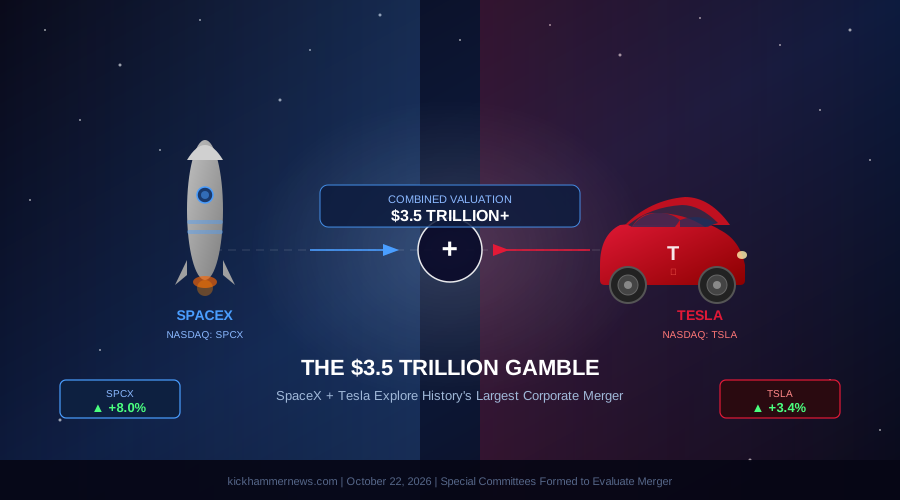
Elon Musk dropped a bombshell on Wall Street this week. During SpaceX’s quarterly earnings call on Tuesday, the company disclosed that both SpaceX and Tesla have formed independent special committees to explore a potential merger — a deal that analysts estimate could top $3.5 trillion in combined value, making it the largest corporate tie-up in history by a staggering margin.
Markets moved instantly. SpaceX shares (NASDAQ: SPCX) surged nearly 8% in extended trading, their best single-day gain since August, while Tesla added 3.4%. In one day, the proposed combination added hundreds of billions to the market caps of both companies — on nothing more than the possibility of a deal.
The question now gripping Silicon Valley, Wall Street, and Washington alike: can Musk actually pull this off?
What’s Being Proposed
The special committees at both companies are tasked with evaluating whether a combination makes strategic and financial sense — without Musk’s direct involvement. Because he is the controlling shareholder and chief executive of both companies, he is formally recused from both committees as a “conflicted party.”
That hasn’t stopped him from cheerleading. On the earnings call, Musk said he sees “a lot of merit to combining the companies,” pointing to overlapping work in AI software, custom chip design, robotics, and space-based computing. He cautioned, however, that the deal is far from certain: “It’s really up to the special committees of both companies.”
No transaction terms, share-exchange ratio, timeline, or vote date have been agreed. These are exploratory talks — albeit ones that have already moved billion-dollar markets.
The Numbers Behind the Hype
Analysts have been running the math since the news broke. RBC Capital Markets has one of the more detailed models: it pegs SpaceX buying Tesla at $480 per share in an all-stock deal, implying roughly a 30% premium for Tesla investors. Under RBC’s framework, the combined entity would be worth $3.74 trillion, with SpaceX shareholders holding 52% and Tesla shareholders 48%.
At that valuation, the deal would dwarf every previous corporate merger in recorded history. For context, the largest completed transaction ever — ExxonMobil’s acquisition of Pioneer Natural Resources in 2024 — came in around $60 billion. A SpaceX-Tesla merger would be more than 60 times that size.
Even by the more conservative $3.5 trillion figure commonly cited by financial press, the deal would be historically unprecedented.
RBC, crucially, notes that it has no inside knowledge of an actual transaction and that these figures are hypothetical modeling. Polymarket traders — who have been reliably accurate on tech-industry predictions — currently put the odds of an official merger announcement at just 18% by year-end 2026. The odds climb to 64% by the end of 2027.
The Strategic Case
On paper, the rationale is real. SpaceX and Tesla already share more than most rival corporations. Tesla’s Supercharger network uses SpaceX’s Starlink satellite connectivity at select stations. Both companies have deep robotics programs — Tesla with its Optimus humanoid robot, SpaceX with increasingly autonomous launch and landing systems. Both are pouring billions into custom silicon: SpaceX’s Terafab chip fabrication plant, targeted for 2028 in Austin, Texas, runs parallel to Tesla’s own HW5 AI inference chip.
Musk has spoken publicly about building a vertically integrated AI stack spanning inference chips, compute infrastructure, software agents, robots, and the physical distribution layer. A merged company would arguably have more of those pieces under one roof than any organization on Earth — more than Amazon, more than Google, more than Microsoft.
“The efficiency gains from pooling engineers, technology, and research budgets — especially in AI — are genuinely significant,” one financial analyst familiar with both companies told financial press this week. “The question is whether governance and shareholders get in the way.”
The Governance Obstacle
Here is where the deal becomes genuinely complicated.
Musk controls roughly 85% of SpaceX’s voting power. Getting SpaceX shareholders to approve a deal is essentially Musk’s decision, full stop. Tesla is a different story. Musk owns about 20% of Tesla’s economic stake and holds no supervoting shares. A merger would require approval from a majority of all outstanding shares — not just a majority of votes cast. Abstentions and shareholders who don’t vote at all effectively count against the deal.
Musk acknowledged this directly on the earnings call: “Quite a high hurdle.”
Finance professors and governance experts have been skeptical. Nejat Seyhun, a shareholder voting expert, told press this week that a deal with zero premium would almost certainly fail, while premiums of 20% to 40% would likely draw less opposition. The challenge is that a premium paid in SpaceX stock is itself a moving target — if arbitrage traders begin selling SpaceX shares on merger speculation, any premium could erode before a deal closes.
Critics have also drawn comparisons to the 2016 SolarCity deal, in which Tesla acquired the solar company founded by Musk’s cousins at a price many institutional shareholders argued was too high. That deal triggered years of litigation and a $13 billion shareholder lawsuit that Musk ultimately settled in 2022. The SolarCity precedent has made Tesla’s institutional investors wary of any transaction in which Musk’s interests may not perfectly align with theirs.
There is also the matter of Tesla’s December 3 shareholder vote on whether Musk should remain on the board — a vote that will itself test shareholder sentiment before any merger ballot could be organized.
Regulatory Dimensions
Beyond governance, a deal of this scale would trigger extensive regulatory review. SpaceX holds billions in U.S. government contracts, spanning NASA crew missions, Department of Defense satellite launches, Starlink spectrum licenses, and now AI defense contracts through its xAI subsidiary. Any acquisition or merger involving SpaceX would almost certainly require review under the Committee on Foreign Investment in the United States (CFIUS) and potentially the Defense Security Service.
Antitrust regulators would face a different but equally complex question: whether combining SpaceX’s launch monopoly (or near-monopoly in certain markets) with Tesla’s dominance in EV charging infrastructure, plus AI chip ambitions, crosses competitive thresholds in markets that haven’t even been defined yet.
Experts expect the committees to take months, not weeks. A Tesla merger vote is unlikely before 2027.
What It Means for the AI Race
Underneath the financial engineering and governance complexity is a simpler story: the AI race is forcing consolidation.
OpenAI, Anthropic, and Google DeepMind have all spent the last two years racing to build end-to-end AI stacks that cover models, compute, deployment infrastructure, and physical embodiment. Musk’s proposed merger is, in this sense, a bet that the company that controls the full stack — from orbital compute to robot hands to chip fabrication — will define the next decade of technology.
Whether the merger closes or not, the announcement signals something significant about where tech is heading. The boundaries between software, hardware, energy, transportation, and space infrastructure are collapsing. The companies that survive the next five years may be those that refuse to treat any of those domains as separate problems.
“What Musk is proposing isn’t just a merger,” one industry observer noted. “It’s a theory of the future.”
The special committees begin their work this week. Wall Street, for one, is watching.


