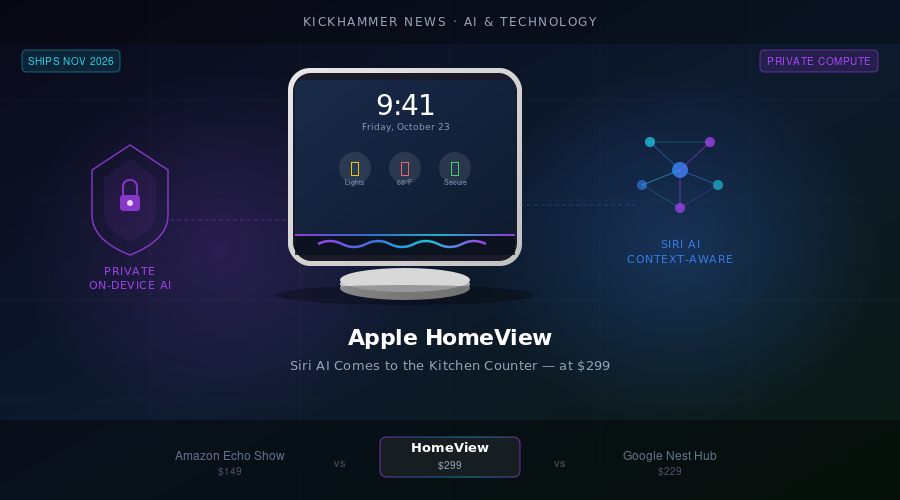
For nearly a decade, Apple watched from the sidelines as Amazon’s Echo Show and Google’s Nest Hub carved up the smart home display market. The HomePod and HomePod mini were always listening, but they were audio-only. If you wanted a screen in your kitchen that could show recipes, manage your smart lights, and answer questions with a visual response, you went to Amazon or Google. Apple didn’t have an answer.
On October 13, 2026, that changed. At what the company branded its “Welcome Home” event, Apple unveiled the HomeView — a $299 smart home display powered by the fully revamped Siri AI that the company has been building toward since it announced Apple Intelligence in 2024. It ships in mid-November in four colors, and it is Apple’s most direct assault yet on the living room intelligence market. More importantly, it may be the device that finally forces consumers to decide which AI ecosystem they actually trust.
What Is the HomeView?
The HomeView is, at its core, a countertop smart display. A screen — described by tech reviewers as having a visual sensibility reminiscent of the original Apple Watch crossed with a translucent G4 iMac — sits on a magnetic puck that tilts and rotates. Connect it to power and your Wi-Fi, and it becomes the hub for Apple’s HomeKit smart home ecosystem, a Siri AI terminal, a media controller for Apple TV, and a personal communication device for FaceTime.
The hardware specs are competitive. The display is the same panel technology Apple uses in the iPad mini — bright, accurate, and power-efficient. The onboard chip is derived from the A17 Pro family. There are two microphones tuned for far-field voice pickup, a front camera for FaceTime and secure face recognition, and speakers tuned by the HomePod audio team. It is not cheap. The Echo Show 8 sells for $149 and the Nest Hub Max for $229. At $299, Apple is betting that buyers will pay a premium for the brand, the privacy architecture, and the Siri AI experience.
The New Siri, Finally
The HomeView is, more than anything else, a Siri AI showcase. The assistant that shipped on this device is a fundamentally different product from the Siri that frustrated users for a decade with misheard commands and laughably limited follow-through.
The new Siri AI — announced as part of Apple Intelligence and gradually rolled out through 2025 and into 2026 — brings large language model reasoning to Apple’s voice assistant for the first time. On HomeView, Siri can hold multi-turn conversations, remember context across a session, and perform compound tasks. Ask it to “find me a pasta recipe that doesn’t use dairy and add the ingredients to my Reminders for a Saturday shopping trip” and it does all three steps without requiring you to repeat yourself.
HomeView’s Siri can also control every HomeKit-compatible device in your home with natural language, understand ambiguous requests (“turn it off in here” understands “it” and “here” from context), and provide explanations and suggestions. It reads your calendar and handles schedule queries without accessing a cloud server — a critical differentiator that Apple is leaning into hard.
Privacy as Product Strategy
Apple’s clearest competitive angle isn’t the screen or the speakers. It’s the privacy architecture. When HomeView processes your voice requests, the company says the vast majority of computation happens on-device, on that A17-derived chip. Apple is calling this “Private Siri” — requests that do need cloud processing go through Private Cloud Compute, the on-demand server infrastructure Apple described in detail when it launched Apple Intelligence in 2024, which uses hardware-enforced privacy guarantees such that even Apple engineers cannot see what users asked.
This is a direct shot at Amazon and Google, both of which have faced sustained criticism and regulatory scrutiny for how their smart home devices handle voice data. Amazon reached a $25 million FTC settlement in 2023 for retaining children’s Alexa recordings. Google has faced similar complaints in the EU about smart home data handling. Apple’s pitch to consumers: your kitchen counter shouldn’t be a microphone for a surveillance-funded advertising business.
Whether that message lands commercially is the open question. Smart home display buyers have historically prioritized price and ecosystem compatibility over privacy promises. But the landscape has shifted. The EU’s AI Act has put data handling obligations on ambient AI devices. Consumer awareness of data harvesting is higher than it’s ever been. And Apple has spent two years building a coherent narrative around on-device AI processing. HomeView is the physical embodiment of that narrative placed on your counter.
No App Store — and What That Means
One notable absence from HomeView: there is no App Store. The device ships with a curated set of Apple experiences — FaceTime, Apple Music, Apple TV+, Apple Home, Calendar, Reminders, Weather, and a cookbook integration — but third-party developers cannot build HomeView apps. This is a significant constraint. The Echo Show supports Prime Video, Netflix, Spotify, Ring doorbells, third-party smart home dashboards, and dozens of productivity tools built by outside developers. HomeView ships with none of that third-party depth at launch.
Apple has said that HomeView is designed as a “trusted core” experience and that it evaluates the platform’s expansion as users and developers signal demand. The subtext: they don’t want to repeat the Vision Pro mistake of launching with too few apps and too many use cases the hardware couldn’t support.
Whether this omission is a principled product decision or a launch-window shortcut will become clearer over time. For now, buyers choosing HomeView are choosing Apple’s curated experience — not an open platform.
The Competitive Picture
The smart home display market has been Amazon’s territory since the Echo Show launched in 2017. Google has maintained a credible second position with the Nest Hub line. Neither has been particularly good at what the HomeView promises: a conversational, context-aware AI at the center of your domestic life.
Both Amazon and Google have layered LLM-powered intelligence onto their assistants over the past two years, but they’re building on legacy architectures designed for keyword matching and cloud round-trips. Apple is building Siri AI from the ground up on a chip designed for on-device inference, using a privacy model that’s architecturally incompatible with the ad business that funds Amazon and Google’s ambient AI products.
The comparison Apple wants you to make isn’t HomeView vs. Echo Show 8 on specs. It’s: when an AI assistant lives on your kitchen counter and hears everything that happens in your home, which company do you want running it?
That is, ultimately, a question about institutional trust. And it’s a question the smart home market hasn’t had to answer before, because the AI assistants that preceded HomeView weren’t capable enough to be genuinely ambient in the way that raises real privacy stakes. A voice assistant you ask for the weather doesn’t feel threatening. An AI that remembers your schedule, knows your family members by face, understands the context of your conversations, and is always listening with LLM-level comprehension is a different proposition entirely.
What Comes Next
HomeView ships in mid-November. Early pricing is $299. Pre-orders opened on October 13. The four launch colors — Midnight, Starlight, Sky Blue, and Sage — continue Apple’s recent trend of muted, furniture-friendly palettes.
Apple announced that the new Apple TV 4K and HomePod mini 2 are shipping alongside HomeView, creating a bundled smart home refresh. The Apple TV 4K gains its own AI-enhanced search and recommendation layer via tvOS, while the HomePod mini 2 gets Siri AI capabilities without the screen. Together, the three products form Apple’s most coherent smart home hardware story yet.
The holiday season will be the first real test. Smart home displays are gift purchases. HomeView will sit in stores next to Echo Shows priced at half its cost. Whether parents and partners choose the Apple name, the privacy story, and the premium Siri experience — or a $149 screen that does most of the same things — will tell us a great deal about where the ambient AI market is really headed.
Apple has waited a long time to answer the Echo Show. The HomeView is that answer. Now the kitchen counter gets to vote.
Word count: approximately 1,150 words


