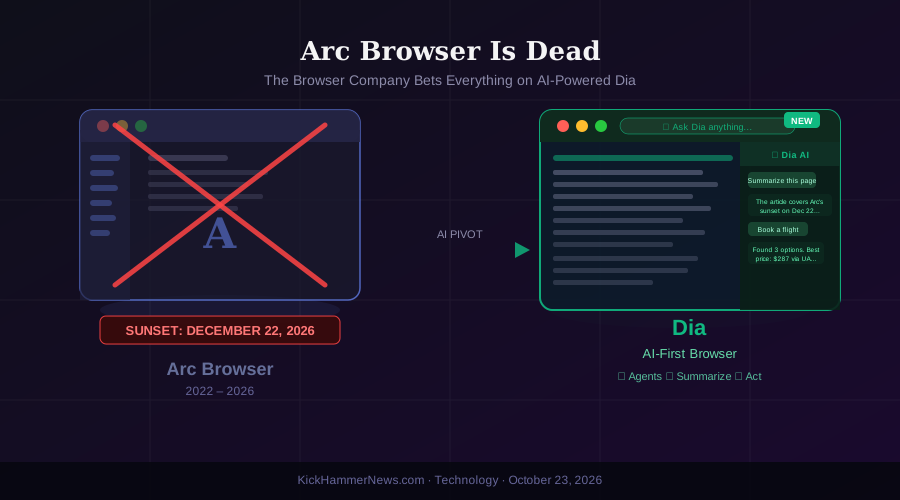
The internet just lost one of its most beloved browsers. The Browser Company announced this week that Arc — the cult-favorite browser that won over millions with its radical rethinking of how people navigate the web — will officially shut down on December 22, 2026. Users have roughly two months to migrate elsewhere, and the company’s message is clear: come to Dia, the AI-native browser that its creators believe represents the future of how humans will interact with the internet.
It’s an abrupt end for a product that, not long ago, was being hailed as a generational leap in browser design. Arc launched publicly in 2022 and spent years cultivating a devoted following with features like Spaces for organizing tabs by context, Easels for combining and annotating web content, and a sidebar-based navigation model that upended the standard tab bar paradigm most browsers had barely touched since the early 2000s. For many of its users, Arc didn’t just change how they browsed — it changed how they thought about what a browser could be.
Why Arc Is Being Put Down
The Browser Company’s founder and CEO Josh Miller didn’t mince words in the announcement. The company has concluded that the future of the web browser isn’t a better version of what exists today — it’s something fundamentally different. Dia, the company’s AI-first browser that began limited rollout earlier this year, is that bet.
Where Arc reimagined the visual organization of browsing, Dia takes a more radical swing: it places a conversational AI agent at the center of the web experience. Rather than navigating to sites and hunting for information yourself, Dia is designed to understand what you’re trying to accomplish and act on your behalf. It can summarize pages without you reading them, fill forms, pull information across multiple sources simultaneously, book appointments, and execute multi-step tasks on the web that used to require a series of manual clicks and searches.
The company says it cannot maintain and develop both products in parallel without diluting both. Engineering bandwidth is finite, and Dia requires a full-court press.
The decision mirrors a pattern playing out across the tech industry. As AI agents become capable of doing more and more of the actual work of using software, the interface layers on top are being redesigned from scratch. Browsers, email clients, code editors, productivity suites — each is being rebuilt around the assumption that the user wants to delegate work to an AI, not perform it manually.
What Happens on December 22?
When the clock runs out, Arc will stop functioning. The Browser Company has been vague about the specific failure mode, but the implication is that cloud-synced features will cease to work, and the application itself may not launch. Users are being advised not to simply wait until the deadline.
The most pressing concern for longtime Arc users is their data. Arc’s Spaces, saved tabs, Easels, and browsing history do not automatically transfer to any other browser in a standard format. The company has published a migration guide that walks users through exporting bookmarks in a format compatible with Chrome, Firefox, Safari, and Dia itself — but the distinctive organizational structures Arc was known for don’t have clean equivalents elsewhere.
For most users, this means a genuine disruption. Arc’s workflows are deeply personal and idiosyncratic. Many users will find that whatever they migrate to feels like a regression, not just a change.
The browser’s fan community, spread across forums and social channels, has responded with a mix of grief and frustration. Some have already moved on to Dia; others are heading to standard alternatives like Chrome, Firefox, and Safari; a vocal contingent is holding out hope that the open-source community will fork Arc and maintain it independently. The Browser Company has indicated it has no plans to open-source Arc, citing the engineering complexity of doing so responsibly.
What Dia Brings to the Table
For users willing to make the jump, Dia offers a genuinely different kind of browsing. Its central feature is a persistent AI panel that sits alongside the web content you’re viewing and can interact with it in real time. Ask it to find the cheapest flight on a page you’re looking at, and it will; ask it to read a long document and pull out three key points, and it does; ask it to help you draft a reply to an email in your webmail client, and it integrates with that context automatically.
Dia also supports what the company calls “browsing agents” — pre-configured AI routines that can run in the background and report back. You might set one to monitor a product page for a price drop, another to collect research links on a topic you’re tracking, and another to summarize new comments on a thread you care about. These agents run while you do other things and surface results in a unified feed.
It is, in many ways, the logical endpoint of the browser-as-productivity-platform vision that Arc itself was gesturing toward. Where Arc tried to help humans be better at browsing, Dia tries to do much of the browsing for them.
The trade-off, as with all AI-forward interfaces, is control and transparency. Arc users loved the product precisely because it made them feel in command of a complex information environment. Dia’s approach asks them to hand more of that control to an AI model whose reasoning is not always visible or predictable. Not every Arc user will be comfortable with that bargain.
The Bigger Picture: AI Is Eating the Browser
The Arc shutdown isn’t an isolated event — it’s a symptom of a broader disruption happening at the application layer of software. The browser was arguably the most important invention in consumer computing after the personal computer itself. For three decades, it was the universal interface through which people accessed most of their digital life. Now that AI agents can navigate, interpret, and act on the web autonomously, the traditional browser’s role is being renegotiated.
Google, Microsoft, and Mozilla are all pursuing various flavors of AI integration into their own browsers. Chrome has increasingly leaned on Gemini capabilities for summarization, translation, and tab organization. Edge has built Copilot deeply into the browsing experience. Firefox has announced partnerships that add AI-driven features to its toolbar. None of them has gone as far as The Browser Company in declaring the conventional browsing paradigm obsolete, but the direction is the same.
The Browser Company’s gambit is that going all-in, even at the cost of abandoning a beloved product and alienating its existing user base, is the only way to build something that matters in this new environment. It’s a bold calculation. Whether Dia succeeds will depend on whether AI-first browsing turns out to be what users actually want — or whether most people, given the choice, still prefer to drive the car themselves.
What You Should Do Before December 22
If you’re an Arc user, the clock is ticking. Here’s what to prioritize in the next two months:
Export your bookmarks and saved content now. Don’t wait until the last week. Arc’s export tools work today; they may become unreliable as the shutdown approaches.
Evaluate Dia on its own terms. Don’t migrate under duress without trying it first. Dia is available now and offers a free tier. Spend real time with it before deciding if it’s your new home.
Consider your alternatives seriously. Firefox, Safari, and Chrome are all solid, actively developed browsers. Firefox in particular has made significant strides and has the advantage of being open-source and community-maintained.
Save your data externally. Any notes, Easels, or curated collections in Arc that you care about should be copied to a format outside Arc’s ecosystem — plain text, a note-taking app, a document — before the shutdown.
Arc’s death is a genuine loss for the people who loved it. But the pivot to Dia is also, depending on your perspective, a serious swing at something that might matter. The browser that replaces the browser might actually be something worth building — if the Browser Company can stick the landing.


