For enterprise IT teams running Red Hat Enterprise Linux (RHEL) on-premises and eyeing the cloud, Oracle Cloud Infrastructure (OCI) has just become a much more attractive destination. In a significant development announced October 19, 2026, Red Hat and Oracle have taken their two-decade collaboration to a new level: RHEL is now a first-party, natively supported operating system offering directly within the OCI Console.
This isn’t merely a marketing milestone. The technical and commercial integrations accompanying the announcement address some of the most persistent friction points that have slowed enterprise cloud adoption — fragmented support contracts, incompatible procurement channels, and the operational drift that develops when on-premises and cloud environments run different OS stacks.
What “Native” Actually Means on OCI
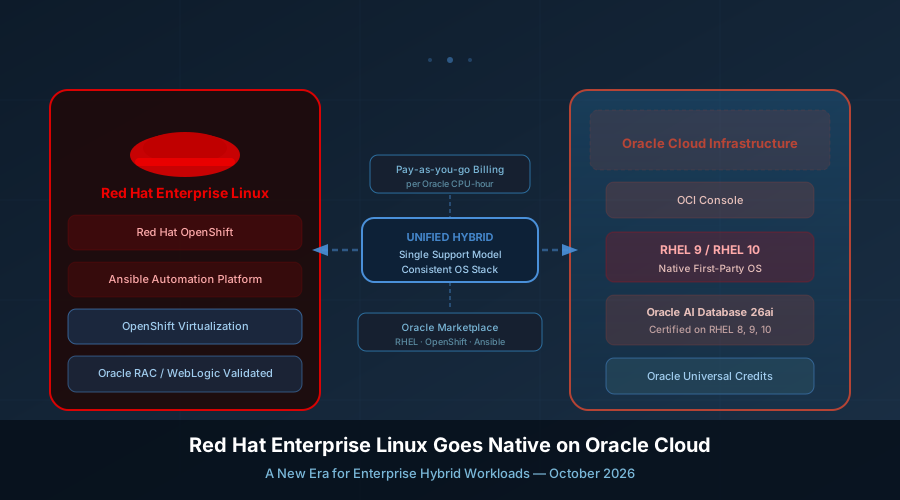
The term “native” is often deployed loosely in cloud vendor announcements, but in this case it carries real operational weight. Customers can now provision RHEL 9 and RHEL 10 virtual machines directly from the OCI Console, the same interface used for managing compute, networking, and storage resources across Oracle’s cloud. The images are optimized for Intel and AMD x86_64 fully-virtualized instances and plug directly into OCI’s monitoring stack, command-line interface (CLI), and automation APIs.
That last detail matters for enterprise automation teams. RHEL on OCI isn’t an afterthought image dropped into a marketplace with limited tooling. It integrates with Terraform workflows, Ansible playbooks, and OCI Monitoring telemetry out of the box — the same way enterprises already manage infrastructure across their hybrid environments.
Billing is pay-as-you-go, charged per Oracle CPU-hour. Critically, purchases count toward Oracle Universal Credits commitments, meaning organizations with existing Oracle spending agreements can apply those credits directly to RHEL consumption without new procurement vehicles or separate Red Hat contracts. For enterprises managing tight software budgets with preferred vendor relationships, the ability to consolidate spending under a single Oracle commitment is a meaningful operational simplification.
The Support Model: One Call Instead of Two
Anyone who has managed a production outage involving a cloud provider’s hypervisor, an OS-level issue, and a third-party software stack knows the pain of the “not our problem” support shuffle. The new OCI RHEL arrangement takes aim at this directly.
Oracle Support serves as the primary contact — Tier 1 and Tier 2 — for issues with RHEL on OCI. When a problem requires deeper OS engineering investigation, Oracle escalates through pre-configured automated channels to Red Hat engineering. There is no handoff friction, no customer stuck in the middle trying to prove to two vendors which layer is responsible.
This support architecture mirrors what customers get with Oracle’s own operating system products and reflects a deliberate design decision by both companies to reduce enterprise support ambiguity, which has historically been one of the strongest arguments against heterogeneous cloud deployments.
Oracle AI Database 26ai: Certified on RHEL
The timing of this announcement is no accident. It coincides directly with the rising enterprise demand to run Oracle’s next-generation database workloads — specifically Oracle AI Database 26ai — on modern, consistent infrastructure. Oracle AI Database 26ai is now certified on RHEL 8, 9, and 10, giving organizations a validated, supported stack for AI-adjacent database workloads across on-premises and OCI environments.
For IT architects designing hybrid data platforms, certification matters. A “works in our tests” statement from a vendor isn’t the same as a formal certification that includes joint escalation paths, documented configuration requirements, and mutual vendor accountability. The Oracle AI Database 26ai certification on RHEL delivers that assurance, which is especially significant for regulated industries where workload placement decisions require documented vendor support positions.
Additionally, Oracle Real Application Clusters (RAC) configurations — both the legacy 19c branch and the new AI Database 26ai — have been validated by Red Hat for on-premises deployment on OpenShift Virtualization. Oracle WebLogic Server has received similar validation for OpenShift Virtualization environments. These validations extend the interoperability story beyond the public cloud, creating a consistent certification layer for the full hybrid deployment lifecycle.
The Oracle Marketplace Ecosystem Play
Alongside the native OCI Console offering, Red Hat has expanded its Oracle Marketplace presence. Customers can now purchase Red Hat Ansible Automation Platform, RHEL, Red Hat OpenShift, and Red Hat OpenShift Virtualization subscriptions directly through Oracle Marketplace — and those purchases count toward Oracle Universal Credits.
This is strategically significant for Red Hat’s enterprise penetration within Oracle’s customer base. Oracle’s installed base — particularly ERP customers running Oracle E-Business Suite, JD Edwards, and Oracle Fusion Applications — has historically been a complex territory for Red Hat to navigate. Oracle’s own Linux distribution, Oracle Linux (a downstream RHEL rebuild), has long competed for the same enterprise footprint. The Oracle Marketplace listing creates a legitimate, Oracle-endorsed channel for RHEL adoption within Oracle-centric organizations.
Customers with existing Red Hat subscriptions retain the option to bring their own subscription (BYOS) to OCI, preserving investment in existing enterprise agreements while gaining access to OCI infrastructure.
Why This Partnership Matters Now
The Red Hat-Oracle relationship has a long, occasionally tense history rooted in Oracle’s decision to offer Oracle Linux as a RHEL-compatible alternative. That dynamic never fully disappeared, but it has become increasingly secondary to the practical demands of the enterprise AI era. Organizations need validated, interoperable stacks — not competing vendor narratives about which OS is the “real” enterprise Linux.
Kevin Kennedy, Vice President of the Global Partner Ecosystem at Red Hat, framed the broader context clearly: “Navigating the complexities of the AI era starts by establishing a strong, flexible open hybrid cloud foundation.” Chris Sullivan, Oracle’s Vice President of Strategic Partnerships, echoed that customers want simpler ways to manage existing infrastructure while modernizing critical systems — a straightforward acknowledgment that procurement and support complexity have been concrete obstacles to hybrid cloud adoption.
The native RHEL availability on OCI addresses both points. It simplifies operations for the large cohort of enterprises running Red Hat Linux on-premises who have historically faced a real or perceived friction when extending those workloads to Oracle’s cloud. That friction now has one fewer legitimate excuse.
What Comes Next
Oracle has indicated that the current availability — spanning public OCI regions worldwide — will expand to distributed cloud deployment options in future engineering updates. This suggests the partnership is designed to follow Oracle’s Alloy and Dedicated Region infrastructure as it pushes OCI closer to customer data centers and sovereign cloud requirements.
For enterprise architects evaluating hybrid cloud strategies, the immediate practical takeaway is clear: RHEL workloads destined for OCI now have a first-party path with consolidated billing, unified support, and certified database compatibility. Whether that’s enough to shift workloads from competing cloud providers will depend on each organization’s existing Oracle footprint and licensing posture — but the integration removes most of the technical and procurement arguments against it.
The Red Hat-Oracle deepening of ties is ultimately a story about the enterprise AI infrastructure stack coalescing. In a world where Oracle AI Database 26ai, Red Hat OpenShift, and Oracle’s GPU infrastructure all need to work together reliably, vendor certification and integrated support aren’t optional extras. They’re the table stakes for enterprise adoption.