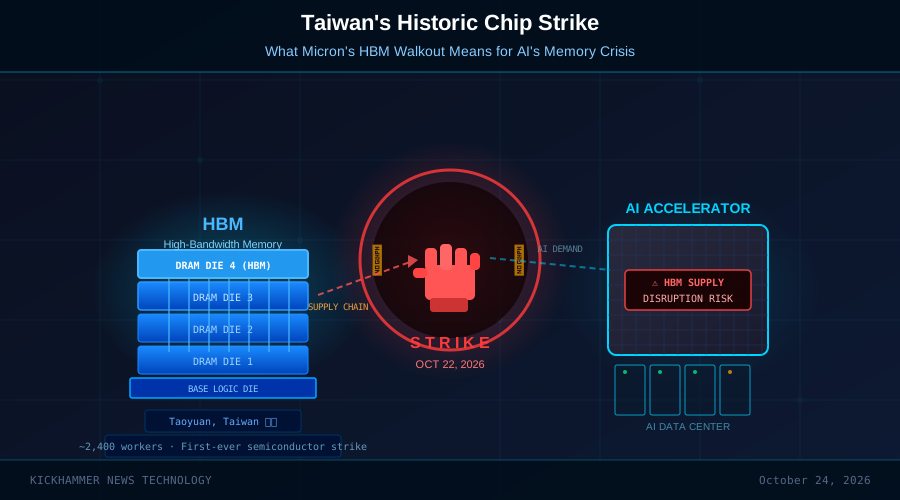
Something unprecedented happened this week on the island that powers the world’s AI ambitions. On October 22, 2026, workers at Micron Technology’s Taoyuan facility in Taiwan walked off the job — the first strike ever recorded at a semiconductor plant on the island. It lasted one day, it was primarily symbolic, and Micron’s production barely blinked. But for an AI industry that has grown dangerously dependent on a shrinking pool of high-bandwidth memory, the message echoed far louder than the silence of a single idle factory floor.
A Dispute Years in the Making
The Taoyuan union’s walkout didn’t come out of nowhere. For months, workers at Micron’s Taiwan operations — roughly 15,000 employees across two cities — have been pushing the company to replace its opaque incentive pay plan with a transparent profit-sharing model tied to 15% of operating profits.
Their argument is simple and hard to refute: Micron has been printing money during the AI boom. High-bandwidth memory — the dense, stacked DRAM that feeds the appetite of AI accelerators like NVIDIA’s H100 and the newer Blackwell successors — is in shorter supply than almost any other component in the AI stack. Demand from cloud hyperscalers, AI chipmakers, and government supercomputing programs has sent prices soaring. Micron’s revenue has surged. Its Taiwan workforce, which produces the majority of that HBM, has not seen a proportional share of those gains.
Workers pointed to rivals Samsung and SK Hynix, both of which have formalized profit-sharing structures that tie employee bonuses more transparently to financial results. Micron’s current plan caps bonuses at around 200% of target — with actual payouts averaging well below even that ceiling.
A Split Outcome
The strike unfolded against a backdrop of fractured labor negotiations. Micron has two major union groups in Taiwan: a Taichung union representing around 11,000 workers, and a smaller Taoyuan union with roughly 2,400 members.
In what appeared to be a strategic move, Micron reached an eleventh-hour agreement with the larger Taichung union on October 21, signing a labor deal just one day before the planned walkout. The terms were not disclosed, but Taichung union members called off their planned show of solidarity and their outstanding mediation session was canceled.
The Taoyuan union, however, proceeded. Their October 22 one-day strike was framed as a demonstration rather than an indefinite work stoppage — a signal that despite Micron’s settlement with Taichung, the smaller Taoyuan group wasn’t going to quietly accept the same undisclosed terms without a fight. The action made it into the history books: Taiwan’s semiconductor industry, which has operated without a single factory-floor work stoppage since the island became the world’s chip capital, now has its first strike on record.
Taiwan’s President Lai Ching-te called on both sides to negotiate “sincerely,” a measured statement that suggested neither alarm nor dismissal.
Why the Chip Industry Held Its Breath
Even a one-day walkout at a single Taoyuan facility was enough to put supply chain analysts on alert — not because of any immediate disruption, but because of what it revealed about fragility.
Taiwan accounts for approximately 60% of Micron’s global memory production. The Taoyuan site specifically produces DRAM and HBM, which are among the most supply-constrained chips in the AI economy. HBM in particular is still characterized by near-zero inventory buffer in the market. Unlike commodity DRAM for consumer laptops or smartphones, HBM cannot simply be substituted or quickly sourced from another supplier. Only three companies in the world produce it at scale: Micron, SK Hynix, and Samsung. Any meaningful disruption to any of the three sends shockwaves through NVIDIA’s delivery timelines, Google’s TPU refresh cycles, and Microsoft’s Azure AI infrastructure buildout.
This isn’t a hypothetical concern. As recently as mid-2026, TSMC warned of capacity crunches across its advanced packaging lines — many of which are used to assemble the chip-on-wafer-on-substrate (CoWoS) stacks that bond HBM dies to AI accelerators. A disruption upstream at Micron’s memory fabs would compound an already stressed system.
The tight market also meant that any pricing power shift in favor of suppliers could push HBM costs higher, compounding expenses for companies that have already been pouring tens of billions into AI infrastructure.
The Bigger Picture: Labor Catches Up to the AI Gold Rush
The Micron strike is part of a broader pattern emerging across the semiconductor and technology sectors in 2026: workers who built the AI boom are beginning to demand a larger share of the windfall.
In South Korea, unionization rates at semiconductor plants have risen steadily. Samsung Electronics’ production workers staged brief work stoppages last year over similar profit-sharing demands. In the United States, a growing number of AI company employees — from data annotators to safety researchers — have organized or publicly resigned over compensation and ethics concerns. In Taiwan, an island whose chip workers have historically had among the most stable employment and compensation packages in Asia’s electronics sector, the emergence of formal labor action signals that the status quo is shifting.
There is something almost poetic about the timing. The AI revolution promises to automate enormous swaths of the global workforce. The machines being built to do so depend on chips fabricated by human hands in Taiwanese clean rooms, assembled by workers who are now asking whether the economic rewards of that revolution will reach them at all.
What Comes Next
For Micron, the path forward likely involves releasing more details of the Taichung settlement to demonstrate good faith to the Taoyuan union, whose dispute remains open. Analysts expect negotiations to resume in November, with some form of enhanced profit-sharing mechanism as the likely outcome — if only because Micron can afford it, and the cost of protracted labor instability in its Taiwan operations is far higher.
For the AI industry at large, the Taiwan chip strike serves as a quiet reminder that the infrastructure underpinning a $600 billion annual capex cycle is not as stable or frictionless as quarterly earnings slides suggest. Every GPU cluster, every AI factory, every inference endpoint traces its lineage back to a production line staffed by people who have their own demands, their own leverage, and as of this week, their own history.
The machines don’t run themselves. Not yet. And the people who make sure they do are starting to act like they know it.


