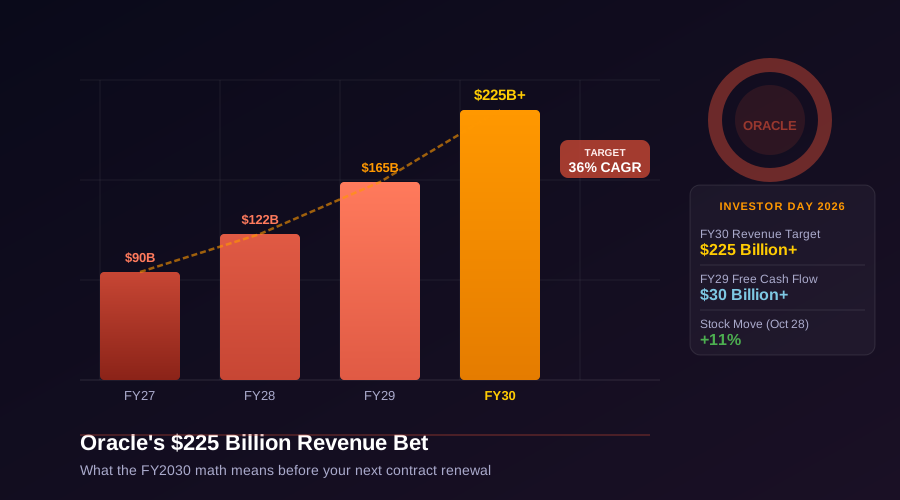
On October 28, Oracle’s stock jumped roughly 11% after the company set a fiscal 2030 revenue target of $225 billion or more at its investor day in Las Vegas — paired with a $300 million collaboration announcement with OpenAI and a new AI orchestration layer called Fusion Companion. Wall Street loved all of it. Enterprise buyers should read the same numbers rather differently.
Here is the math that most coverage is skipping, and the narrow window it opens.
What Oracle Actually Committed To
The headline is striking: $225 billion in revenue by fiscal year 2030 (ending May 2030), against a reaffirmed FY27 target of $90 billion. That implies Oracle needs to more than double in three years. The compound annual growth rate required from FY27 to FY30 works out to roughly 36 percent annually — sustained across cloud infrastructure, database, and applications at the same time.
The company also announced it would cap new capital markets funding at $20 billion between FY27 and FY30: $10 billion in equity and $10 billion in gross debt, excluding refinancing of existing obligations. Management said growth would be “self-funded beginning in FY29,” with free cash flow turning positive in the second half of FY28 and reaching a target of $30 billion or more in FY29.
Two products were central to the investor story: Oracle Fusion Companion, a new AI orchestration layer released in Fusion Cloud Applications Release 26D, and the Oracle AI Workspace powered by OpenAI models — including ChatGPT plugins that let employees initiate Oracle business workflows from inside ChatGPT without touching the underlying application.
The Calculation Your Finance Team Needs to Run
The growth Oracle is projecting has to come from somewhere. Most of it, management implied, comes from existing enterprise cloud customers expanding workloads and from new cloud migrations. For enterprise buyers, this has a direct pricing implication: Oracle needs you to spend more.
For a 100-seat Fusion Cloud ERP customer currently paying a typical all-in rate of $200 per user per month ($240,000 per year), here is what budget planning looks like under two price-increase scenarios over the next four years:
- At 15% annual contract growth (conservative in a 36%-CAGR expansion environment):
- – Year 1: $240,000 → Year 2: $276,000 → Year 3: $317,400 → Year 4: $364,910
- – Four-year total: $1,198,310
- At 22% annual contract growth (more aggressive, closer to what cloud-native peers have done when scaling fast):
- – Year 1: $240,000 → Year 2: $292,800 → Year 3: $357,216 → Year 4: $435,803
- – Four-year total: $1,325,819
- Delta between the two scenarios: $127,509 — nearly half of a year’s current spend, accumulated in just four years.
For a 500-seat organization, the same delta at 22% vs. 15% growth accumulates to roughly $637,000 over four years. At 1,000 seats, the gap reaches $1.27 million — money that would meaningfully fund headcount, competing tools, or technology modernization elsewhere.
None of this requires Oracle to do anything improper. It simply requires them to hit their own targets. Enterprise procurement teams have roughly 12 to 18 months to renegotiate or lock in multi-year terms before Oracle’s financial position strengthens enough to shift leverage decisively their way.
The Fusion Companion Question: Buy Now or Wait for 26D?
Fusion Companion — announced alongside the investor day — is positioned as the AI orchestration layer that makes Oracle’s entire application suite conversational. An employee can submit a request through ChatGPT or the new Fusion Agentic Home interface, and Companion interprets it, triggers the relevant workflows, routes approvals, and takes authorized actions across systems, including non-Oracle ones.
The appeal is real. The risk is also real: this is an extremely young capability, and the investor day announcement is as much a roadmap signal as a shipping product. Release 26D implies availability in the current quarterly release cycle, but enterprise rollouts of AI orchestration at this layer typically take 12 to 18 months after general availability before they are stable enough for production at scale.
My read: Organizations currently evaluating Fusion Cloud upgrades or NetSuite expansions should ask Oracle for explicit contractual commitments on Fusion Companion availability, SLAs, and pricing before renewing, not after. Once the contract is signed, leverage evaporates.
The SMB Bundle Is a Smarter Offer Than It Looks
The Oracle AI SMB Bundle — free to start, with $12,000 in annual OCI cloud credits — deserves more attention than it is getting in coverage focused on the enterprise investor narrative.
To put $12,000 in OCI credits in concrete terms: Oracle’s standard OCI Compute VM E5 shape runs at roughly $0.025 per OCPU-hour. Over a year (8,760 hours), $12,000 covers approximately 54 continuous OCPUs of compute. For a small business that is not running 24/7 production workloads, that is meaningful capacity.
The bundle also includes NetSuite QuickStart for core functions such as invoicing and cash flow, ChatGPT Business, AI Workspace, Codex, and App Composer — Oracle’s no-code app builder powered by OpenAI’s Codex model. The full retail value of comparable standalone subscriptions would easily exceed $60,000 annually for a 10-person team (NetSuite alone starts at roughly $999/month plus $99/user/month).
The strategic purpose, however, is not charity. This is Oracle’s clearest attempt yet to capture the SMB market before Microsoft 365 Copilot and Google Workspace AI become entrenched. A small business that processes its invoices through NetSuite and builds its internal tools through App Composer is an Oracle customer for a very long time. Finance teams at small organizations should weigh the attractive entry cost against lock-in risk on core business data before committing.
A Contrarian Take: The $20 Billion Debt Cap Is Not Fiscal Responsibility — It’s a Signal
Most coverage frames Oracle’s $20 billion funding cap as a sign of balance sheet discipline and improved capital efficiency. The more likely read is that it is a message to equity investors after a bruising period.
Oracle completed a $20 billion at-the-market equity raise in Q1 FY27 — a move that significantly diluted existing shareholders. The $20 billion cap on *additional* funding through FY30 is designed primarily to prevent another round of dilution anxiety, not to constrain the business. Oracle is signaling: we are done raising at the scale we just did, not that we are being conservative.
For enterprise buyers, the practical implication is different: Oracle will increasingly fund AI infrastructure build-out through customer prepayments and vendor financing. The press release specifically mentions “vendor financing, customer-provided hardware, and customer prepayments are expected to reduce upfront cash needs.” Translation: multi-year prepayment deals will be heavily incentivized. Organizations that agree to prepay should negotiate aggressively for price locks, SLA protections, and exit ramps, because the leverage they hold before signing is the leverage they permanently surrender after.
The OpenAI Integration: Real Capability, Real Data Risk
The Oracle AI Workspace, which connects ChatGPT directly to Oracle Fusion Applications, NetSuite, OCI, and enterprise data, is genuinely useful in theory. The workflow is elegant: an employee types a request in ChatGPT, and the system orchestrates the necessary Oracle transactions behind the scenes, maintaining governance and approvals.
The risk that the announcement buries in fine print: business context sent to ChatGPT as part of this workflow leaves the Oracle environment. Oracle states governance and controls are maintained, but neither the press release nor the investor day materials specify exactly what data is transmitted to OpenAI’s models, under what retention policies, or whether it falls inside Oracle’s existing data protection addendum.
Enterprise security and compliance teams should request explicit written clarification on this point before piloting at scale. A workflow that routes procurement approval context or financial projections through a third-party model needs to be scoped precisely, not assumed compliant.
Your October–December Action Checklist
The investor day results and the Fusion Companion announcement create several time-sensitive tasks for enterprise Oracle customers:
- By November 15: Pull your current Oracle contract renewal dates from the enterprise admin console. Flag any renewals occurring in the next 18 months for strategic review — these are your highest-leverage negotiation windows.
- By November 30: Request Oracle’s formal Fusion Companion roadmap document and release 26D availability date for your specific Fusion Cloud modules. Ask explicitly whether Companion is included in your existing contract or a paid add-on.
- By December 15: Run a 4-year TCO projection at both 15% and 22% annual contract growth rates for your current user count and module footprint. Present the delta to your CFO before Oracle’s Q2 FY27 earnings (expected December 2026) — earnings strength will reduce Oracle’s incentive to negotiate.
- By January 15, 2027: If evaluating the SMB bundle, map your core business data residency requirements against Oracle’s standard OCI regional commitments. Confirm that NetSuite QuickStart covers your specific compliance needs (SOX, HIPAA, or regional data regulations as applicable) before committing.
- Ongoing: Track whether Oracle updates the Data Protection Addendum to explicitly cover ChatGPT-integrated workflows. This is the clearest indicator of how seriously they are treating the enterprise data boundary question.
What This Investor Day Actually Means
Oracle has made an extraordinarily ambitious bet in public: 36 percent annual growth for three consecutive years, turning free cash flow positive on a debt-heavy balance sheet, while simultaneously shipping AI orchestration across applications, database, and cloud infrastructure.
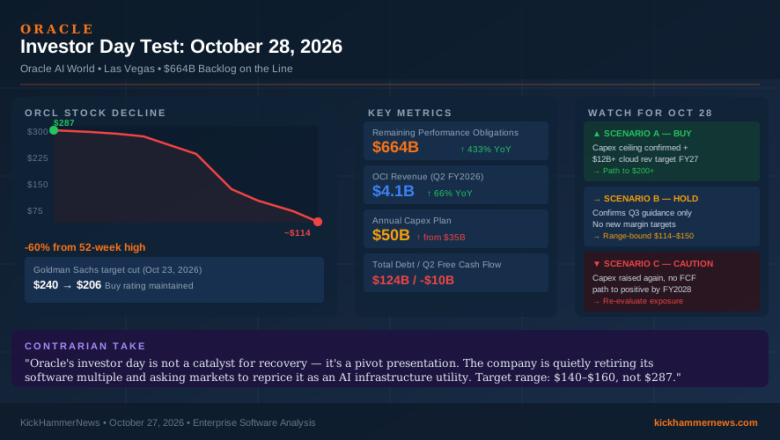
The bet might work. Oracle’s AI infrastructure demand has been real — the $664 billion cloud backlog reported at the end of last quarter is genuine. The OpenAI partnership is strategically coherent. Fusion Companion addresses a real friction point in enterprise AI adoption.
But the correct reading for enterprise buyers is not to share the market’s optimism or its skepticism. It is to recognize that a company chasing 36 percent growth is highly motivated to expand your contract, and that motivation is most useful to you right now — before the growth materializes and removes the pressure. The investor day told you Oracle needs you to spend more. The question is whether you use that fact, or simply comply with it.