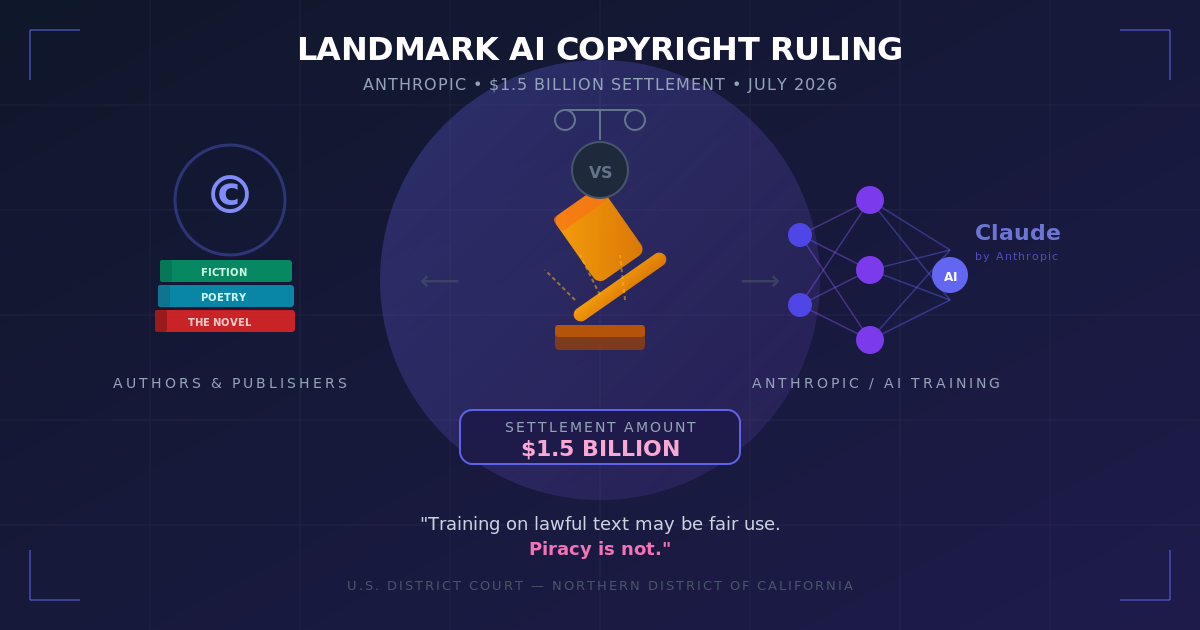
On July 21, 2026, a federal judge in San Francisco granted final approval to Anthropic’s $1.5 billion settlement with authors and publishers whose works were used to train Claude, the company’s flagship AI model. The ruling closes one chapter of what has become a defining legal battle for the artificial intelligence industry — and opens a new one for every AI company still in court.
The Case That Shook the AI Industry
The lawsuit, filed by a class of authors and publishers, alleged that Anthropic obtained millions of copyrighted books not through legitimate licensing channels, but by collecting pirated copies from unauthorized digital repositories. The plaintiffs argued that Anthropic stored these materials in a centralized digital library, used them extensively during Claude’s training, and did so knowing the copies were obtained illegally.
U.S. District Judge Araceli Martinez-Olguin’s ruling drew a distinction that will likely echo through AI litigation for years. The court found that training AI models on lawfully obtained text could qualify as transformative fair use under copyright law — a significant win for the AI industry’s core argument that machine learning constitutes a new and protected form of expression. However, that fair use shield does not cover how companies obtain the material in the first place. Acquiring books from piracy websites, the court ruled, falls squarely outside fair use protections.
That distinction — not whether AI training can be fair use, but how companies source their training data — is now the sharpest legal boundary in the field.
The Numbers
The settlement is staggering in scope. Of the more than 482,000 books covered by the ruling, over 91% have been claimed by eligible authors or publishers, who will receive roughly $3,000 per work after legal fees are deducted. Attorneys fees alone exceed $101 million. The total $1.5 billion payout is the largest copyright class action settlement in history, surpassing earlier music industry cases and previous technology disputes.
Anthropic’s decision to settle rather than proceed to trial was a calculated risk management move. Had the case gone to a jury, statutory damages for piracy — which can reach $150,000 per willfully infringed work — could have yielded a verdict far exceeding $1.5 billion across nearly half a million titles. The settlement allowed Anthropic to cap its exposure and move forward without the uncertainty of a jury verdict on a case with significant symbolic weight.
What It Means for the Broader AI Industry
The ruling does not resolve the AI copyright question. Separate lawsuits against OpenAI, Meta, Google, Stability AI, and other model developers remain active in courts across the United States. But the Anthropic settlement provides the first high-resolution look at what a negotiated resolution looks like and what legal arguments are most likely to succeed or fail.
For AI companies, the takeaway is nuanced. The court’s implicit recognition that AI training on legitimately obtained text may qualify as fair use gives the industry a meaningful legal foothold. That argument — that learning from text is transformatively different from republishing it — has been the cornerstone of AI companies’ copyright defense. Seeing it survive judicial scrutiny, even in a settlement context, matters.
But the ruling is equally a warning. The source of training data is now a litigation target in its own right, separate from how that data is used. Companies that built their early models on broad internet scrapes, shadow library collections, or datasets of uncertain provenance are not protected by the fair use argument if those datasets contained illegally obtained material.
The Shadow Library Problem
The case against Anthropic centered largely on what researchers and copyright advocates call shadow libraries — large unauthorized digital archives of books, academic papers, and other copyrighted text that have circulated online for years. Books3, LibGen, Z-Library, and similar repositories have been widely used by AI researchers to build massive training corpora, often with the assumption that their use fell under fair use or that enforcement was unlikely.
That assumption now carries significant legal risk. The Anthropic settlement establishes that knowingly acquiring pirated books — even for the purpose of AI training — creates copyright liability that no fair use argument can neutralize. AI developers with similar sourcing histories now face a harder calculation about whether to settle, restructure their training documentation, or litigate.
Implications for Future AI Models
The practical effect on the AI industry is likely to accelerate a shift that was already underway: the move toward licensing deals with major publishers and the creation of curated, rights-cleared datasets for training next-generation models.
Several large publishers began negotiating licensing arrangements with AI companies after early lawsuits were filed. The terms of those deals have remained largely private, but they typically involve flat fees or per-word compensation in exchange for access to back catalogs. The Anthropic settlement, which values individual works at roughly $3,000 each, gives publishers a data point for calibrating what they might demand in future negotiations.
For smaller authors and independent publishers, the settlement is both a vindication and a limitation. A $3,000 payout per book is meaningful — it represents real recognition that the work had value to Anthropic’s business — but it is also a fraction of what some authors had hoped courts might award if the cases proceeded to trial with maximum statutory damages.
What Comes Next
The settlement also has a forward-looking component. As part of the resolution, Anthropic agreed to adopt new practices around training data sourcing and documentation, though the specific terms were not fully disclosed in the public record. Those commitments may become a template that other AI companies adopt voluntarily — or that regulators begin to require.
The settlement does not affect Anthropic’s ongoing operations or its ability to develop new models. The company has continued to release Claude updates, and its most recent models have been trained on datasets that the company says comply with licensing agreements and its updated sourcing policies. From a competitive standpoint, Anthropic’s ability to put the legal dispute behind it while rivals still face active litigation could be an advantage — or a signal that the others will eventually reach similar agreements.
Meanwhile, the broader AI copyright landscape continues to evolve. The U.S. Copyright Office is developing guidance on AI-generated works. Congress has discussed legislation that would create new licensing frameworks for AI training data. And several other jurisdictions, including the European Union, have taken different approaches that may require AI companies operating internationally to navigate a patchwork of rules.
The Precedent That Will Outlast the Settlement
History will likely remember the Anthropic copyright case not primarily for its dollar figure but for the legal line it drew. AI training, at least on lawfully obtained material, can be transformative. Piracy, no matter how sophisticated the downstream use, is not exempt from copyright law.
That distinction will shape how the next generation of AI models is built — not through courtroom mandates alone, but through the simple calculus that no company can afford to repeat Anthropic’s experience when the stakes run into the billions.
Sources: TechStartups, Reuters, U.S. District Court for the Northern District of California, TechCrunch, Fortune, SiliconAngle, Android Headlines


