July 28, 2026
Apple today officially launches Apple Upgrade, a sweeping lease-to-own program that lets U.S. consumers spread the cost of iPhones, iPads, Macs, and Apple Watches across multi-year payment plans — a fundamental shift in how the world’s most valuable company sells its hardware. The program, powered by Swedish fintech Klarna, goes live just two days before Apple’s high-stakes July 30 earnings call and arrives at a moment when hardware prices across the industry have climbed sharply due to a global memory chip shortage.
The End of Outright Purchases as the Default
For decades, Apple’s core consumer proposition was simple: pay full price upfront, finance over 24 months through Apple Card or a carrier, or — for iPhones specifically — enroll in the iPhone Upgrade Program, which guaranteed an annual trade-in. Apple Upgrade consolidates and expands all of these into a single leasing umbrella that covers nearly the entire product lineup.
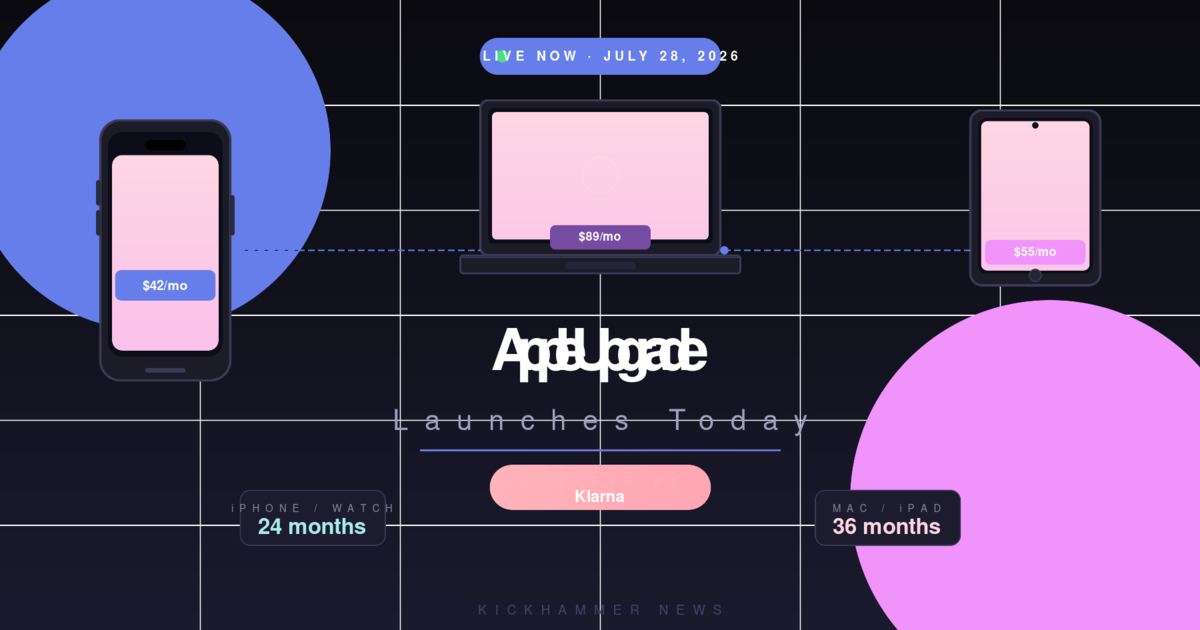
Under the new structure, customers can lease iPhones and Apple Watches on 24-month terms, while Macs and iPads qualify for longer 36-month leases. Enrollment requires only a soft credit check and can be completed in Apple Stores or online. Monthly payments are positioned to be meaningfully lower than Apple’s existing financing options, though the total cost over a full lease term depends on whether customers opt to own the device at the end or simply return it.
The existing iPhone Upgrade Program is being discontinued for new signups. Customers currently enrolled can finish out their terms, but Apple will not accept new applications. Standard device financing is also being wound down in favor of this unified program.
Who’s Backing the Money
The financial architecture of Apple Upgrade is notable for what Apple chose not to do. After shuttering its Apple Pay Later buy-now-pay-later service in 2024 — just one year after launching it — Apple clearly decided that being in the consumer lending business wasn’t core to its strategy. Instead of rebuilding in-house credit infrastructure, the company handed that role entirely to Klarna.
Under the arrangement, Klarna provides the financing rails and absorbs all credit risk. When a customer defaults or fails to return a device, that’s Klarna’s problem, not Apple’s. Apple, for its part, maintains full control over the customer experience: it owns the storefront relationship, determines the upgrade cadence, and keeps the brand equity of the transaction squarely in its ecosystem.
This is an elegant split of risk and reward. Apple gets the subscriber lock-in and accelerated hardware turnover without carrying credit exposure on its balance sheet. Klarna gets a high-frequency, high-volume merchant relationship with the most powerful consumer brand on the planet — a deal that sent KLAR shares surging as much as 11% on the day the Bloomberg report broke on July 21.
Why Now? RAMageddon and Rising Prices
Context matters here. Apple Upgrade isn’t launching in a vacuum — it’s arriving as a direct response to what the tech industry has taken to calling “RAMageddon”: an industrywide shortage of high-bandwidth memory driven overwhelmingly by AI infrastructure demand. Data centers building out GPU clusters have consumed so much DRAM and NAND that the spillover effects have hit consumer electronics hard.
Apple has not been immune. The company already raised prices on its Mac and iPad lines earlier this year, with some configurations jumping by hundreds of dollars. CEO John Ternus — who took over from Tim Cook in April 2026 — acknowledged the strain publicly, calling the supply situation “unsustainable” for pricing. Apple has been careful to hold the line on iPhone pricing so far, but with new models arriving in the fall and component costs still elevated, that position may not hold indefinitely.
Apple Upgrade is the company’s answer to sticker shock. If the new iPhone Ultra carries a price tag that triggers consumer hesitation, a monthly lease payment can paper over that friction. It’s the same psychological trick the auto industry has used for decades: nobody talks about the price of a car, they talk about the monthly payment.
How the Program Actually Works
Consumers have three paths at the end of a lease term. They can upgrade to the latest model (the program’s namesake incentive), pay a remaining balance to own the device outright, or simply return it. Mid-term upgrades are also available — customers can trade into a newer model before the lease expires, though additional fees may apply in some cases.
Not every Apple device qualifies at launch. The iPhone 16, the entry-level iPad, and the Apple Watch SE are initially excluded from the program, suggesting Apple is prioritizing the premium tier of each category where higher price points create the most purchasing friction. AppleCare+ is no longer bundled automatically — it’s now an optional add-on, which effectively lowers the base monthly payment while keeping the warranty revenue stream available as an upsell.
The program launches exclusively in the United States. Apple has offered no timeline for international expansion, which is notable given that the company’s fastest-growing markets — India, Southeast Asia, and parts of Europe — are precisely the places where affordability concerns are most acute.
The Strategic Logic
Apple Upgrade solves multiple problems at once. The most immediate is demand protection during a period of elevated prices and macroeconomic uncertainty. But the deeper strategic value lies in what leasing does to upgrade cycles.
When a consumer buys a phone outright, the upgrade decision is entirely in their hands. They can stretch a device to four or five years without any structural incentive to change. A lease creates a built-in expiration date. At 24 months, the customer faces a deliberate choice point: return, pay to own, or lease a new device. Apple controls the terms of that conversation in a way it never could with outright sales.
Over time, a large installed base of lease customers becomes a predictable, recurring revenue stream in hardware — the kind of visibility that Wall Street has long wanted from Apple’s device segment. Apple has spent years building recurring revenue through Services: the App Store, Apple Music, iCloud, Apple TV+. Apple Upgrade extends that logic into the physical product itself.
Klarna’s Moment
For Klarna, the Apple deal is a watershed. The Swedish fintech went public in 2025 after years of delays, and has been working to reposition beyond its origins as a buy-now-pay-later service for fashion and retail into broader consumer credit. A multi-year hardware leasing partnership with Apple is a categorically different kind of business — stickier, longer-term, and far higher in average ticket size than a $60 clothing purchase.
Analysts at Keefe Bruyette maintained their Outperform rating on KLAR following the announcement, setting a $26 price target and noting that the Apple relationship would “strengthen Klarna’s position with U.S. merchants and deepen its presence in consumer financing.” The 11% single-day stock jump reflects how significant the market views the partnership.
What to Watch
Apple’s July 30 earnings call will be the first real test of how management frames this program to investors. Revenue recognition for leased devices differs from outright sales, and analysts will push for detail on how Apple plans to account for lease income, residual device values, and the financial impact of mid-term upgrades.
The competitive dynamic is also worth tracking. Samsung has offered device financing through various carriers and financial institutions for years, but nothing as structurally integrated as Apple Upgrade. If the program gains traction, it could pressure competitors to respond with similar arrangements — turning hardware leasing from an Apple-specific program into an industry norm.
For now, Apple Upgrade represents the clearest sign yet that the company under John Ternus is willing to rethink the fundamentals of how it sells products. In an environment where AI’s appetite for memory chips is reshaping the cost structure of consumer electronics, making the monthly payment the primary metric — rather than the sticker price — may be the smartest move Apple has made in years.


