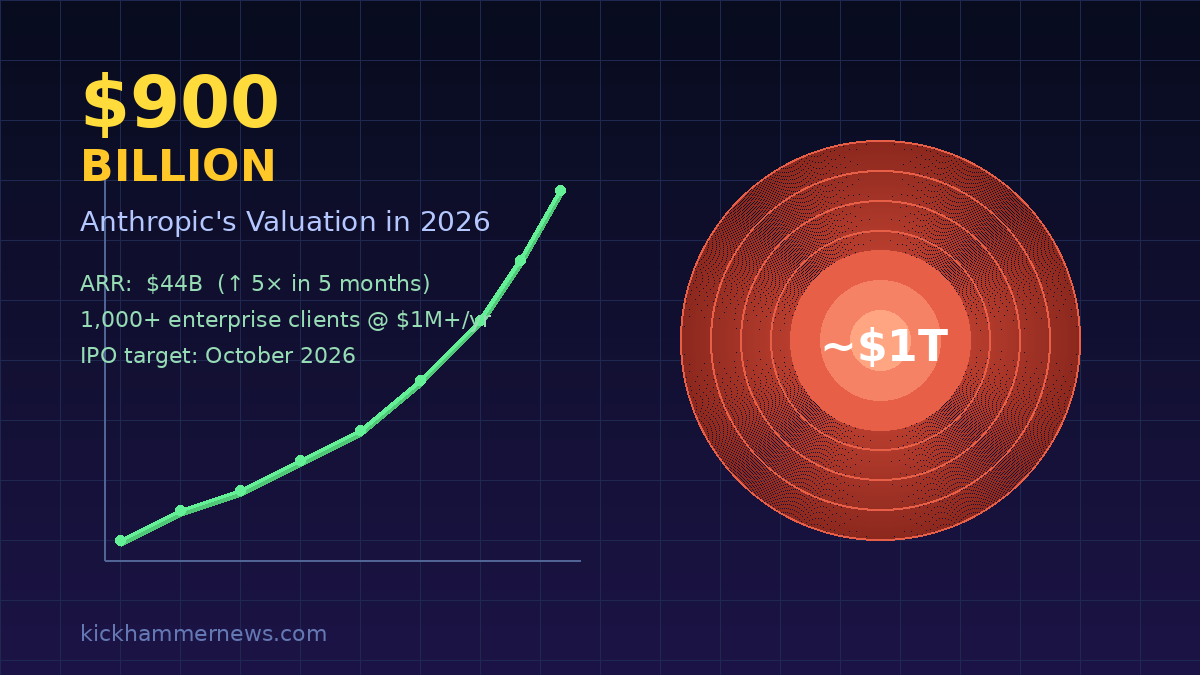
Three months ago, Anthropic closed a $30 billion funding round that valued the company at $380 billion — a figure so large that it shocked even seasoned Silicon Valley veterans. Today, that number looks almost modest. According to Bloomberg and multiple reports confirmed this week, Anthropic is now in advanced talks to raise another round at a valuation exceeding $900 billion, nearly tripling its worth in fewer than 90 days. When the dust settles, the maker of Claude could become the most valuable private company in the history of technology.
To understand how this happened, you need to understand what has occurred inside Anthropic over the first five months of 2026. It is, by virtually any financial measure, the most dramatic growth curve ever recorded in the enterprise software industry.
The Numbers That Broke the Calculator
At the end of 2025, Anthropic’s annualized revenue sat at roughly $9 billion — already impressive for a company less than four years old. By February 2026, it had crossed $14 billion in ARR. Then something remarkable happened: the launch of Claude Code, Anthropic’s agentic coding product, ignited a wave of enterprise adoption that sent revenue soaring in a way that defied conventional growth models.
By May 2026, Anthropic’s annualized revenue had surged past $44 billion — nearly a fivefold increase in five months. More than 1,000 enterprise customers now spend over $1 million per year on Claude services, a figure that doubled in under two months as corporate buyers rushed to lock in capacity. Dario Amodei, Anthropic’s CEO, reportedly described the internal situation as “too hard to handle,” a rare admission from a startup founder that their own success has become a logistics problem.
The new $30 billion raise — expected to close before the end of May — would be co-led by Dragoneer, Greenoaks, Sequoia Capital, and Altimeter Capital, with each firm committing $2 billion or more. When combined with the new investment, Anthropic’s post-money valuation would become the highest ever recorded for a private technology company, surpassing the previous records held by ByteDance and SpaceX.
What the Money Is Actually For
At these revenue levels, the question becomes: why does Anthropic need more money at all?
The answer is compute. Training and running frontier AI models at Anthropic’s current scale requires staggering quantities of GPU processing power, and the company is burning through chips faster than any datacenter partnership can currently supply. Earlier this year, Anthropic struck a landmark deal with SpaceX, securing access to the entire Colossus 1 supercomputer in Memphis — 220,000-plus NVIDIA GPUs consuming 300 megawatts of electricity. By the standards of 2024, this would have been unimaginable infrastructure for a single company. By the standards of 2026, Anthropic says it’s still not enough.
The capital also serves a second purpose: positioning the company ahead of a potential initial public offering. Sources familiar with the matter indicate that Anthropic is targeting an IPO as early as October 2026, with Goldman Sachs and Morgan Stanley among the banks being considered to lead the offering. If successful, it would rank among the most significant market debuts in history — though some investment bankers have privately noted that public market investors may push back on the $900 billion private valuation, with more conservative estimates placing IPO pricing in the $400–500 billion range.
That gap, if it materializes, will be one of the defining stories in tech finance this year.
The Competitive Landscape Is Reshaping Around Anthropic
The rise of Anthropic at this scale has profound implications for every other player in the AI industry.
For OpenAI, the threat is existential in a new way. OpenAI’s own ARR is currently estimated at around $25 billion — substantial, but now trailing Anthropic’s $44 billion. The two companies have different revenue compositions: OpenAI draws more from consumer products like ChatGPT Plus subscriptions, while Anthropic’s business is disproportionately enterprise-driven. Enterprise revenue tends to be stickier, higher-margin, and more defensible. The launch of OpenAI’s own Deployment Company in May was widely seen as a response to Anthropic’s growing dominance in corporate accounts.
For Google, the picture is complicated. Google is both a major investor in Anthropic (having committed $10 billion at the $350 billion valuation earlier this year) and a direct competitor through Gemini. Tomorrow’s Google I/O 2026 keynote is expected to feature a new Gemini model — though early benchmarks suggest it will land “meaningfully short” of Anthropic’s Claude Mythos, which has been dominating enterprise evaluations since its release. Google’s financial interest in Anthropic’s success creates an unusual dynamic: the company may benefit handsomely from an Anthropic IPO even while competing against it.
For Amazon, which has committed $5 billion to Anthropic and hosts Claude models on AWS Bedrock, the relationship remains deeply symbiotic. As Anthropic grows, so does demand for Amazon’s cloud infrastructure. The two companies are bound together in ways that make simple “competitor vs. partner” frameworks inadequate.
The Trillion-Dollar Question
The obvious headline here is that Anthropic may soon be worth a trillion dollars. But the more interesting question is whether the underlying business justifies it.
Bears will point to the compute costs. Running Claude at scale is expensive — some estimates suggest Anthropic spends $0.70 or more in compute for every dollar of revenue at current prices, though that ratio has been improving as the company negotiates better infrastructure deals and improves model efficiency. They’ll also point to the competitive intensity: in AI, the moats that seem deep today can erode quickly as models converge on similar capability levels.
Bulls will counter with the enterprise penetration data. Those 1,000-plus seven-figure customers represent relationships that are difficult and costly to unwind. When a Fortune 500 company rebuilds its internal workflows around Claude, the switching cost is real. Anthropic has also demonstrated a capacity to ship — Claude Opus, Sonnet, and Haiku across multiple versions, Claude Code, and Mythos have all arrived with notable reliability, distinguishing the company from competitors that have struggled with delays.
What’s clear is that Anthropic has achieved something no one fully anticipated three years ago: it has become the financial center of gravity in the AI industry. Not just a promising lab, not just an OpenAI challenger, but a company whose scale and trajectory are forcing everyone else to reckon with the new order.
A trillion-dollar AI company. By October, we may find out whether the public markets agree.
*Sources: Bloomberg, TechCrunch, Yahoo Finance, VentureBeat, Shacknews*


