Tomorrow, at Shoreline Amphitheatre in Mountain View, Google will take the stage for Google I/O 2026 — the company’s biggest developer event of the year. And if the pre-show leaks and executive interviews are any indication, one of the most consequential announcements won’t be about a new AI model. It will be about an operating system that has been quietly brewing inside Google for years: Aluminium OS.
For the roughly 50 million Chromebook users worldwide and the hundreds of millions of Android phone owners who have long wished their devices played better together, Aluminium OS represents the most significant reshaping of personal computing Google has attempted in over a decade. Here is everything we know heading into tomorrow’s keynote.
What Is Aluminium OS?
Aluminium OS is Google’s new Android-based desktop operating system, built from the ground up for laptops and large-screen devices. Google confirmed in mid-2025 that ChromeOS — the browser-first operating system powering Chromebook laptops — would “merge” with Android under one unified platform. Aluminium OS is that platform.
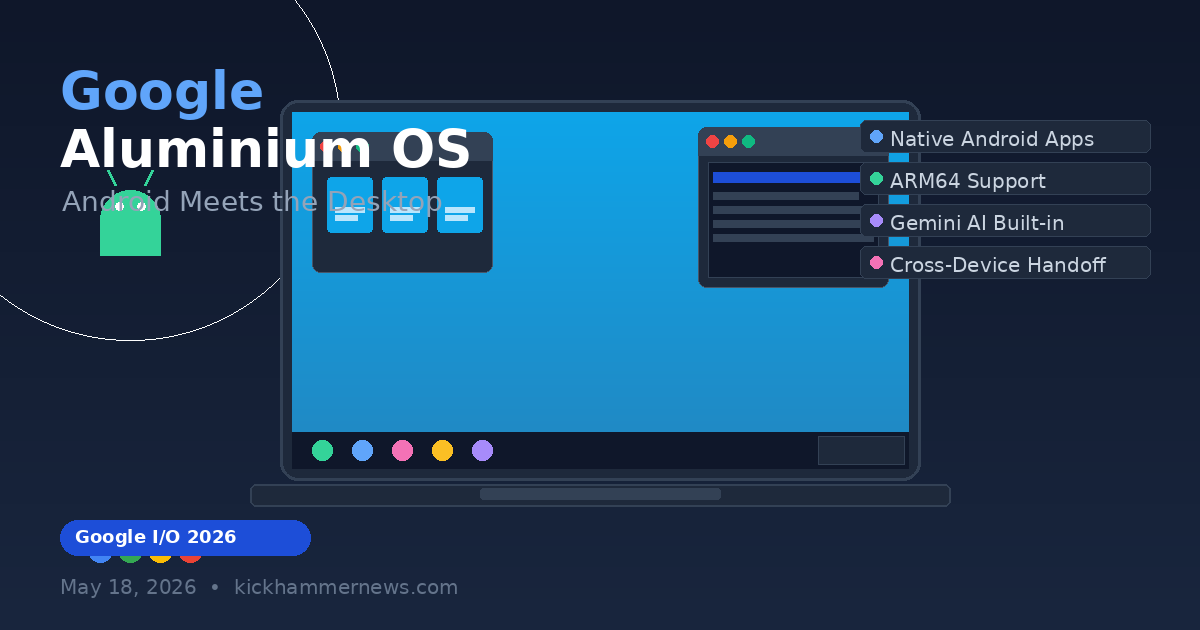
Unlike ChromeOS, which is built on top of Linux and centered on the Chrome browser, Aluminium OS is fundamentally Android. It is built on Android 17 and features a completely custom window manager, a real taskbar, virtual desktops, and native Android app compatibility without any containerization layer. Every app that runs on an Android phone runs on Aluminium OS natively — no translation, no emulation, no sandboxing workarounds.
Google VP Sameer Samat, President of the Android Ecosystem, described the OS at MWC 2026 as something that goes “even beyond what Chrome OS is focused on.” The consumer laptop market — people who need real multitasking, serious app access, and tight integration with their Android phones — is the explicit target.
The Leaks: What Fresh Screenshots Reveal
Hours before Google’s Android Show on May 12, new screenshots of Aluminium OS leaked online — and they revealed several features that had not been publicly confirmed before.
ARM64 support is confirmed. The leaked screenshots showed the Files app labeling the device as “Multi-device ARM64,” a significant disclosure. This means Aluminium OS is being actively developed and tested on ARM-based hardware, which points toward future devices powered by Qualcomm Snapdragon X-class processors — the same chips powering Microsoft’s Copilot+ PCs. For consumers, ARM chips mean longer battery life and thinner, lighter laptops.
Gemini AI is embedded in the Files app. A prompt visible inside the Files application reads: “Use AI to get more from your Files. AI in Files includes advanced search, short file descriptions, and more.” The example shown — an AI that understands the context of a trip to locate a specific flight confirmation document — points to Gemini-powered semantic file search built natively into the operating system. This is not a third-party search widget. It is a first-party AI layer that understands file content and intent.
Full windowed multitasking is a system-wide feature. Earlier leaks showed Chrome running in a windowed mode. The May 11 screenshots show two separate Files app windows open simultaneously, each with standard minimize, maximize, and close controls. The implication is clear: windowed multitasking is not a privilege reserved for specific apps. It is a core OS capability, meaning any Android app should eventually support it.
The OS wants to be recognized as a PC. One subtle but important UI string: the Volume settings panel labels internal audio output as “This computer (internal)” — not “This phone” or “This device.” This deliberate platform-identity choice signals that Google wants Aluminium OS to present itself to users, apps, and accessories as a PC-class device.
Why Google Is Doing This Now
The timing is not accidental. According to Samat, AI is fundamentally changing how people use laptops.
“People had thought this form factor was yesterday’s news,” Samat said in his March 2026 interview with Android Authority. “AI is really bringing the laptop back.”
The argument makes sense. As generative AI tools become more powerful — and as agentic AI assistants begin automating complex, multi-step workflows — the laptop’s large screen, physical keyboard, and desktop-class multitasking make it the ideal interface for working with AI. Smartphones are powerful but cramped. Tablets are portable but awkward for productivity. The laptop, when paired with an AI-native operating system, may be having its renaissance.
Android, meanwhile, has a library of over three million apps, a developer ecosystem that is the largest in the world, and deep integration with Google’s own services — Gmail, Drive, Maps, YouTube, and now Gemini. By bringing Android to the laptop, Google gives Aluminium OS an instant, mature software library that ChromeOS spent years trying to approximate through web apps and Android runtime layers.
There is also a competitive angle. Microsoft’s Windows 11 with Copilot has been aggressively marketed as the AI PC platform of the future. Apple’s macOS and the Apple Silicon chip transition have made MacBooks the aspirational productivity laptop for a significant share of consumers. Google needs a credible answer in the consumer laptop market, and ChromeOS — despite its strengths in education and managed enterprise environments — has never broken through with mainstream consumers.
Aluminium OS is that answer.
What Happens to ChromeOS?
Despite the “merger” language used throughout 2025, Samat was unambiguous at MWC: ChromeOS is not going away.
“Chrome OS has done really well. Its management capability is second to none,” Samat said. “Development for Chrome OS will absolutely continue as is.”
Chromebooks remain dominant in K–12 education in the United States, where their low cost, centralized management tools, and browser-first simplicity make them ideal for school districts managing thousands of devices. That use case is not going away, and Google has no reason to disrupt it.
Instead, Google appears to be pursuing a two-platform strategy. ChromeOS stays focused on browser-led computing, education deployments, and enterprise environments where manageability is the top priority. Aluminium OS targets the broader consumer laptop market — users who want Android apps, tighter phone integration, and a richer desktop experience.
Current ChromeOS devices will continue receiving software updates until they reach their natural end-of-life cycle. No Chromebook users are being stranded. But future consumer-focused laptop hardware from Google’s hardware partners — HP, Lenovo, Acer, and ASUS have all been named in reports — will run Aluminium OS.
Cross-Device Continuity: The iPhone Killer Feature
One of the most compelling promises of Aluminium OS is the cross-device continuity experience. Android 17 introduces Handoff — a feature similar to Apple’s Handoff — that allows users to start an activity on their phone and seamlessly continue it on their laptop. Open a document on your phone on the commute, pick it up on your Aluminium OS laptop when you sit down at your desk.
“A lot of Android users are excited about the ability to have their phone and their laptop interoperate and work better together,” Samat said.
For users who have envied the seamless handoff between iPhone and MacBook — AirDrop, Handoff, iMessage on desktop, Universal Clipboard — the Android ecosystem has lagged behind. Aluminium OS, paired with Android 17’s Handoff API, is Google’s attempt to close that gap and give Android phone users a reason to choose an Aluminium OS laptop over a Windows machine or a MacBook.
Hardware: What to Expect
The leaked screenshots suggest Aluminium OS is being tested on a tablet form factor, adding weight to speculation that the OS will launch across both traditional clamshell laptops and large-screen tablet devices. Qualcomm Snapdragon X-class chips are a likely hardware partner, given the ARM64 confirmation in the leaks.
Hardware partner announcements from HP, Lenovo, Acer, and ASUS are expected at Google I/O. The stable 1.0 release and first retail devices are broadly anticipated for Q2–Q3 2026. A “Googlebook” — Google’s own branded laptop hardware — has also been rumored, positioned as the showcase device for the platform, similar to how the Pixel phones serve as the reference implementation for Android.
What to Watch at Google I/O Tomorrow
Google I/O 2026 kicks off Monday, May 19, at 10am PT. Based on the pre-show signals, here is what to watch for regarding Aluminium OS:
Official name confirmation. The OS has been referred to internally and in leaks as “Aluminium OS,” but Google has not used the name in any official communications. Tomorrow may be the first public use of the name.
Hardware partner announcements. Expect OEM partners to be named, along with pricing signals for first-generation Aluminium OS devices.
Release timeline. A Q3 2026 window has been widely anticipated. An official date would put the product on a firm countdown.
Gemini AI integration depth. The leaked Files app AI feature is just one piece. Expect Google to show how Gemini is woven throughout the OS — in search, in the assistant, in creative tools, and in agentic workflows.
ChromeOS transition details. Google will likely clarify the long-term roadmap for ChromeOS users and how, if at all, existing Chromebooks fit into the Aluminium OS future.
The Bigger Picture
Aluminium OS is not just a new version of ChromeOS, and it is not just Android for laptops. It is Google’s attempt to redefine what a personal computer is in an era where AI is the primary interface, Android is the world’s largest app platform, and the boundary between phone and laptop is dissolving.
If the leaked features — native ARM64 support, Gemini-powered file search, system-wide windowed multitasking, and cross-device Handoff — are representative of the final product, Aluminium OS has the ingredients to be a serious competitor in the consumer laptop market for the first time.
Tomorrow’s keynote will tell us whether Google executes on that promise. But one thing is already clear: the personal computer is changing, and Google intends to be at the center of that change.
Google I/O 2026 begins Monday, May 19, at 10am PT. The keynote will be livestreamed at io.google.