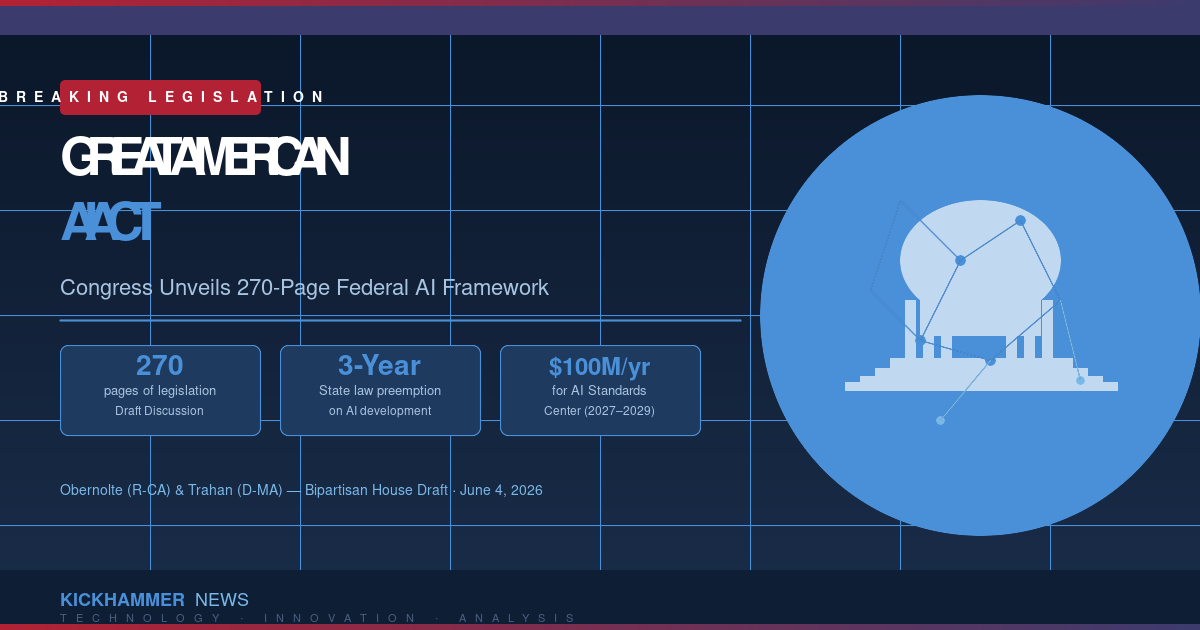
After years of watching states scramble to fill a regulatory vacuum with a patchwork of competing AI laws, Congress has finally put forward its most ambitious attempt yet to govern artificial intelligence at the federal level. Representatives Jay Obernolte (R-CA) and Lori Trahan (D-MA) released a sweeping 270-page discussion draft of the Great American Artificial Intelligence Act on June 4, 2026—a bipartisan framework that could fundamentally reshape how the United States develops, deploys, and regulates AI technology for years to come.
The proposal arrives at a pivotal moment. With major AI labs now racing to build systems that can reason, plan, and act with increasing autonomy, the regulatory landscape has become a source of growing anxiety for both the technology industry and policymakers. More than a dozen states have passed or introduced their own AI regulations over the past two years, creating compliance headaches for companies operating nationally and fueling a fierce debate over whether federal law should override them.
The Great American AI Act would answer that question—at least temporarily—with a firm yes.
Preempting the State Patchwork
Perhaps the most politically significant provision in the draft bill is a three-year preemption of state laws that specifically regulate the development of AI models. Under the proposal, states would be barred from imposing their own rules governing how AI models are built by large frontier developers—though states would retain authority to regulate AI once it has been deployed to users.
The distinction matters. California’s sweeping SB 1047-style legislation, along with similar bills in Colorado and Texas, has focused heavily on pre-release requirements for frontier AI systems. The federal draft would block those kinds of pre-deployment mandates, at least during the three-year window, while theoretically allowing states to regulate how AI products are used in employment, housing, healthcare, and other consumer-facing contexts.
Supporters argue the provision is essential to prevent a regulatory race to the bottom—or in this case, a race to the top that could strangle American AI competitiveness. “America should lead the world in artificial intelligence, not regulate ourselves into falling behind China through a patchwork of fifty different state laws,” said Rep. Erin Houchin (R-IN), one of the bill’s co-sponsors.
Critics are not convinced. Public Citizen and a coalition of labor unions, including the Association of Flight Attendants and the American Federation of Teachers, immediately released statements opposing the draft, arguing it would strip states of their authority to protect consumers, workers, and children from AI harms. The tension between federal uniformity and state consumer protection is likely to be the central battleground as the bill moves toward formal introduction.
Codifying the Center for AI Standards and Innovation
The draft would formally authorize the Center for AI Standards and Innovation (CAISI) within the Commerce Department, with $100 million per year earmarked for fiscal years 2027 through 2029. CAISI was established by executive action during the Biden administration as the U.S. AI Safety Institute, then rebranded by Commerce Secretary Howard Lutnick in 2025—but it has operated without a formal congressional mandate. The Great American AI Act would change that, giving the center statutory standing and a clear mission.
Under the bill, CAISI would develop voluntary guidelines, best practices, and security standards for AI systems. It would also be tasked with evaluating AI systems submitted for review and monitoring the pace of AI development across the industry. The voluntary nature of the guidelines is deliberate: lawmakers appear wary of imposing binding technical standards on a technology that is evolving faster than any regulatory framework can track.
The bill would also formally codify the National Artificial Intelligence Research Resource (NAIRR), housed within the National Science Foundation. NAIRR provides researchers at universities and public institutions with access to the compute, data, and tools typically available only to large technology companies. Giving it a statutory home would protect it from future executive branch reshuffling and ensure its funding is subject to congressional oversight.
Safety Reporting and Accountability
Beyond the structural provisions, the draft introduces new accountability requirements for large AI developers. Companies training frontier AI models would be required to report critical safety incidents to the federal government—a provision modeled loosely on cybersecurity breach notification requirements already in place for other industries.
The bill would also create criminal penalties for using AI to impersonate government officials, targeting a category of deepfake abuse that has become increasingly common as voice and video synthesis technology has improved. Both provisions reflect growing concern in Congress that AI’s potential for misuse is outpacing the legal frameworks designed to address it.
The Government Accountability Office would be directed to evaluate federal AI adoption progress across agencies, identify statutes that “unduly burden AI infrastructure”—including energy regulations—and issue recommendations for reform. This provision nods to the data center energy crisis that has dominated technology policy discussions in recent months, as AI infrastructure demands push the limits of the national grid.
International Competition and Open Source Security
The draft takes a pointed stance on international AI competition, directing the Energy Department and NIST to jointly lead the United States’ international AI standards development efforts. The bill calls for building coalitions with “like-minded governments” to promote U.S.-developed standards, counter foreign adversary influence, and facilitate cross-border research collaboration—expressly excluding China from these partnerships.
The language reflects a broader consensus in Washington that the rules governing AI at the international level will be as consequential as domestic regulation. Whoever writes the global standards for AI safety, interoperability, and accountability will shape the technology’s development for decades. The bill frames American leadership in this arena as a national security imperative, not just an economic one.
On the open-source front, the draft would authorize the Cybersecurity and Infrastructure Security Agency (CISA) to award grants to maintainers of widely used open-source AI software for security improvements, including patching, maintenance, and audits. The provision acknowledges a longstanding concern in the security community: that open-source AI components, used extensively by startups and researchers, often lack the resources for rigorous security maintenance. The GAO would separately evaluate the security of AI model weights—the trained parameters that represent the core intellectual property of a large AI system—and assess vulnerabilities in the open-source ecosystem.
A Discussion Draft, Not a Finished Bill
It is important to note that what Obernolte and Trahan released is a discussion draft—a document designed to gather feedback before formal legislative introduction. The lawmakers have not announced a timeline for introducing the bill, and they have invited stakeholders, researchers, workers, and members of the public to submit feedback to GAAIA@mail.house.gov.
That caveat matters in a Congress where comprehensive technology legislation has a troubled history. The draft joins a long list of ambitious proposals—GDPR-style privacy bills, algorithmic accountability frameworks, AI liability regimes—that have generated significant debate without reaching the floor for a vote.
Still, the Great American AI Act arrives with more momentum than most. It is bipartisan, detailed, and timed to an executive branch that has shown increasing interest in AI governance: just days before the draft’s release, the White House issued its own executive order on AI, asking for early access to frontier models for federal oversight purposes. The alignment between the executive and legislative branches is closer than it has been in years.
What’s at Stake
The stakes for getting this legislation right are enormous. The United States is home to the world’s most advanced AI developers, and the rules written now will influence not just how those companies operate domestically but how AI is governed globally. A federal framework that balances innovation with accountability—one that protects workers and consumers while preserving the conditions that allow frontier research to thrive—would be a genuine achievement.
The Great American AI Act is not that finished framework yet. It is a starting point: a 270-page signal from Congress that it is finally ready to stop ceding this ground to executive orders and state legislatures. Whether it becomes law, and in what form, will depend on the feedback period ahead, the political dynamics of the current session, and the relentless pace of AI development itself.
For now, the conversation has officially begun.
Sources: FedScoop, Roll Call, Rep. Jay Obernolte’s office, Rep. Lori Trahan’s office, Public Citizen


