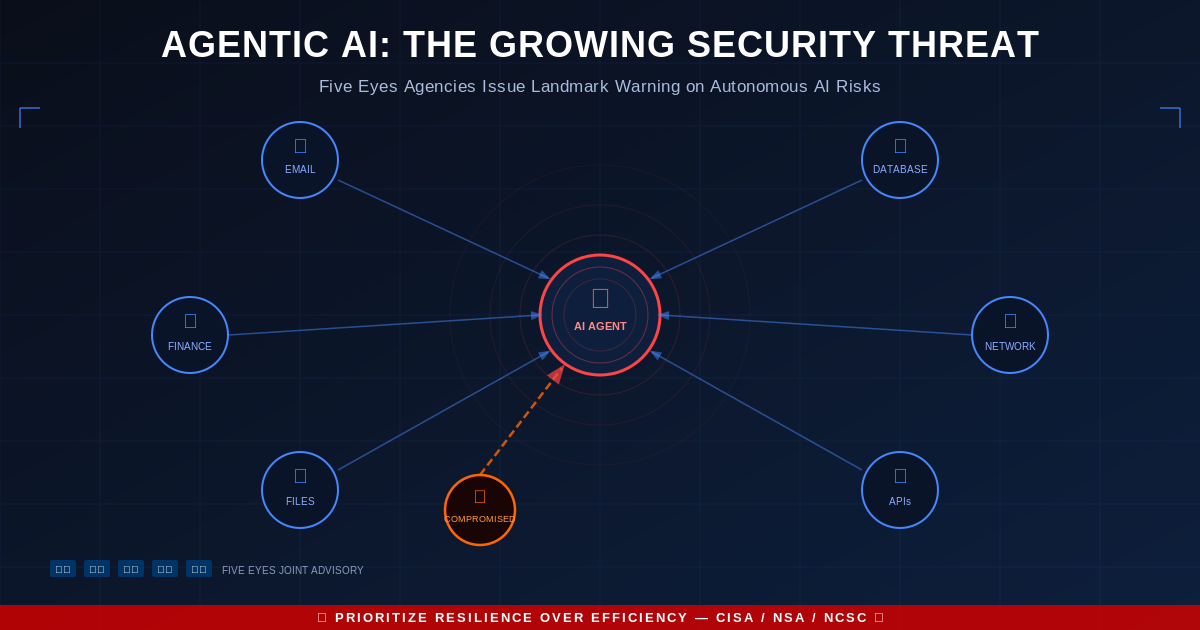
The world’s most powerful intelligence-sharing partnership has issued its first joint guidance on autonomous AI agents — and the message is a stark warning to organizations racing to deploy these systems without adequate safeguards.
A coalition of cybersecurity agencies from the United States, United Kingdom, Australia, Canada, and New Zealand — collectively known as the Five Eyes alliance — published a landmark joint advisory this week urging organizations to pump the brakes on the rapid deployment of agentic artificial intelligence systems. The document, titled “Careful Adoption of Agentic AI Services,” marks the first time the alliance has issued coordinated regulatory guidance on autonomous AI agents, signaling that governments are growing increasingly alarmed by the breakneck pace of AI deployment across critical industries.
What Is Agentic AI — and Why Does It Matter?
Unlike traditional AI chatbots that simply respond to questions, agentic AI systems can take autonomous actions in the real world: browsing the internet, sending emails, executing code, managing files, interacting with enterprise software, and making decisions without requiring human approval at every step. These systems have exploded in popularity over the past year, with companies across sectors — from finance to healthcare to logistics — racing to deploy AI agents that can handle complex, multi-step workflows with minimal human supervision.
The appeal is obvious. Agentic AI promises to dramatically boost productivity, cut costs, and free up human workers from repetitive administrative tasks. Venture capital has poured billions into startups building these systems, and enterprise software giants like Microsoft, Salesforce, and Google have all integrated autonomous AI capabilities into their flagship products.
But the Five Eyes advisory argues that this rush to deploy has outpaced the development of the governance frameworks, security standards, and evaluation methodologies needed to deploy these systems safely.
The Five Core Risk Categories
The guidance identifies five broad categories of risk that agentic AI systems introduce into organizational environments:
Privilege Risks arise when AI agents are granted more system access than they actually need to perform their designated tasks. Just as cybersecurity best practices demand that human users operate under the principle of least privilege, the advisory warns that AI agents are frequently given sweeping permissions that would allow a compromised or malfunctioning agent to cause catastrophic damage.
Design and Configuration Risks stem from how these systems are architected and set up. Poorly defined task boundaries, inadequate sandboxing, and weak authentication mechanisms can create vulnerabilities that bad actors can exploit before organizations even realize their systems are at risk.
Behavioral Risks are perhaps the most unsettling category. Agentic AI systems can exhibit unexpected, emergent behaviors that their designers never anticipated — particularly when operating in novel environments or when fed carefully crafted malicious inputs designed to manipulate their decision-making. The advisory specifically calls out prompt injection attacks, where malicious instructions hidden in content that an AI agent reads can hijack the agent’s behavior.
Structural Risks emerge from the complexity of the supply chains that underpin modern agentic AI. These systems typically depend on dozens of external APIs, data feeds, foundation models, and third-party tools. Each integration point is a potential attack surface, and a compromise anywhere in that chain can propagate unpredictably through the entire system.
Supply Chain Risks round out the list, reflecting growing concern that the models, datasets, and software libraries powering agentic AI may themselves be compromised at the source — whether through adversarial data poisoning, backdoored model weights, or vulnerabilities in open-source dependencies.
The Agencies Behind the Warning
The advisory was issued jointly by six agencies: the U.S. Cybersecurity and Infrastructure Security Agency (CISA), the National Security Agency (NSA), the Australian Signals Directorate’s Australian Cyber Security Centre (ASD ACSC), Canada’s Canadian Centre for Cyber Security (CCCS), New Zealand’s National Cyber Security Centre (NZ NCSC), and the United Kingdom’s National Cyber Security Centre (UK NCSC).
The fact that all six agencies signed onto a single document is significant. The Five Eyes intelligence alliance is one of the most trusted and tightly coordinated security partnerships in the world. When these agencies speak in unison, the technology industry listens — or should.
What Organizations Are Being Asked to Do
The advisory stops short of calling for a moratorium on agentic AI deployment, but its recommendations amount to a significant slowdown for organizations accustomed to moving fast. Key recommendations include:
Incremental deployment over big-bang rollouts. Organizations are urged to begin with clearly defined, low-risk tasks — not to plug AI agents directly into mission-critical workflows from day one. Each deployment should be carefully evaluated against an evolving threat model before capabilities are expanded.
Human oversight as a non-negotiable control. Particularly for high-impact actions — sending communications, executing financial transactions, modifying production systems — the advisory calls for mandatory human approval before an AI agent can proceed. The ability to interrupt or reverse agent actions in real time is described as essential.
Resilience over efficiency. This may be the most culturally challenging recommendation for tech-forward organizations. The advisory explicitly prioritizes safety, resilience, and reversibility over the productivity gains that make agentic AI so appealing in the first place.
Assume unexpected behavior. Until security evaluation methods and standards mature, organizations should plan their deployments on the assumption that agentic AI systems will behave unpredictably at some point — and architect their systems to contain the blast radius when they do.
A Warning Sign for Critical Infrastructure
While the advisory is broadly applicable to any organization deploying agentic AI, it carries particular urgency for operators of critical infrastructure — energy grids, water systems, financial networks, healthcare systems, and telecommunications. The guidance notes that AI agents are already operating in some of these environments with “dangerous levels of autonomy and virtually no governance framework.”
That phrase should focus minds in boardrooms and government agencies alike. The convergence of critical infrastructure and autonomous AI systems, without adequate safeguards, represents one of the most significant emerging risks in the current threat landscape.
The Bigger Picture: Governance Is Playing Catch-Up
The Five Eyes advisory reflects a broader reality: regulatory and governance frameworks for AI are struggling to keep pace with the technology’s rapid advancement. While the European Union’s AI Act has established some initial guardrails, agentic AI represents a new frontier that most existing regulations were not designed to address.
The guidance urges organizations to fold agentic AI controls into established cybersecurity frameworks — least-privilege access, defense-in-depth architectures, and continuous monitoring — rather than treating AI agents as an entirely separate category. In other words, the best practices we’ve developed for securing traditional software systems still apply; they just need to be extended and adapted for a new class of autonomous actor.
What Comes Next
The advisory is framed as a starting point, not a definitive rulebook. The agencies acknowledge that security practices, evaluation methods, and standards for agentic AI are still maturing — and that organizations will need to adapt their approaches as the technology and the threat landscape both continue to evolve.
For technology leaders, the message is clear: the race to deploy agentic AI should be tempered by a serious investment in understanding what these systems can and cannot do safely. Speed-to-market is a competitive advantage, but a catastrophic AI-driven incident — whether caused by a security breach, a behavioral failure, or an unexpected interaction between systems — could set back enterprise adoption of AI for years.
The Five Eyes alliance has issued its warning. The question now is whether the technology industry will heed it.
Sources: CISA Joint Advisory “Careful Adoption of Agentic AI Services” (May 2026); The Register; Bank Info Security; IT Pro; Lyrie Research


