Meta’s annual developer conference delivered a sweeping hardware refresh on Wednesday, with CEO Mark Zuckerberg taking the stage to announce an entirely new category of device — ultra-thin VR Glasses — alongside upgraded Ray-Ban Meta smart glasses, a camera-free audio variant, and a miniaturized AI pendant that puts the company’s Muse agent on a keychain. The announcements signal Meta’s most aggressive push yet into the wearables market, and represent a direct challenge to Apple, Snap, and Google in what is shaping up to be the decade’s fiercest battle for real-world AI computing dominance.
Meta VR Glasses: The Company’s Most Ambitious Hardware Yet
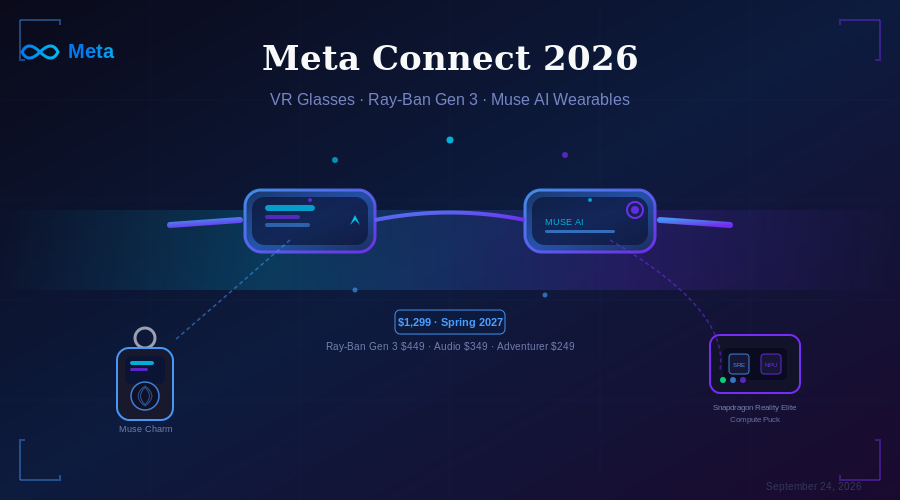
The headline product of Meta Connect 2026 is the Meta VR Glasses, a device Zuckerberg described as “the first true spatial computer for everyone.” Weighing approximately 100 grams on the face — roughly five times lighter than the Quest 3 headset — the glasses achieve their svelte profile by offloading processing to a small compute puck worn on the belt or kept in a pocket. The puck houses Qualcomm’s new Snapdragon Reality Elite chipset, and the two communicate wirelessly so there’s no cable tethering you to the experience.
Display quality is a genuine step forward. The Meta VR Glasses use micro-OLED panels delivering 37 pixels per degree of resolution, full-color passthrough for mixed reality use, and support for Dolby Vision HDR content. For serious film fans, ILM’s Disney Immersive Cinema app will offer VR-enhanced versions of blockbusters including Avengers: Infinity War and Star Wars: A New Hope in spring 2027, alongside Disney+ 3D streaming beginning in November.
At launch, the glasses support 75 hand-gesture-controlled games — including a significantly updated version of Beat Saber featuring a new narrative campaign, hand tracking, and a music-driven “Flux” mode — with Touch Plus controllers supported for users who prefer tactile input. Battery life runs up to three hours of continuous mixed-reality playback, with 45-watt fast charging returning the device to full in under an hour.
Priced at $1,299.99 and arriving in spring 2027, the Meta VR Glasses won’t be an impulse purchase. But they represent a meaningful bet that consumers are ready for an always-on spatial computing layer — one that happens to look like a pair of glasses rather than a ski mask.
Ray-Ban Meta Gen 3: Smarter, Sharper, More Social
The third generation of Meta’s partnership with Luxottica arrives today in 27 frame-and-lens combinations, with the company leaning into both hardware improvements and social cachet. The Gen 3 upgrades the camera to 12 megapixels with 3K video capture, extends battery life by an hour over its predecessor to a full nine hours, and introduces a six-microphone array that the company claims reduces background noise by more than 90 percent — a meaningful improvement for hands-free calls in busy environments.
New frame styles include the Aviator and a Zena cat-eye silhouette designed in collaboration with Italian designers, alongside limited editions featuring Kylie Jenner and BLACKPINK’s Lisa, priced from $399. The new action button on the temples provides quick access to Muse AI without requiring a voice command — useful for discreet public use.
Starting at $449, the Ray-Ban Meta Gen 3 builds on the commercial success that made its predecessor one of the surprise hardware hits of the mid-2020s. With millions of units already sold across Gen 1 and Gen 2, the ecosystem is no longer a niche experiment — it’s a platform.
Ray-Ban Meta Audio: A Camera-Free Option for the Privacy-Conscious
Not everyone wants a camera mounted to their face, and Meta is directly addressing that hesitation with the Ray-Ban Meta Audio — a pair of smart glasses featuring spatial audio, Muse AI integration, and a 12-hour battery life, but with the camera hardware removed entirely.
Available in Clubmaster and Burbank styles across 23 color and lens combinations, the Audio variant weighs just 43 grams and includes a carry case that provides an additional 48 hours of charge. Pre-orders open now at $349, with units shipping October 13. The timing is deliberate: it positions the Audio as a gift consideration well ahead of the holiday shopping season.
Support for prescription lenses is confirmed, and the company is targeting hearing health as a major use case. Later this year, a software feature enabling mild-to-moderate hearing enhancement — FDA-cleared as an over-the-counter hearing aid — will expand from existing Ray-Ban Display units to the Gen 3 and Audio lines. The feature costs $149.99 as a one-time purchase, or is included with a Meta One subscription.
Meta Adventurer: A Budget Entry Point
For shoppers who want the Ray-Ban cachet without the Gen 3 price tag, Meta is introducing the Meta Adventurer — its own-brand smart glasses at $249, with pre-orders opening today and units shipping October 23. The Adventurer shares the core AI and audio features of the Ray-Ban line but uses Meta’s in-house frame design rather than the licensed Luxottica aesthetics. A limited-edition Meta Fury variant with a clear frame and mirrored lenses is also teased, though pricing was not confirmed.
Muse Charm: Your AI Agent in Your Pocket
The most unexpected announcement of Meta Connect 2026 may be the Muse Charm — a small pendant that puts the company’s Muse AI agent on a keychain. Featuring a small display, built-in speakers, microphones, and a fingerprint sensor for secure access, the device is designed for the moments when you’re not wearing smart glasses but still want Muse at hand.
The Muse AI agent itself also received a major expansion in capabilities. Shopping integrations now span Walmart, Best Buy, and Sephora, letting users buy products on the fly with a voice command. Productivity connections cover Box cloud storage and GitHub repositories. On Mac, Muse now supports computer use — observing the screen and taking actions on your behalf — a feature that puts it in direct competition with Anthropic’s Claude Computer Use and OpenAI’s Operator service.
Muse will also power hologram video calling via WhatsApp, generating a digital avatar that represents users during calls in a way that Zuckerberg described as “the first step toward truly presence-based communication.”
The Bigger Picture: Spatial Computing Gets Real
Meta Connect 2026 is best understood not as a product event but as a declaration of intent. The company has now built a hardware ladder that spans $249 to $1,299, covering every major consumer use case from passive audio to full spatial computing. Across this portfolio, the Muse AI agent serves as the common thread — the software layer that makes every device more useful and creates the habit loop that keeps users inside Meta’s ecosystem.
The navigation features now available on the Ray-Ban Display — cycling routes, public transit departures, landmark-based directions — suggest that Meta sees the glasses as a smartphone replacement for many daily tasks, not merely a companion device. With more than 100 live sports events annually coming to the VR Glasses via ESPN Immersive Sports, the company is also making a serious bid for living-room entertainment that moves with you.
For competitors, the picture is complicated. Apple’s Vision Pro established that high-end spatial computing is technically achievable but commercially limited at $3,499. Meta is now offering meaningful spatial computing at $1,299, with a credible roadmap to further reductions. Snap announced its own AR Specs just yesterday; Google’s Aluminium OS ambitions remain largely software-focused. The race for the face is accelerating, and today Meta made clear it intends to be first across the finish line.
The Meta VR Glasses ship in spring 2027 at $1,299.99. Ray-Ban Meta Gen 3 is available now from $449. Ray-Ban Meta Audio and Meta Ray-Ban Display international pre-orders open today, shipping October 13. The Meta Adventurer ships October 23 at $249. The Muse Charm is expected in fall 2026 with pricing to be announced.
Sources: Engadget, Tom’s Guide, VR.org


