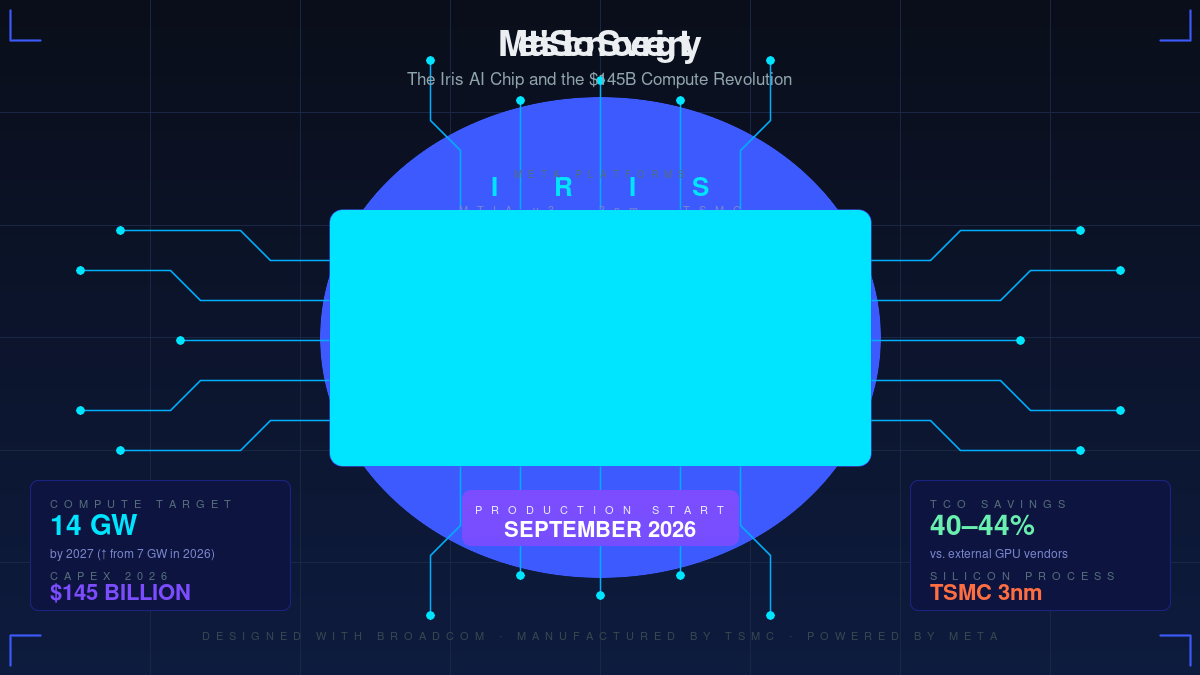
Meta Platforms is preparing to manufacture its most ambitious custom processor yet — an in-house AI accelerator codenamed “Iris” — with production set to begin in September 2026. The move signals a decisive shift in how the world’s largest social media company plans to power its AI future: not by buying compute from Nvidia, but by building it from scratch.
The Chip Behind the Curtain
Iris is the third generation of Meta’s MTIA program — Meta Training and Inference Accelerators — a multi-year initiative to reduce the company’s dependence on third-party AI chips. Designed in collaboration with Broadcom and manufactured by Taiwan Semiconductor Manufacturing Company (TSMC) on its cutting-edge 3-nanometer process node, Iris is an Application-Specific Integrated Circuit (ASIC) optimized for recommendation ranking, advertising systems, and increasingly, the heavy-duty AI inference and training workloads that underpin Meta AI, the company’s fast-growing assistant platform.
What makes the Iris launch particularly notable is how cleanly it arrived. According to an internal memo reviewed by Reuters in early July, the chip completed its initial silicon validation testing in just six weeks — a remarkably compressed timeline for a chip of this complexity — and did so without any major design anomalies. In the hardware world, taping out a chip without significant bugs is a rare feat; doing it in six weeks borders on extraordinary.
A War for Compute Sovereignty
The bigger story isn’t just the chip — it’s what it represents. Meta’s 2026 capital expenditure guidance sits between $125 billion and $145 billion, most of it pointed directly at AI infrastructure. The company’s internal roadmap calls for deploying 7 gigawatts of computing capacity this year, then doubling that to 14 gigawatts by 2027. To put that in perspective: 14 gigawatts is roughly the output of fourteen nuclear power plants running continuously, all dedicated to keeping Facebook feeds relevant and Meta AI competitive.
This is not a company hedging its bets. It is a company making an all-in wager that controlling its own silicon is the only sustainable path to AI supremacy — or at least to not bleeding out on Nvidia GPU invoices.
Meta estimates that deploying its own MTIA chips versus buying equivalent capacity from external vendors delivers a 40 to 44 percent reduction in total cost of ownership (TCO). At the scale Meta operates — hundreds of thousands of servers across dozens of data centers globally — that efficiency gap translates to billions of dollars in annual savings. Iris isn’t just a chip; it’s a cost structure.
The MTIA Roadmap: Moving at Chip Speed
Meta isn’t planning to pause and admire Iris. The MTIA program runs on a relentless cadence. Following Iris (MTIA v3), the company has already mapped out three successor generations:
- MTIA v4 (Santa Barbara) — expected in 2027
- MTIA v5 (Olympus) — also targeted for 2027
- MTIA v6 (Universal Core) — planned for 2028
The intent is to release a new custom AI processor roughly every six months through 2027, a pace that would challenge even established chip companies. The “Universal Core” designation for v6 hints at a more generalized architecture — one that may eventually handle a wider range of workloads beyond Meta’s current recommendation-heavy profile.
Why Now? The Nvidia Problem
To understand what’s driving Meta’s chip ambitions, you have to understand the Nvidia problem that every major hyperscaler is quietly grappling with. Nvidia’s H100 and B200 GPU families remain the gold standard for AI training, but they come with gold-standard price tags — and constrained supply. During the height of the AI buildout in 2024 and 2025, hyperscalers were paying premiums well above list price just to secure allocations.
More fundamentally, general-purpose GPUs are exactly that — general purpose. They’re brilliant at a wide range of matrix operations, but they carry overhead and architectural complexity that a company like Meta, running predictable, well-defined workloads at colossal scale, simply doesn’t need. ASICs strip that overhead away. They do fewer things, but they do those things with brutal efficiency.
Google learned this lesson early with its Tensor Processing Units (TPUs), which have been powering its AI stack since 2016. Amazon followed with Trainium and Inferentia for AWS. Apple has built its entire device strategy around custom silicon. Now Meta, after years of incremental custom chip work, is making its most serious move yet.
What Iris Means for the AI Industry
The Iris announcement is a milestone in what analysts have been calling the “silicon sovereignty” era — a period in which the largest AI consumers are becoming, to varying degrees, their own chip companies. This trend has profound implications.
For Nvidia, the math is straightforward: every watt of compute that Meta runs on Iris is a watt that doesn’t run on an H100 or B200. At 14 gigawatts of custom capacity, Meta is carving out a meaningful slice of the addressable market that Nvidia might otherwise have claimed. Nvidia remains indispensable for cutting-edge training workloads where custom ASICs struggle to compete, but the inference and ranking markets — where Meta’s chips excel — are enormous.
For the broader chip ecosystem, Meta’s success would further validate the ASIC-over-GPU playbook for inference at scale, potentially accelerating similar moves by other large-scale AI operators. Broadcom, which is co-designing Iris, stands to benefit from being the go-to partner for hyperscaler custom silicon — a role it has cultivated alongside Google, Apple, and now Meta.
For the AI industry writ large, Meta’s infrastructure expansion is a signal about where the competitive center of gravity lies. Intelligence is no longer differentiated purely by model architecture or data quality — it is increasingly determined by who can deploy the most compute at the lowest cost, fastest. Meta’s $145 billion capex bet is, at its core, a bet that raw infrastructure scale will remain a decisive competitive advantage in the AI era.
The Road to September
Meta’s Iris chip enters production in just weeks. Between now and broad deployment, the company will work through manufacturing ramp-up at TSMC, logistics, integration testing at the rack and cluster level, and software stack optimization. The fact that silicon validation passed cleanly suggests the hardest part — getting the chip to work at all — is done.
What remains is the industrial challenge of producing these chips at the volume required to scale from 7 to 14 gigawatts of capacity in under twelve months. That’s not a chip problem anymore. That’s a manufacturing, supply chain, and deployment problem — and it’s one Meta appears ready to tackle.
Silicon sovereignty, it turns out, isn’t free. But at 40 to 44 percent TCO savings, it might just be worth $145 billion.
Sources: Reuters (internal Meta memo, July 2026), TechDogs, FullStackEvolved, MLQ News, Electronics Weekly, Data Center Dynamics


