July 27, 2026 | Windows • Security • Enterprise AI
In July 2026, Microsoft did something unprecedented: it shipped 622 security patches in a single month. That is three times the June record, more CVEs in one release than most vendors publish in an entire year, and enough to prompt Dustin Childs, head of threat awareness at Trend Micro’s Zero Day Initiative, to call it “the mother of all releases.” The year-to-date CVE count from Microsoft now exceeds every previous full-year total on record.
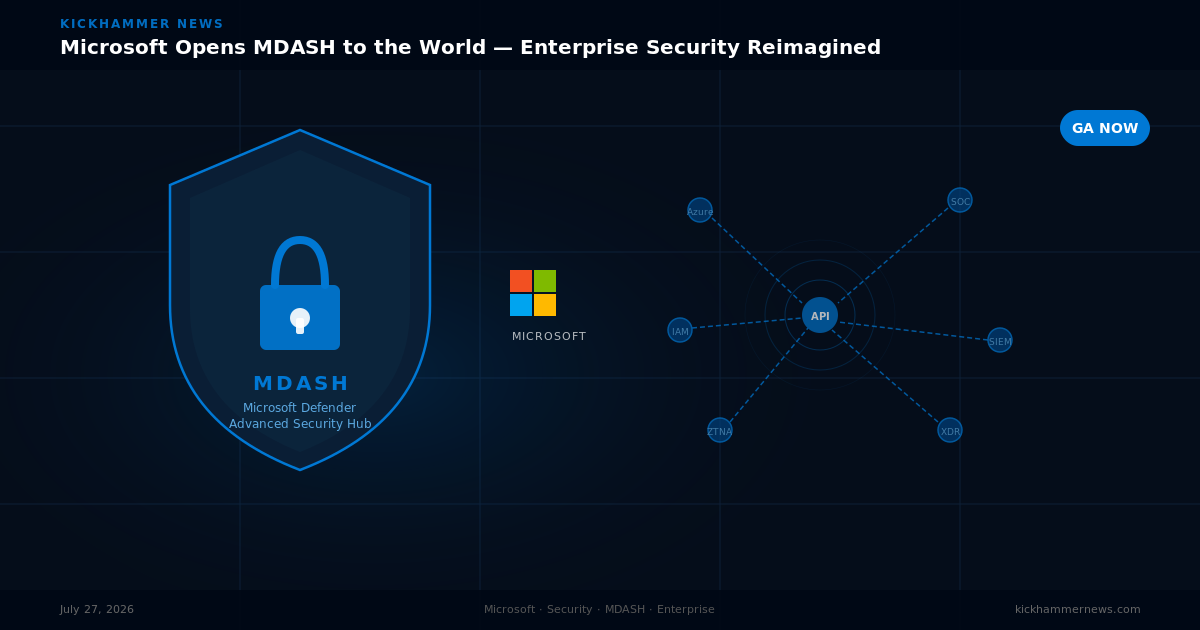
The engine behind the explosion is not a team of thousands of security researchers working overtime. It is MDASH — the Multi-Model Agentic Scanning Harness — Microsoft’s internally developed AI vulnerability scanner. And in July, Microsoft made two decisions that will reshape enterprise security for the rest of the decade: it opened MDASH to public preview, letting outside security teams run the same scanner against their own code, and it disclosed plans for Project Perception, a commercial cybersecurity platform set to launch before the end of July that packages the multi-model approach for enterprise deployment.
What MDASH Actually Does
MDASH is not a traditional static analysis tool. It is an orchestration layer that routes vulnerability-analysis tasks across multiple large language models, including models from Microsoft, OpenAI, and Anthropic. Once candidate vulnerabilities are identified, a debate mechanism pits models against each other to eliminate false positives. Only findings that survive multi-model scrutiny reach a human engineer for final validation.
The result is a dramatically higher signal-to-noise ratio than conventional scanners produce. Microsoft credits MDASH with discovering 16 Windows networking and authentication vulnerabilities in the July Patch Tuesday batch alone, including several critical remote code execution flaws that would not have surfaced through traditional tooling for months, if ever.
Pavan Davuluri, Microsoft’s executive vice president of Windows + Devices, described the architecture plainly: “A scanner pipeline scans critical binaries and validates candidates using multi-model debate across multiple model families.” The phrase “multiple model families” is the key. This is not different versions of the same model — it is architecturally distinct models from competing providers, deliberately chosen because no single AI excels at every security task.
Static analysis of C++ memory corruption, logic flaws in JavaScript APIs, and authentication bypass patterns in Active Directory configurations each require different capabilities. MDASH routes each job to the model best suited for it and uses the disagreements between models to surface the findings most likely to be real.
Project Perception: Bringing the Platform to Everyone
MDASH started as an internal Microsoft tool. Project Perception is how Microsoft plans to sell the concept to every enterprise. According to reporting from The Information, the platform routes vulnerability-analysis tasks among models from Microsoft, OpenAI, and Anthropic, selecting the least expensive model capable of handling each specific job. The goal is delivering Anthropic Mythos-level bug detection at a price point accessible to enterprises that are not among Mythos’s roughly 50 approved Project Glasswing partner organizations.
The context matters here. Anthropic’s Claude Mythos Preview — the current capability benchmark in AI vulnerability hunting — autonomously found 271 vulnerabilities in Firefox and generated working exploits for 181 of them. It has identified over 10,000 high and critical-severity vulnerabilities across its partner organizations. But access is restricted by invitation only. OpenAI’s GPT-5.5-Cyber scored 85.6 percent on CyberGym (the benchmark for reproducing known software vulnerabilities) and is accessible via API, but is focused primarily on open-source ecosystems rather than private enterprise codebases.
Microsoft’s play is architectural rather than capability-based. MDASH integrates natively with Microsoft 365 E5 through Security Exposure Management, connects to CI/CD pipelines through a GitHub connector, and runs through the Defender CLI. When Project Perception launches, it adds an intelligent routing layer on top — matching each security task to the most cost-efficient model available, whether that model comes from Microsoft, OpenAI, or Anthropic.
This is the same strategy Microsoft executed with Azure OpenAI Service: own the enterprise deployment layer, let the model providers build the models. In AI security, the approach is even more powerful because multi-model orchestration produces better results than any single model alone.
The Enterprise Patching Crisis Getting Worse
The timing of MDASH’s public preview could not be more fraught for enterprise security teams. FIRST’s mid-year CVE forecast projects approximately 66,000 vulnerabilities for 2026 — running 46 percent above the February estimate, with AI-assisted discovery cited as the primary structural driver. Microsoft alone is on pace to disclose more than 3,000 CVEs this year, more than double the previous record of 1,245 set in 2020.
Meanwhile, enterprise patching is moving in the wrong direction. The Verizon 2026 Data Breach Investigations Report found that the median time-to-patch rose from 32 to 43 days — a 34 percent increase — even as the window from public vulnerability disclosure to working exploit collapsed from 745 days in 2020 to under 12 hours in 2026. Organizations are closing only 26 percent of CISA Known Exploited Vulnerability (KEV) list items, down from 38 percent the prior year.
Exploitation of known, patchable vulnerabilities now accounts for 31 percent of all breaches — up from 20 percent — making it the most common initial access vector in the DBIR. AI is finding vulnerabilities exponentially faster. Enterprises are patching them linearly slower. The gap widens every month.
Microsoft has explicitly warned customers to expect this trend to continue. “Customers will see a higher volume of security updates included in each security release,” the company stated, attributing the increase directly to expanded AI vulnerability discovery. Satnam Narang of Tenable estimates Microsoft could exceed 3,000 CVEs this calendar year. July’s 622 patches, in other words, is the new floor — not a ceiling.
What Enterprise CISOs Need to Do Now
The MDASH public preview and Project Perception’s imminent launch create three concrete action items for enterprise security teams.
First, patching capacity must scale ahead of the volume increase. Teams relying on 30-day patch cycles built for the pre-AI era will not survive the flood of AI-discovered vulnerabilities now moving through the pipeline. Automated patch validation and deployment — matching the speed of AI-powered discovery — is no longer a nice-to-have.
Second, triage workflows require a complete rethink. When an AI scanner generates tens of thousands of valid findings per year against a large enterprise codebase, human-in-the-loop review of each individual finding is not operationally viable. The same multi-model debate technique MDASH uses for false-positive elimination can be applied to prioritization: which vulnerabilities face internet-exposed services, which match actively exploited patterns, which affect data stores subject to regulatory requirements.
Third, the cost model of security is inverting. Historically, finding vulnerabilities was the expensive part — penetration tests, bug bounties, and manual code reviews all carry high per-engagement costs. AI vulnerability hunting pushes discovery toward zero marginal cost. Remediation remains a human-intensive, per-fix expense. Gartner forecasts that securing AI will become the largest enterprise security line item by 2029, reaching $31.2 billion and surpassing endpoint protection platforms. Total AI cybersecurity spending is projected at $51.3 billion in 2026, double the 2025 figure.
The Platform Choice Is the Model Choice
Microsoft may not have the most capable individual AI model for security. Anthropic’s Mythos demonstrates autonomous vulnerability discovery at a scale MDASH does not yet match. But Microsoft has something Anthropic cannot replicate at enterprise scale: distribution.
MDASH is already deployed inside Security Exposure Management on every Microsoft 365 E5 tenant. The Defender CLI ships on every Windows administrator’s machine. The GitHub connector integrates into any CI/CD pipeline with a configuration template. When Project Perception launches this month, it will route security tasks to the best available model — including Anthropic’s — through a single Microsoft-managed interface that already lives inside the tools enterprise IT teams use every day.
For enterprise CISOs, the practical implication is straightforward. You do not need the best AI model. You need the best AI platform. The platform that connects to your CI/CD pipeline, integrates with your SIEM, and routes each task to the right model is worth more than any single frontier model running in isolation. Right now, Microsoft is the only vendor building that layer at enterprise scale.
The 622-patch July was not a bug. It was a proof of concept — for the scanner that found them, and for the platform that is about to make that scanner available to everyone.
Sources: Microsoft Security Response Center, Pavan Davuluri / Windows Devices Blog (July 9, 2026), Dustin Childs / Zero Day Initiative (July 14, 2026), Rajesh Beri / The Daily Brief (July 18, 2026), Verizon 2026 DBIR, FIRST CVE Mid-Year Forecast, Gartner 2Q26 Information Security Forecast, Cyberscoop, BleepingComputer, The Information.


