For most of Claude’s short public life, anyone who wanted to talk to it out loud was talking to a stripped-down version. Voice mode worked, but it ran exclusively on Haiku — Anthropic’s fastest and lightest model — keeping latency low but capping the assistant’s reasoning depth. Complex questions, multi-step tasks, nuanced writing feedback: all of those felt slightly out of reach through a microphone. That changes now.
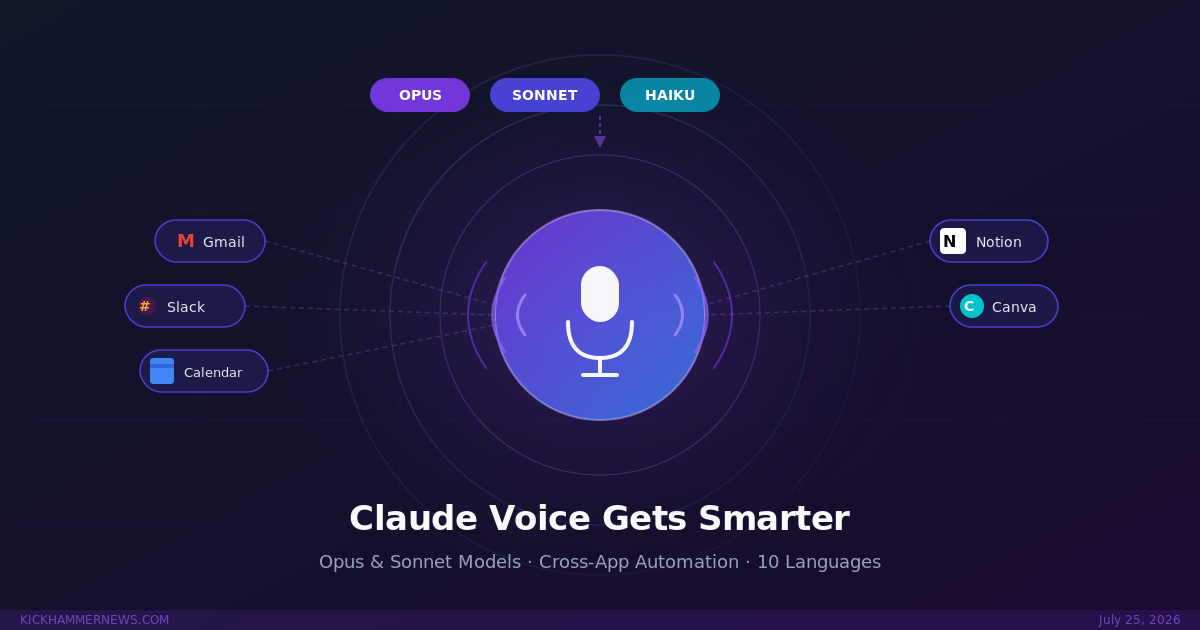
Anthropic on July 23 pushed a substantial update to Claude’s voice mode, unlocking support for its full model lineup — including the flagship Opus and the workhorse Sonnet — while simultaneously rolling out cross-app integrations that let spoken commands reach into Gmail, Google Calendar, Slack, Canva, and Notion. It is the most significant expansion of Claude’s voice capabilities since the feature launched, and it repositions the assistant from a handy voice interface into something closer to a spoken operating layer for digital work.
From One Model to Three
The old voice mode was a deliberate tradeoff. Haiku responds in roughly half the time of larger models, and for casual voice interactions — setting reminders, asking quick questions, getting a recipe read aloud — that speed felt right. But users who regularly switched between text and voice found the experience jarring. The same Claude that could write a detailed product specification in the text interface would give thin, hedged answers in voice because Haiku simply lacked the parameter depth for sustained reasoning.
The updated voice mode defaults to whatever model the user last selected in text chat. Open Claude on your phone, switch to Opus, then activate voice, and voice now runs on Opus. Paid subscribers have access to all three models — Opus, Sonnet, and Haiku — and can switch between them within a voice session. Free users get Haiku and a single connected app. The system automatically routes to the fastest available version within each tier.
The practical difference is immediate. Opus in voice mode can sustain multi-turn reasoning without losing context, handle ambiguous follow-up questions with genuine nuance, and produce long-form output — things like a detailed project plan or a fully rewritten email draft — without the response feeling truncated by model limitations. Sonnet sits between the two in speed and depth, making it the likely daily driver for most users who want more than Haiku but find Opus overkill for routine tasks.
The Cross-App Layer
The model upgrade alone would have been enough to generate headlines. What makes the update more interesting is what it can now do with other applications.
The new integrations allow Claude voice to read from and write to connected accounts in Gmail, Google Calendar, Slack, Canva, and Notion. A user can say “reschedule my 3pm meeting with Jake to tomorrow morning and send him a message in Slack explaining why” and Claude will pull the calendar event, move it, compose the Slack message with context from the conversation thread, and confirm each action back in plain speech. That chain — calendar read, calendar write, messaging app write, spoken summary — previously would have required manual switching between three applications.
The integrations are built on OAuth, so Claude only touches accounts the user explicitly connects through Anthropic’s standard permissions flow. The company has emphasized a prompt-before-act policy: before any write action (sending a message, modifying a calendar entry, publishing to Notion), Claude describes what it is about to do and waits for verbal confirmation. Read-only actions like checking an inbox or pulling meeting context proceed without a confirmation gate.
Language support has also expanded to ten languages, including Spanish, French, German, Japanese, Korean, Portuguese, Italian, Dutch, Polish, and Chinese (Mandarin). The added language coverage is notable given that voice-driven AI tools have historically launched with English-first roadmaps that left non-English speakers waiting months for parity features.
Why This Matters Beyond the Feature List
The shift to smarter models in voice mode is part of a broader trend in 2026: AI companies are converging on the idea that voice is not a separate product category but a different modality for the same underlying capability stack. OpenAI’s Advanced Voice Mode — which has run GPT-5.6 Sol since May — set that expectation at the frontier level. Google’s Gemini Live integration into Android 16 extended it to the OS layer. Apple’s rebuilt Siri, expected in September and running on Google Cloud and Nvidia Blackwell infrastructure, is meant to prove that even a voice assistant that spent years as the butt of AI jokes can make a credible run at the category.
Anthropic is approaching the space from a different angle. Where competitors have tied voice to hardware (Google to Pixel and Android, Apple to iPhone) or to a single flagship product (OpenAI’s app), Anthropic’s strategy appears to be model-first and platform-agnostic. Claude voice runs on iOS, Android, and the web. The cross-app integrations work through Anthropic’s own connector layer rather than requiring device-level OS hooks. That means Claude voice can work on a three-year-old Android phone or a desktop browser, without waiting for a hardware upgrade cycle.
The tradeoff is that the experience lacks the always-on ambient sensing that characterizes Siri or Google Assistant’s wake-word model. Claude voice is activated on demand, not passively listening. For some users that is a privacy preference, not a limitation. For others — particularly those who want voice as an always-available layer across their environment — it remains a gap that platform-native assistants still fill better.
What Users Are Saying Early
Early user reactions in the first twenty-four hours have focused on two specific use cases: morning workflow briefings and voice-driven editing sessions. Several developers on Anthropic’s forums reported using Claude Opus voice mode to do a spoken stand-up with themselves — running through open GitHub issues, calendar blocks, and Slack threads out loud while commuting — and having Claude synthesize action items by the time they reached their desk. Writers have noted that the ability to dictate and receive real-time feedback on tone and structure, without dropping to a lighter model, makes voice editing feel genuinely useful for the first time.
The integrations are still in preview status for several apps. Canva and Notion access requires joining a waitlist. Gmail and Google Calendar are live for all paid subscribers immediately. Slack is live with read access and limited write access — Claude can post to channels the user specifies but cannot yet create new channels or manage workspace settings.
Looking Ahead
Anthropic has not disclosed a roadmap for additional app integrations, but the architecture suggests the connector framework is designed to expand. The developer documentation published alongside the update describes a tool registry that third-party developers can apply to join, similar in structure to the plugin ecosystem that OpenAI introduced in 2023 and subsequently wound down. Whether Anthropic follows through on broad third-party integration — or keeps the connector layer curated — will determine how much of the ambient productivity layer Claude voice can realistically capture.
For now, the July 23 update represents a meaningful raise on the voice AI stakes. A voice assistant that can actually reason at the level of Anthropic’s best models, connect to the apps people spend most of their day in, and do it across platforms without requiring new hardware, is a different proposition than what Anthropic was offering six months ago. The question is no longer whether AI voice assistants can handle sophisticated tasks. It is which one becomes the spoken layer that users actually reach for first.