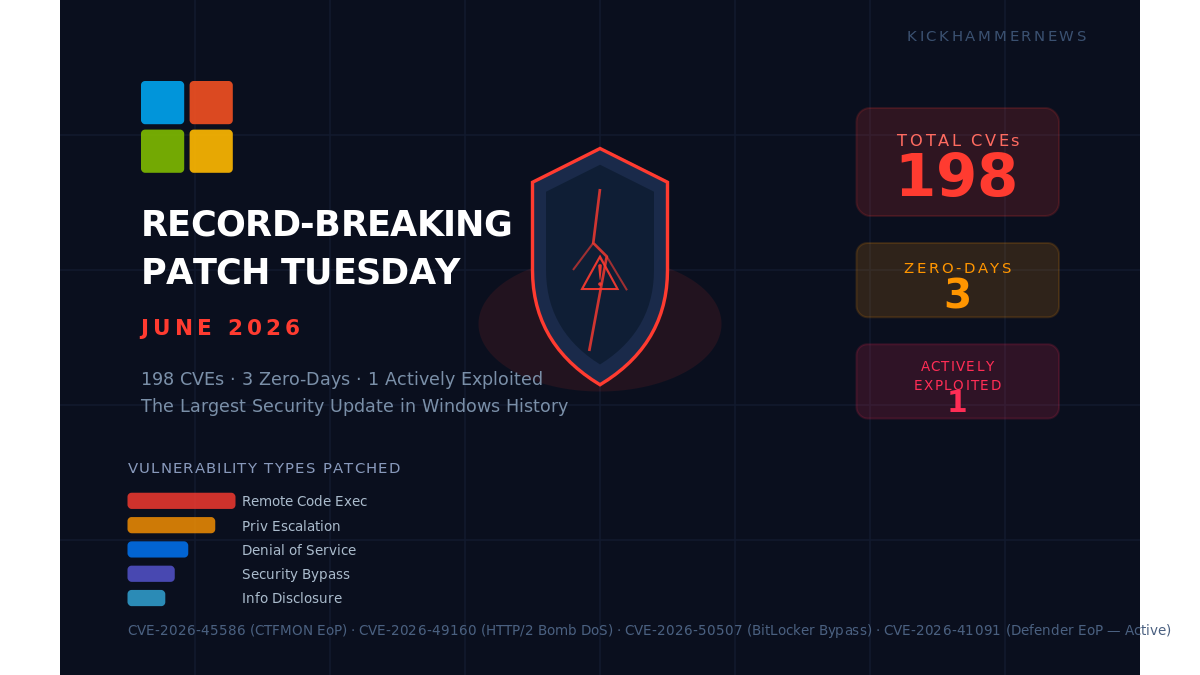
Microsoft dropped its June 2026 Patch Tuesday update on June 9th, and the numbers are staggering. This month’s security rollout addresses 198 Common Vulnerabilities and Exposures (CVEs), making it the largest single Patch Tuesday release in the company’s history. Among those patches are fixes for three zero-day vulnerabilities — flaws that were either actively exploited or publicly known before Microsoft had a chance to release a fix. If you run Windows in any capacity, this update demands your immediate attention.
A Record That Speaks for Itself
Every month, Microsoft releases a coordinated batch of security updates on the second Tuesday — a practice known as Patch Tuesday that the company has maintained since 2003. Over the years, the monthly patch counts have grown alongside the complexity of the Windows ecosystem. But June 2026 marks a new high-water mark: 198 CVEs addressed in a single release, surpassing previous records and signaling just how expansive the modern attack surface has become.
Security researchers and IT administrators had been watching the bulletin closely. The sheer volume of fixes reflects both the relentless pace of vulnerability discovery and the increasingly interconnected nature of Windows components — from the kernel to cloud-connected services, from BitLocker encryption to AI-assisted accessibility features.
The Three Zero-Days Explained
Zero-days are a category apart. Unlike ordinary vulnerabilities patched before anyone could exploit them, zero-days are flaws that attackers (or researchers) knew about and potentially weaponized before the vendor could respond. June’s Patch Tuesday includes three such cases, each targeting a different corner of the Windows stack.
CVE-2026-45586: GreenPlasma — Windows CTFMON Elevation of Privilege
The first zero-day, CVE-2026-45586, targets the Windows Collaborative Translation Framework (CTFMON) — the background process that supports voice recognition, handwriting input, and other language services. The vulnerability was dubbed “GreenPlasma” by the security researcher Nightmare Eclipse, who publicly disclosed the flaw before a patch was available.
With a CVSSv3 score of 7.8 (rated Important), the bug exploits improper link resolution before file access — a technique sometimes called “link following.” An authenticated local attacker can use this weakness to elevate their privileges, potentially gaining SYSTEM-level access on a compromised machine. While the attacker needs an existing foothold on the system to exploit this, privilege escalation bugs like GreenPlasma are a favorite second stage in multi-step attack chains.
CVE-2026-49160: The HTTP/2 Bomb — HTTP.sys Denial of Service
The second zero-day strikes at the heart of Windows Server infrastructure. CVE-2026-49160 is a Denial of Service vulnerability in HTTP.sys, the kernel-mode driver that handles HTTP and HTTPS traffic for Windows-based web servers, including those running IIS (Internet Information Services).
The attack method — an HTTP/2 Bomb — exploits how the HTTP/2 protocol handles header compression. By sending a carefully crafted, extremely small payload, an attacker can force the target server to allocate a disproportionately massive amount of memory. The result: the server crashes or becomes completely unresponsive. This type of amplification attack requires no authentication and can be launched remotely, making it particularly dangerous for any organization running Windows web services exposed to the internet.
Organizations running public-facing Windows Server deployments or services powered by ASP.NET and IIS should treat this patch as a top priority.
CVE-2026-50507: BitLocker Security Feature Bypass
The third zero-day — CVE-2026-50507 — targets something that many organizations treat as a safety net of last resort: BitLocker, Windows’ built-in full-disk encryption solution. A successful exploit of this bypass vulnerability allows an attacker with physical or local access to circumvent BitLocker’s protections entirely, potentially reading encrypted drives as if the encryption were not there.
This is especially alarming for organizations that rely on BitLocker to protect data on lost or stolen laptops. If a device protected by a vulnerable version of Windows falls into the wrong hands, the encryption that was supposed to keep sensitive data safe could be defeated before a patch is applied. Microsoft rated this one Important — but given its implications for data at rest and compliance frameworks like HIPAA, SOC 2, and GDPR, enterprises should treat it with critical urgency.
The Fourth Bug You Should Know About: CVE-2026-41091
While not technically a zero-day in the classical sense, CVE-2026-41091 deserves special attention because it is confirmed under active exploitation in the wild. This Elevation of Privilege vulnerability resides in Microsoft Defender — the very security tool designed to protect Windows systems from threats.
With a CVSSv3 score of 7.8, the flaw allows an unprivileged attacker to write a specially crafted file to a privileged system location. Microsoft Defender then inadvertently writes the file back to that location with elevated permissions, effectively granting the attacker SYSTEM-level access. The irony of an antivirus program becoming an attack vector is not lost on the security community, and this bug has reportedly been observed in the wild in targeted campaigns.
Scope: What Kinds of Vulnerabilities Are Covered?
Beyond the zero-days, the 198 CVE batch spans a wide range of vulnerability types and Windows components. The breakdown includes remote code execution (RCE) bugs — the most severe class — along with elevation of privilege flaws, security feature bypasses, information disclosure vulnerabilities, denial of service bugs, and spoofing issues. Microsoft’s own products touched by the patch wave include Windows 11, Windows Server 2025 and 2022, Microsoft Office, Azure-connected services, and Visual Studio components.
Security firms including Tenable, Rapid7, and the Zero Day Initiative have all published detailed breakdowns, with analysts flagging a handful of RCE vulnerabilities in Windows as particularly high-risk even without confirmed exploitation — scenarios where a malicious file or network packet alone can compromise a system.
What IT Teams and End Users Should Do Right Now
For IT administrators and security teams, the guidance is clear: prioritize this patch cycle immediately. The combination of a record-high CVE count, three zero-days, and one actively exploited critical bug in Defender creates a patch debt that no organization can afford to carry.
For consumers and home users, Windows Update will handle most of this automatically — but it’s worth confirming that your system has pulled and installed the June 2026 cumulative update. Users running Windows 11 on modern hardware can check via Settings → Windows Update → Check for updates.
For enterprise teams managing fleets of machines, a phased rollout with accelerated timelines is advisable given the severity of the zero-days. Testing in a staging environment remains best practice, but the HTTP.sys and BitLocker vulnerabilities warrant expedited deployment to internet-facing and field-deployed devices respectively.
The Bigger Picture: Why These Numbers Keep Growing
June 2026’s record patch count isn’t an anomaly — it’s a trend. The Windows ecosystem has expanded dramatically over the past decade: cloud-connected services, AI-powered features like Copilot integrations, accessibility tools, and the ever-growing web of third-party protocols and drivers that Windows supports all represent additional surface area for attackers to probe.
Security researchers, both independent and affiliated with nation-state teams, are finding bugs faster than ever — aided in part by the same AI tools that Microsoft and its competitors are building into their products. The result is a monthly arms race that plays out in patch notes, CVE databases, and the work hours of IT teams around the world.
For all the inconvenience it creates, Patch Tuesday remains one of the most important security rituals in enterprise computing. When Microsoft ships 198 fixes in a single month — three of them for vulnerabilities already known to attackers — the message is unambiguous: patch early, patch often, and patch now.
Sources: Tenable, BleepingComputer, CyberSecurityNews, SecurityAffairs, Zero Day Initiative, Splashtop


