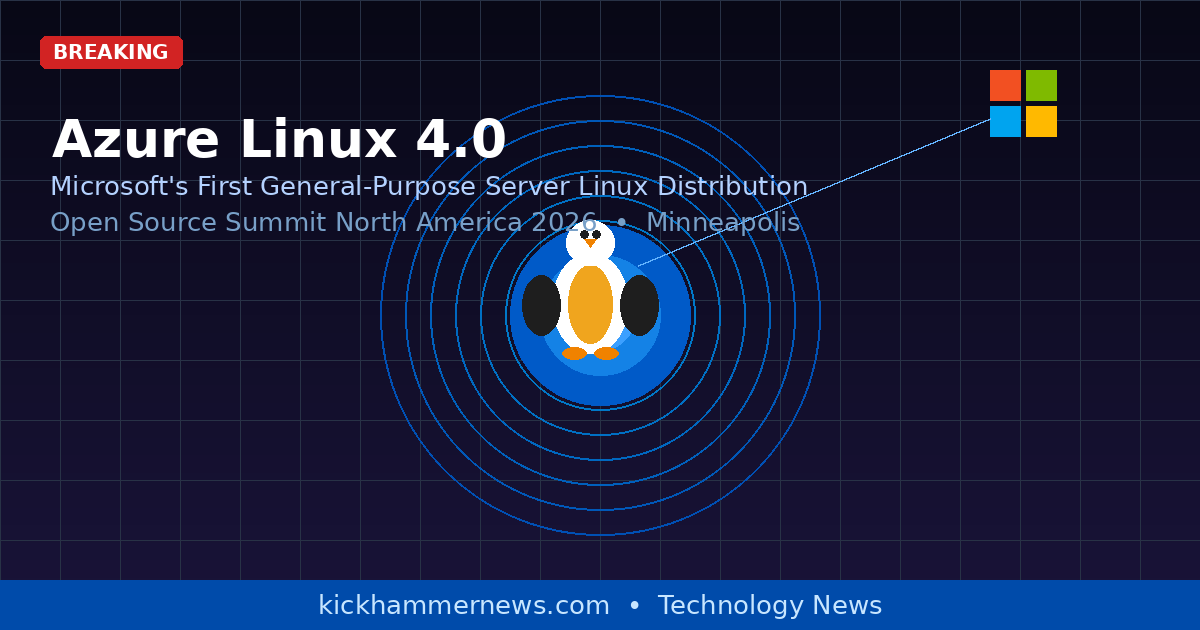
May 19, 2026 — In a move that few would have predicted even a decade ago, Microsoft this week officially announced Azure Linux 4.0, its first fully supported, general-purpose server Linux distribution, at the Open Source Summit North America 2026 in Minneapolis. The announcement marks a major milestone not just for the company, but for the entire enterprise Linux landscape — and signals that Microsoft’s relationship with open source has evolved far beyond mere coexistence.
From Internal Tool to Full-Fledged Server OS
Azure Linux wasn’t born as a desktop or server distribution. It started its life in 2020 as CBL-Mariner (Common Base Linux), an internally developed container host designed specifically for Microsoft’s own cloud infrastructure and edge workloads. For years, it remained a narrowly scoped, stripped-down system — powerful within its lane, but never intended to be a general-purpose server operating system that enterprises could run as their primary cloud VM choice.
Azure Linux 4.0 changes that entirely.
With this release, Microsoft is transforming Azure Linux into a Fedora-based RPM package ecosystem, providing a comprehensive, standards-compatible platform that enterprises and developers are already familiar with. The shift to RPM means compatibility with a massive library of existing packages, tooling, and enterprise workflows — removing one of the primary barriers for organizations that might have hesitated to run an unfamiliar base OS in production.
Crucially, Microsoft is maintaining Azure Container Linux as a completely separate, immutable container-optimized track. This dual-track approach is deliberate: organizations that just need a hardened, minimal container runtime can stay on Container Linux, while those who need a full VM operating system for more general server workloads can now turn to Azure Linux 4.0. It’s a separation that reflects a maturity in thinking — acknowledging that one size never fits all in enterprise infrastructure.
Why This Matters: The Numbers Behind the Story
To understand the significance of this announcement, you have to appreciate the scale of Linux on Azure today. Microsoft’s own data shows that more than two-thirds of customer cores on Azure run Linux. The platforms underpinning Microsoft 365, GitHub, and OpenAI’s ChatGPT — which scales across more than 10 million compute cores worldwide and serves a billion queries a day — all run on Linux foundations.
Microsoft is not just hosting Linux workloads as a cloud provider. The company is now shipping its own server-grade Linux distribution to customers. That’s a statement about identity as much as it is about product strategy.
Brendan Burns, Corporate Vice President and Technical Fellow for Azure OSS and Cloud Native at Microsoft, framed the announcement in terms of what modern AI workloads demand: “As AI workloads scale, developers need that foundation to be more secure, more predictable, and easier to build apps and agents.” Azure Linux 4.0 and Azure Container Linux are Microsoft’s answer — hardened distributions with a reduced package footprint, transparent supply chain, and consistent performance characteristics from the host all the way up to the container.
The Timeline: What to Expect and When
For organizations eager to get hands on Azure Linux 4.0, Microsoft is targeting a public preview starting June 17, 2026, initially available on Dv5, Ev5, and NVads A10 v5 series virtual machines in East US and West Europe regions, with additional regions to follow. Azure Container Linux is already generally available, with broader rollout announced alongside Microsoft Build on June 2.
Microsoft has confirmed no additional charges for Azure Linux 4.0 beyond standard compute costs — an important assurance for enterprises doing cost modeling, and a direct competitive move against the growing complexity and licensing concerns that have shadowed other enterprise Linux vendors.
A Broader Open Source Bet: The Agentic AI Foundation
The Azure Linux 4.0 announcement didn’t arrive in isolation. It came alongside a sweeping set of open source commitments from Microsoft that underscore just how central open source has become to the company’s AI strategy.
Perhaps most striking was Microsoft’s involvement with the Agentic AI Foundation (AAIF), which the company described as already being the “fastest-growing project in Linux Foundation history.” As a founding member, Microsoft is pushing for open standards for agent-to-agent communication, agent runtimes, and agent orchestration — essentially applying the Kubernetes playbook to the emerging world of AI agents. The goal: ensure that agentic AI doesn’t become locked down to any single vendor’s proprietary ecosystem.
Microsoft also unveiled its Agent Governance Toolkit, an open-source framework that provides identity, policy, audit, and access-boundary primitives for organizations deploying AI agents responsibly. Burns drew a clear analogy: “Just as Kubernetes needed RBAC and admission controllers to be enterprise-ready, agentic systems need governance primitives — and those primitives belong in the open.”
Alongside these, the Microsoft Agent Framework — which consolidates the work from Semantic Kernel and AutoGen into a single SDK and runtime for building, deploying, and managing multi-agent systems — was highlighted as a key piece of the open agentic stack. The framework maps from local development to cloud deployment, with built-in observability, evaluation, and lifecycle primitives that production systems require.
Open Source Supply Chain Security Gets Serious
With AI agents growing more autonomous, every software dependency they touch becomes part of a trust boundary. Microsoft used the Open Source Summit stage to announce expanded investment in open source security, including continued funding for OpenSSF and Alpha-Omega, using agentic capabilities to harden the software supply chain itself.
The company is also a founding partner in the GitHub Secure Open Source Fund, which pairs direct financial support ($10,000 per project) with security education, mentorship from GitHub Security Lab, and tooling. The program is designed to treat open source maintainers as people, not just package publishers — a recognition that sustainable security requires investing in the humans who write and maintain foundational code.
A Long Road to Here
It’s worth pausing to consider how remarkable this moment is in context. In 2009, Microsoft contributed 20,000 lines of Hyper-V driver code to the Linux kernel — a move that was met with skepticism and even controversy at the time. Today, the company is shipping a Linux distribution and standing as the second-largest overall contributor to CNCF projects for three years running, leading among public cloud providers.
The evolution isn’t just a PR narrative. Microsoft has donated foundational open source projects like Dapr, KAITO, KubeFleet, Radius, Drasi, Copacetic, and more to the broader community. The company’s open source engineering teams work upstream, contributing to Kubernetes, Helm, containerd, Istio, and Envoy — the runtime layer the entire cloud-native ecosystem depends on.
What It Means for Enterprise Customers
For enterprises running workloads on Azure, Azure Linux 4.0 offers something genuinely valuable: a hardened, fully supported server OS that comes from the same team that operates the cloud it runs on. Security patches, supply chain transparency, and performance tuning are no longer the concern of a separate downstream vendor. The OS and the cloud infrastructure are now from the same source.
For regulated or security-sensitive environments — finance, healthcare, government — that alignment is not a minor convenience. It’s a meaningful reduction in operational complexity and an easier path to compliance documentation.
For developers, the shift to Fedora-based RPM packaging means less friction. The tools, workflows, and packages they already use in other RPM-based environments — RHEL, CentOS Stream, Fedora itself — carry over cleanly. There’s no need to relearn a bespoke package management system.
The Bottom Line
Azure Linux 4.0 is the clearest evidence yet that Microsoft’s transformation from a proprietary software giant into a genuine open source stakeholder is not just complete — it’s accelerating. The announcement at Open Source Summit 2026 wasn’t a defensive move or a box-checking exercise. It was a confident stride into territory that would have been unthinkable for the Microsoft of the early 2000s.
With the public preview arriving in June and general availability to follow, enterprises evaluating their Azure Linux strategies should begin planning their evaluation workloads now. The Fedora-based ecosystem, the container-optimized parallel track, the AI-native design goals, and the supply chain security investments all point toward a distribution built for the workloads that will define the next decade of cloud computing.
Microsoft has shipped its first true server Linux. The question now is how quickly the enterprise world will adopt it.
*Sources: Microsoft Open Source Blog, Windows News AI, Hacker News, HPCWire AIwire, BackBox.org News*