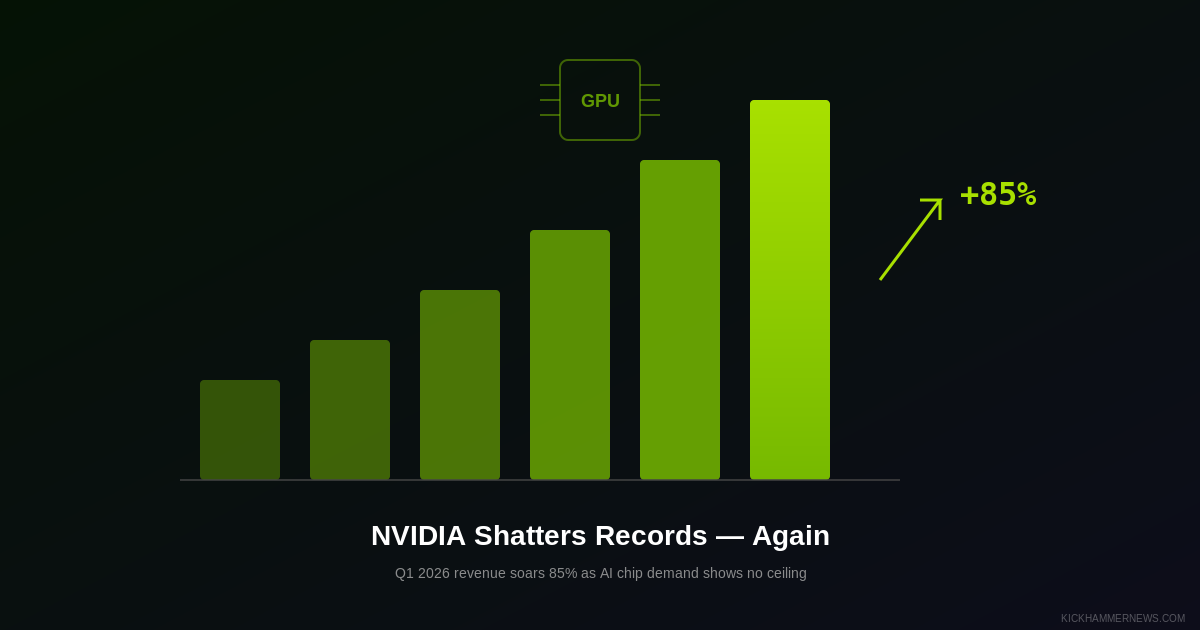
Nvidia has done it again. For what feels like the hundredth quarter in a row, the Santa Clara-based chipmaker has obliterated Wall Street’s expectations, posting blockbuster first-quarter fiscal 2027 results that confirm one thing above all else: the AI infrastructure buildout is not slowing down — it is accelerating.
The company reported revenue of $81.62 billion for the quarter ending April 26, 2026, an 85% jump from $44.01 billion in the same period a year earlier, and a 20% sequential leap from the prior quarter. Net income came in at a staggering $58.32 billion, or $2.39 per diluted share — more than triple the $18.78 billion earned in the year-ago quarter. Analysts polled by FactSet had been expecting earnings of $1.75 per share on revenue of $78.91 billion. Nvidia delivered both beyond anyone’s projections.
Data Centers Are the Engine
At the beating heart of Nvidia’s extraordinary growth is its data center segment, which posted revenue of $75.2 billion for the quarter — up 92% year-over-year. That figure alone dwarfs the total revenue of most technology companies on the planet.
The surge is being driven by insatiable enterprise and hyperscaler demand for Nvidia’s Blackwell architecture chips, specifically the GB200 NVL72 systems that have become the gold standard for large-scale AI training and inference workloads. Crucially, sovereign governments are now purchasing the same full-stack Blackwell GB200 systems that Microsoft, Google, Amazon, and Meta are deploying, a trend that has kept Nvidia’s margins remarkably robust even as supply chains strain to keep up.
GAAP gross margins for the quarter held at 74.9%, while non-GAAP gross margins came in at 75.0% — figures that underscore just how dominant Nvidia’s pricing power remains in a market where its chips have no credible alternatives at the cutting edge.
One of the most striking breakout numbers from the quarter was networking revenue, which exploded 263% year-over-year to $10.98 billion, driven by NVLink demand for GB200 and GB300 systems. As AI clusters grow to tens of thousands of interconnected GPUs, the speed and bandwidth of the networking fabric between chips becomes as critical as the chips themselves — and Nvidia has positioned itself to profit from both.
Jensen Huang’s Vision: The Age of AI Factories
CEO Jensen Huang, who has become something of a rock star in the technology industry — appearing at events from Dell Technologies World to the White House — did not undersell the moment in his earnings statement.
“The buildout of AI factories — the largest infrastructure expansion in human history — is accelerating at extraordinary speed,” Huang said.
The term “AI factory” is one Huang has been evangelizing for over a year, and it has taken root. The concept reframes how we should think about data centers: not as passive storage and compute facilities, but as active industrial plants that take in raw data and energy and produce intelligence as their output. In that framing, Nvidia’s GPUs are the turbines — the indispensable machinery without which the factory cannot run.
On the inference side of the equation, Huang was equally direct. “Grace Blackwell with NVLink is the king of inference today — delivering an order-of-magnitude lower cost per token,” he said, addressing the growing conversation around whether inference workloads — running AI models in production — require as much GPU horsepower as training. His answer, effectively, is yes — and Nvidia’s chips deliver it more efficiently than anything else on the market.
The $91 Billion Question
Nvidia’s Q2 guidance of approximately $91 billion in revenue sent a clear signal to the market: the company expects the momentum to continue. Wall Street analysts had been forecasting $87.29 billion for the current quarter, meaning Nvidia is guiding nearly $4 billion above consensus. For a company already generating revenue at a pace that would have seemed fictional just three years ago, that figure is almost surreal.
The company also announced plans to return capital to shareholders in a significant way: Nvidia authorized an $80 billion stock buyback program and raised its quarterly cash dividend from 1 cent per share to 25 cents per share — a 2,400% increase that signals management’s confidence in the company’s ongoing cash generation ability.
A $5.4 Trillion Company That Nobody Expected
Perhaps the most striking context for Nvidia’s results is the trajectory of its market capitalization. At the end of 2022, Nvidia was worth approximately $400 billion — a substantial company, certainly, but one considered something of a niche player in gaming and professional graphics. As of the close of trading on Wednesday, its market cap stood at $5.4 trillion, making it one of the most valuable companies in human history.
That valuation, however, also explains the muted reaction from markets. Nvidia shares dipped slightly in after-hours trading to $222.12, even after closing the regular session at $223.47. David Wagner, head of equity and portfolio manager at Aptus Capital Advisors, captured the paradox well.
“Time and time again, Nvidia obliterates expectations and consensus; it delivered exactly on what people wanted, especially regarding data centers,” Wagner said. “But the market doesn’t always act as you would expect after a strong report like this one.”
At a $5.4 trillion valuation, investors have already priced in a great deal of perfection. The question the market is grappling with is not whether Nvidia is dominant today — it clearly is — but whether that dominance can be sustained as competitors like AMD, Intel, and a wave of custom silicon startups backed by hyperscalers chip away at its market share over the coming years.
The Competitive Landscape: Real Threats, Distant Horizons
Nvidia’s operating expenses increased 49% year-over-year to $7.75 billion, reflecting the company’s aggressive investment in research and development as it works to stay ahead of the competition. AMD has made meaningful strides with its MI300X and next-generation AI accelerators, and Google, Amazon, Microsoft, and Meta are all developing proprietary AI chips to reduce their dependence on Nvidia. Apple’s chips have already transformed the consumer AI edge.
But Nvidia’s moat is not just hardware — it is CUDA, the software ecosystem that Huang has spent decades building and that remains deeply embedded in the workflows of AI researchers, developers, and enterprise customers worldwide. Switching from Nvidia’s chips does not just mean buying different silicon; it means retraining teams, rewriting code, and accepting meaningful performance and toolchain tradeoffs. For most organizations, that calculus still points firmly toward Nvidia.
What This Means for the Broader AI Economy
Nvidia’s results are a proxy for the entire AI investment wave. Every billion dollars that hyperscalers spend on Nvidia’s chips is a vote of confidence that AI is generating — or will soon generate — returns that justify the expenditure. Microsoft’s Copilot, Google’s Gemini, Amazon’s Bedrock, and Meta’s Llama models are all monetizing AI at scale, and the infrastructure they are building to do so runs on Nvidia silicon.
The ripple effects extend well beyond tech. AI-driven automation is beginning to touch every sector of the economy — from healthcare diagnostics and drug discovery to financial modeling, legal research, logistics, and manufacturing. The demand for compute to power those applications is only just beginning to ramp.
Jensen Huang’s “AI factory” metaphor may be more apt than even its author intended. The industrial revolution did not stop after the first steel mill was built, and the AI revolution is unlikely to stop after the first wave of data center construction. If anything, Q1 2026 suggests the second wave is already building.
For Nvidia, the only real question heading into the second half of 2026 is whether the world can build fast enough to keep up with its ambitions — and whether the power grids, cooling systems, and supply chains of the planet can keep pace with the extraordinary demand it is helping to create.
Based on everything we saw this week, betting against Jensen Huang has not been a profitable strategy.


