Released September 30, 2026 — the 34th OpenStack iteration positions open-source private cloud as a serious contender for regulated AI workloads
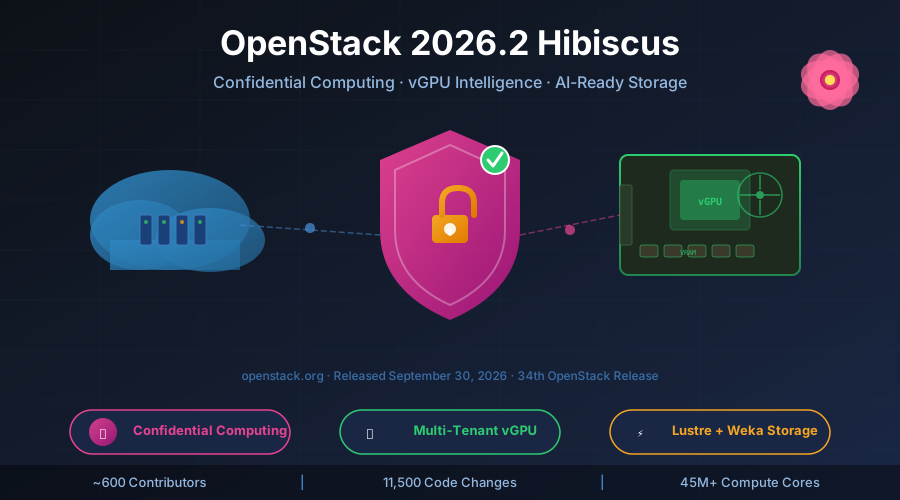
The open-source cloud infrastructure project OpenStack marked its 34th release at the end of September with a feature set squarely aimed at the two things enterprise operators care about most right now: running AI workloads and keeping regulators happy. OpenStack 2026.2, codenamed “Hibiscus,” brings hardware-enforced confidential computing, improved virtual GPU management, parallel filesystems for machine learning, and a major memory efficiency win in networking — all on a foundation that now powers more than 45 million compute cores worldwide.
Nearly 600 contributors submitted roughly 11,500 code changes during the six-month development cycle, representing a 21 percent rise in contributors and a 28 percent rise in merged changes compared to the previous 2026.1 release. The OpenDev Zuul continuous integration system ran approximately 1.6 million jobs to validate those changes — a figure that speaks to both the scale of the project and the rigor with which it is maintained.
Confidential Computing Comes of Age
The headline feature for enterprises in regulated sectors is full support for confidential computing through two of the industry’s leading hardware implementations. Nova, OpenStack’s compute service, now supports AMD’s SEV-SNP (Secure Encrypted Virtualization — Secure Nested Paging) and Intel’s TDX (Trust Domain Extensions).
AMD SEV-SNP is the third generation of AMD’s memory encryption technology. It goes beyond its predecessor SEV-ES by adding stronger integrity protection and, crucially, signed attestation reports that allow a workload to cryptographically verify the environment it is running in before processing sensitive data. Operators enable it with the hw:mem_encryption_model=amd-sev-snp flavor extra specification or an equivalent image property.
Intel TDX, supported on 5th Generation Xeon Scalable processors and later, provides hardware-enforced isolation through Trust Domain Extensions, with attestation facilitated by the Quote Generation Service. Like AMD’s implementation, TDX allows a tenant or software stack to verify that the underlying infrastructure has not been tampered with.
For industries such as financial services, healthcare, and the public sector, these capabilities matter enormously. Confidential computing allows organizations to run sensitive workloads on shared infrastructure — or even to send workloads to a cloud operator — without giving that operator access to the data in memory. Until recently, this has been a sticking point for moving regulated workloads off on-premises hardware. Hibiscus makes OpenStack a credible platform for exactly those deployments.
vGPU Management Gets Smarter
AI and machine learning workloads require GPU access, and Hibiscus significantly improves how OpenStack handles virtual GPUs. Previously, Nova’s native vGPU support and the Cyborg accelerator service operated independently, creating potential scheduling conflicts in environments that used both. In Hibiscus, the libvirt driver can now manage mediated devices — such as virtual GPUs — through Cyborg as an alternative to Nova’s built-in mechanism. A new OWNER_NOVA resource trait prevents the two systems from stepping on each other when scheduling GPU-accelerated instances.
The change matters because virtual GPUs allow a single physical GPU to be partitioned among multiple workloads. For inference tasks that do not require a full accelerator card, vGPU slicing dramatically improves utilization and reduces per-tenant cost. The tighter Nova-Cyborg integration in Hibiscus makes this kind of multi-tenant GPU sharing more reliable at scale.
AI Storage: Weka and Lustre Join Manila
High-performance storage is often the bottleneck in AI training pipelines, and the Manila shared filesystem service now ships with drivers for two leading parallel filesystems: Weka and Lustre. Both are widely used in AI, machine learning, and high-performance computing environments where thousands of processes need to read the same dataset simultaneously at high throughput.
The addition means operators can deploy purpose-built AI training infrastructure entirely within OpenStack, from the compute and GPU layer through to the high-bandwidth storage tier, without bolting on separate storage systems. This is a meaningful step toward OpenStack as an end-to-end platform for private AI clouds rather than simply a general-purpose infrastructure layer.
Networking Memory Use Cut by 15x
One of the less glamorous but operationally important changes in Hibiscus is a dramatic reduction in memory consumption for Neutron’s ML2/OVS high-availability router deployments. The team reduced memory footprint by more than 15 times for these configurations, which have been a pain point for operators running thousands of virtual routers. At that scale, memory overhead accumulates quickly, and the improvement substantially lowers the hardware cost of running large multi-tenant networks.
Hibiscus also adds BGP EVPN (Ethernet VPN) integration through a new service plugin and OVN agent extension for EVPN Type-5 routes using FRR (Free Range Routing). This allows tenant network prefixes to be advertised directly into the physical fabric, reducing gateway hops and improving east-west traffic performance in environments that need tight integration between the virtual network and physical switching.
Security: More Advisories, More Fixes
The first eight months of 2026 saw approximately 40 OpenStack security advisories — roughly ten times the project’s historical average of around three per year. Project leaders attribute the surge largely to AI-driven vulnerability discovery tools that are systematically scanning open-source code at a pace human researchers cannot match. The Hibiscus cycle addressed more security bugs in Ironic than any previous six-month period.
Notable fixes include a cross-tenant zone ownership bypass in Designate (OSSA-2026-034) that could have allowed one tenant to create duplicate, subzone, or superzone records belonging to another tenant — enabling DNS hijacking or denial of service. The patch enforces ownership checks across all pools. Glance received patches for four separate CVEs (CVE-2026-71196, CVE-2026-71197, CVE-2026-71198, and OSSA-2026-038), and the Cyborg service addressed CVE-2026-40213 and CVE-2026-40214.
On the proactive side, Designate now supports TLSA records for DANE (DNS-Based Authentication of Named Entities), allowing domain owners to publish in DNS which TLS certificates are valid for their services. It also gained post-quantum cryptography readiness checks — a forward-looking feature as the industry begins preparing for the eventual arrival of quantum computing capable of breaking current asymmetric encryption.
Runtime Changes and the Upgrade Path
Hibiscus sets Python 3.11 as the minimum supported runtime, with 3.12 and 3.13 tested as defaults on Ubuntu 24.04 and Debian 13. Support for Ubuntu 26.04, CentOS Stream 10, Rocky Linux 10, and AlmaLinux 10 is in advance testing. Python 3.9 and 3.10 support has been dropped.
Because Hibiscus is a non-SLURP (Skip Level Upgrade Release Process) release, operators on 2026.1 Gazpacho have the option to skip it and upgrade directly to 2027.1 Indri, expected in March 2027. Those who prefer to stay on supported releases without skipping can upgrade to Hibiscus before moving to Indri. The flexibility accommodates both operators who want the latest features now and those with longer maintenance cycles who prefer to minimize upgrade frequency.
Why This Release Matters
OpenStack has sometimes been characterized as the enterprise cloud platform that peaked in the early 2020s, outpaced by hyperscale public clouds and Kubernetes-native infrastructure. Hibiscus challenges that narrative directly. The combination of hardware-level confidential computing, multi-tenant GPU management, high-performance AI storage, and a 15x networking memory reduction addresses real operational problems that neither the hyperscale clouds nor Kubernetes alone solve cleanly for operators who need to keep data on premises or under tighter compliance controls.
With 45 million compute cores already running on OpenStack globally and a contributor base that grew by more than 20 percent in a single cycle, the platform is demonstrably not standing still. For any organization building private AI infrastructure and dealing with data sovereignty or regulatory requirements, the Hibiscus release is worth a careful look.
OpenStack 2026.2 “Hibiscus” release notes and upgrade documentation are available at releases.openstack.org. The next OpenStack release, 2027.1 “Indri,” is scheduled for March 2027.