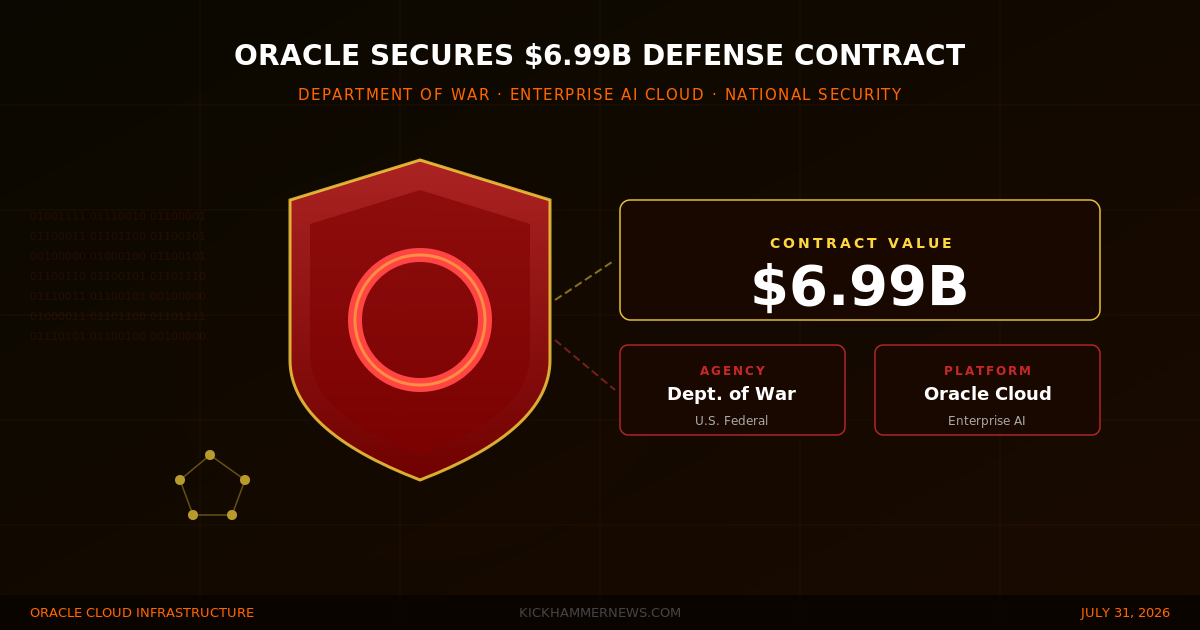
Oracle’s position at the heart of America’s defense infrastructure just got a lot harder to dislodge. On July 23, 2026, the database and cloud software giant announced it had secured a landmark 10-year Indefinite Delivery/Indefinite Quantity (IDIQ) contract under the U.S. Department of War (DoW) Enterprise Software Initiative (ESI), with a potential total value of $6.99 billion. It is the single largest, most consolidated Oracle procurement vehicle in the Pentagon’s history — and it signals a dramatic shift in how the world’s largest employer buys enterprise software.
The Deal at a Glance
The contract carries a base value of $3.31 billion covering an initial five-year ordering period. If option years are exercised in full, cumulative spending could reach $6.99 billion over the full decade. The award was made by the Naval Information Warfare Center Pacific and covers authorized organizations across all military branches, the U.S. Coast Guard, and the U.S. Intelligence Community — with the Central Intelligence Agency confirmed as Oracle’s first customer under the new unified structure.
For the first time in the Pentagon’s history, a single procurement vehicle covers the department’s entire on-premises Oracle software footprint. Defense organizations can now issue task and delivery orders for Oracle perpetual and subscription licenses, software support, Software-as-a-Service (SaaS) applications, and specialized professional services — all under one roof.
Why This Matters: Procurement Friction Is a National Security Problem
The DoW is one of the largest employers in the United States, with more than 3.4 million civilians and military personnel distributed across dozens of specialized agencies and branches of the armed forces. At that scale, the sheer bureaucratic overhead of procuring mission-critical enterprise software — security reviews, procurement processes, separate contract vehicles for each branch — has long been an impediment to operational agility.
“For the Department of War, the challenge is not just finding the right technology, it’s doing so quickly, compliantly, and at scale, without getting bogged down by complex procurement processes,” said Kim Lynch, executive vice president, Government, Defense & Intelligence, Oracle. “ESI is designed to address those challenges by creating a more standardized and efficient path to Oracle cloud and AI technology tuned to support mission-critical scenarios.”
The ESI framework consolidates what had previously been a fragmented patchwork of individual contracts and procurement vehicles into a single, flexible agreement. Pricing, deliverables, and performance criteria are defined at the order level — giving individual agencies the flexibility to customize their deployments while maintaining a streamlined contracting structure at the top.
According to the DoW, the consolidation is projected to save taxpayers at least $441 million through reduced procurement overhead and standardized licensing terms. In Washington’s current fiscal climate, that kind of efficiency dividend matters.
Oracle’s Long Game in Defense
Oracle has been a supplier to the Department of War since the 1990s. Over three decades, its database and ERP software has become so embedded in defense operations that switching away would itself be a multi-year, multi-billion-dollar undertaking. The ESI contract, in effect, acknowledges this reality and turns it into a structured, formalized long-term commitment on both sides.
The timing is notable. Oracle has faced a volatile few months in the markets. In early July, the company endured what some analysts called its worst week since 2001, as investors worried about the capital expenditure demands of the AI era and whether enterprise software firms could keep pace. The DoW contract announcement on July 23 helped stabilize sentiment — Oracle shares advanced 2.3% in extended trading on the day of the announcement. (Though the stock remained under pressure in broader trading, closing at $120.04 on July 24 — a nearly 5% drop that day, reflecting ongoing macro headwinds.)
This deal doesn’t just provide revenue visibility; it provides a narrative. At a time when investors are scrutinizing Oracle’s cloud transition and AI roadmap, a $7 billion federal anchor contract is exactly the kind of long-term, recurring commitment that shores up the investment thesis.
Cloud and AI Are at the Center of This Deal
The ESI contract is not purely about perpetual on-premises licenses. Defense organizations purchasing under the framework will have access to Oracle’s full commercial catalog — including Oracle Cloud Infrastructure (OCI), its Software-as-a-Service application suite, and increasingly, its AI-powered enterprise tools.
Oracle has been aggressively positioning its cloud and AI capabilities for government use cases. The company’s OCI Government Cloud regions — including FedRAMP-authorized and IL5-classified infrastructure — are central to this pitch. The ability for defense agencies to seamlessly move from on-premises Oracle software to OCI, under the same contracting umbrella, removes a major friction point in the federal cloud adoption journey.
The Intelligence Community’s inclusion as an authorized buyer under the contract is particularly significant. Intelligence agencies are notoriously selective about their technology suppliers and procurement frameworks. Getting the CIA listed as an early customer under this vehicle suggests Oracle’s security and compliance posture has passed some of the most rigorous vetting in the federal government.
What Comes Next: Transition and Modernization
The DoW will begin transitioning to the ESI contract vehicle in the Summer of 2026 — meaning the transition is already underway. Oracle has committed to providing dedicated program operations support and standardized intake processes throughout the transition period, helping route requests efficiently across Oracle teams.
Looking further out, the expectation is that the DoW will increasingly lean on standardized procurement processes like ESI as it seeks to modernize its IT estate. Oracle’s full stack — database, middleware, ERP, HCM, supply chain, cloud infrastructure — positions it well to become even more central to that modernization effort over the contract’s 10-year horizon.
For comparison, consider what a similar consolidation looks like in the commercial ERP market: organizations that standardize on a single vendor’s enterprise software stack typically spend more, not less, over time — because the platform becomes the foundation for additional deployments. The DoW’s ESI structure mirrors this dynamic at government scale.
Industry Implications
The award will likely draw attention from Oracle’s competitors. SAP, which has been pushing hard into government markets with its S/4HANA cloud ERP platform, does not benefit from this deal. Microsoft, which has been building its Dynamics 365 footprint in federal agencies, is also watching a major rival lock in a decade of preferred access across the entire Department of War.
For enterprise software observers, this deal is a reminder that the government sector — often overlooked in favor of commercial cloud growth narratives — remains a high-stakes battleground where long-term vendor relationships, deep integration, and compliance certifications can lock in billions in recurring revenue for a decade at a time.
The $6.99 billion Oracle DoW contract is not just a win for Oracle. It’s a statement about how the United States government plans to buy, deploy, and modernize enterprise software for the foreseeable future — and Oracle intends to be at the center of it.
Sources: Oracle Press Release (July 23, 2026), Yahoo Finance / Investing.com, TechTimes, The Defense Post, Washington Times