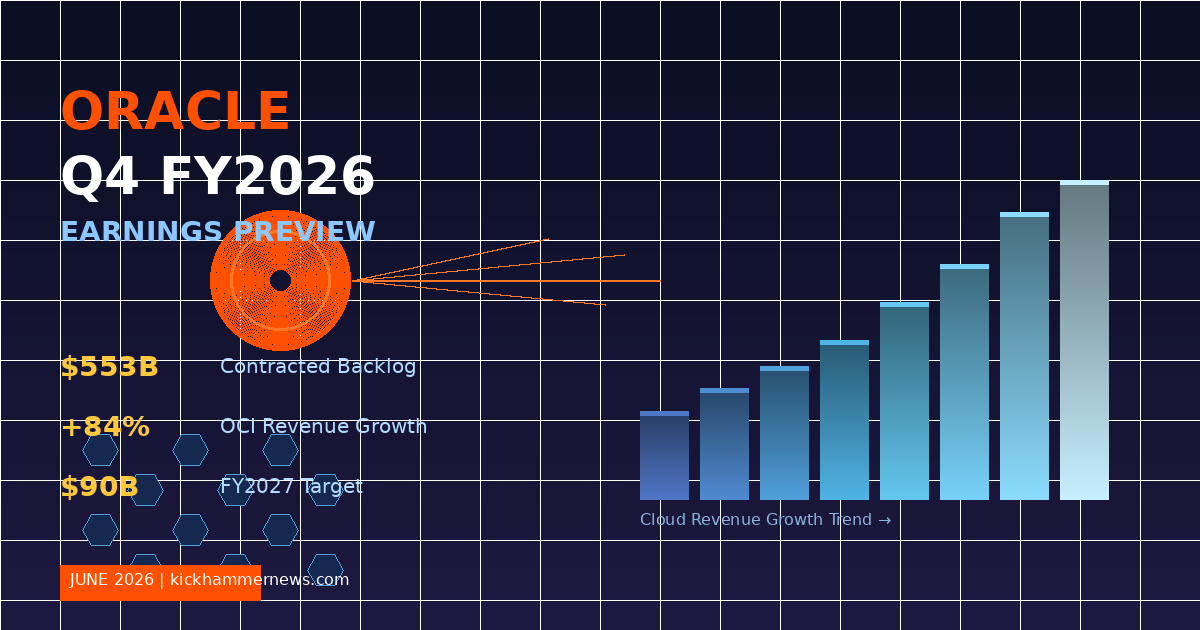
When Oracle reports its fourth-quarter fiscal 2026 results on June 10, investors, enterprise customers, and cloud infrastructure watchers will be scrutinizing numbers that have, over the past year, become genuinely jaw-dropping. A $553 billion remaining performance obligations figure — up 325% year over year — signals a demand wave that even the most bullish Oracle analyst would have struggled to forecast eighteen months ago. The question heading into Q4 isn’t whether Oracle has the orders; it’s whether the company can build fast enough to fulfill them.
The Numbers Behind the Hype
Oracle’s Q3 FY2026 results, delivered on March 10, 2026, set a high bar. Total quarterly revenues reached $17.2 billion, up 22% in USD terms and 18% in constant currency. But the headline-grabbing figure was cloud infrastructure: Oracle Cloud Infrastructure (OCI) revenue surged 84% year over year to $4.9 billion in a single quarter. Total cloud revenues, which include applications such as Fusion ERP and NetSuite, climbed 44% to $8.9 billion.
Those numbers prompted Oracle to raise its full-year FY2026 revenue guidance to approximately $67 billion and, more significantly, to lift its FY2027 revenue target to $90 billion — a figure that would have seemed fantastical even a few years ago when Oracle was still being written off as a legacy database vendor struggling to find its cloud footing.
For Q4 FY2026, Oracle has guided for total revenue growth of 18% to 20% in constant currency and 19% to 21% in USD. Cloud revenue is expected to grow between 44% and 48% in constant currency — meaning the blistering pace of the past several quarters shows no sign of cooling.
The $553 Billion Backlog: What It Means
The remaining performance obligations figure deserves special attention. At $553 billion — a 325% increase year over year — Oracle’s contracted-but-not-yet-recognized revenue dwarfs what many software companies bill in their entire history. This backlog is largely a function of multi-year cloud infrastructure deals with some of the world’s largest AI companies and hyperscalers.
Oracle has confirmed deals with OpenAI, Nvidia, TikTok, and a growing roster of sovereign AI programs across Europe, the Middle East, and Asia-Pacific. Larry Ellison, Oracle’s co-founder and chief technology officer, has repeatedly stated that Oracle intends to build more cloud data center capacity than all of its competitors combined in the coming years — an audacious claim, but one backed by an announced capital expenditure plan of $50 billion for FY2026 alone.
The backlog is meaningful for another reason: it provides forward revenue visibility that most enterprise software companies simply do not have. When Oracle says $90 billion in FY2027, it isn’t extrapolating from trend lines — much of that revenue is already contracted and waiting to be recognized as infrastructure comes online and services are delivered.
OCI vs. the Hyperscalers: Oracle’s Surprising Edge
For years, Oracle Cloud Infrastructure was considered an also-ran in a market dominated by Amazon Web Services, Microsoft Azure, and Google Cloud. That narrative has shifted dramatically. OCI’s appeal to AI workloads comes from a combination of factors that matter acutely for training large language models and running inference at scale.
First, OCI offers a flat, low-latency network fabric that connects GPU clusters without the network congestion bottlenecks that can plague larger, more heterogeneous clouds. Oracle built much of its second-generation infrastructure from scratch, without the legacy architecture baggage accumulated by AWS over nearly two decades.
Second, pricing. Oracle has consistently undercut its hyperscaler rivals on compute and storage pricing — sometimes by wide margins. For customers running sustained, high-throughput AI workloads, the economics can be compelling.
Third, Oracle’s willingness to build dedicated, isolated cloud regions — including air-gapped sovereign cloud environments — has made it the infrastructure partner of choice for government agencies, defense contractors, and enterprises in regulated industries where data sovereignty is non-negotiable.
NetSuite and Fusion ERP: The Application Layer
While OCI drives the explosive revenue growth, Oracle’s application cloud businesses are no less important to the overall story. Oracle Fusion Cloud ERP and Fusion HCM posted a combined annualized revenue run rate of $16.1 billion in Q3 FY2026. NetSuite, Oracle’s cloud ERP product targeting mid-market companies, continues to add customers at a steady pace, benefiting from a wave of businesses moving off on-premises Sage, Epicor, and legacy Microsoft Dynamics installations.
The integration of agentic AI capabilities into Fusion applications — announced with Fusion 26B earlier this year — is beginning to show up in renewal rates and expansion revenue. Customers who might have viewed their ERP as a back-office cost center are now seeing Oracle pitch it as an AI-enabled operational intelligence platform: a system that not only records transactions but actively recommends actions, automates workflows, and surfaces anomalies in real time.
That repositioning is more than marketing. It creates stickiness and raises switching costs at a moment when SAP and Workday are pursuing the same AI-first narrative. Oracle’s advantage is that its infrastructure and application layers are vertically integrated — when you run Fusion on OCI, you get performance and cost benefits that aren’t available if you run the same workloads on a third-party cloud.
Risks Heading into Q4
Not everything is tailwinds. Oracle’s aggressive capital expenditure plans — $50 billion in FY2026 — mean that free cash flow will remain under pressure even as revenue climbs. The company has announced plans to raise up to $50 billion in additional debt and equity to finance its data center buildout, a move that has rattled some investors concerned about leverage at a moment when interest rates remain elevated.
Data center construction timelines are another risk. Oracle has massive contracted demand, but fulfilling that demand depends on securing land, power, cooling infrastructure, and — most critically — GPUs and networking hardware that remain in tight supply. Any slippage in data center delivery timelines could delay revenue recognition and erode customer confidence.
There is also the question of AI demand durability. While enterprise AI adoption has accelerated sharply, the economics of AI inference are improving rapidly as models become more efficient. If the GPU-hours required to run a given workload fall dramatically over the next two to three years — as many researchers predict — the revenue per customer could compress even as the customer base grows.
What to Watch on June 10
Analysts will be focused on several specific data points when Oracle reports Q4 results:
OCI revenue growth rate — Can it sustain 84%? Even a modest deceleration to 70% would be remarkable, but any sharp pullback would raise questions about whether the Q3 surge was front-loaded.
Remaining performance obligations — The $553 billion figure from Q3 was the single most-discussed number in enterprise cloud last quarter. If it grows further, it will cement Oracle’s narrative as the infrastructure backbone of the AI era.
Capex guidance for FY2027 — How much does Oracle plan to spend as it moves from $50 billion in FY2026 to what could be an even larger commitment next year?
Margin trajectory — With heavy infrastructure investment, operating margins have been under pressure. Investors will want to see a credible path back toward expansion as the data centers begin generating returns.
The Bigger Picture
Oracle’s transformation from a legacy database giant into one of the world’s most critical AI infrastructure providers is one of the more remarkable second-act stories in enterprise technology. It is a story built on years of unglamorous investment in networking, storage, and database engineering — work that looked like defensive trench-digging when the hyperscalers were ascendant, but which now looks prescient.
The June 10 earnings report will be more than a quarterly financial update. It will be a data point in the broader narrative of who builds the infrastructure that runs the AI economy — and whether the early lead that Oracle has established in cloud infrastructure backlog can translate into sustained, profitable growth at a scale the company has never achieved before.
The $90 billion target for FY2027 is ambitious. But with $553 billion already contracted, it no longer looks like a stretch goal. It looks like an obligation.


