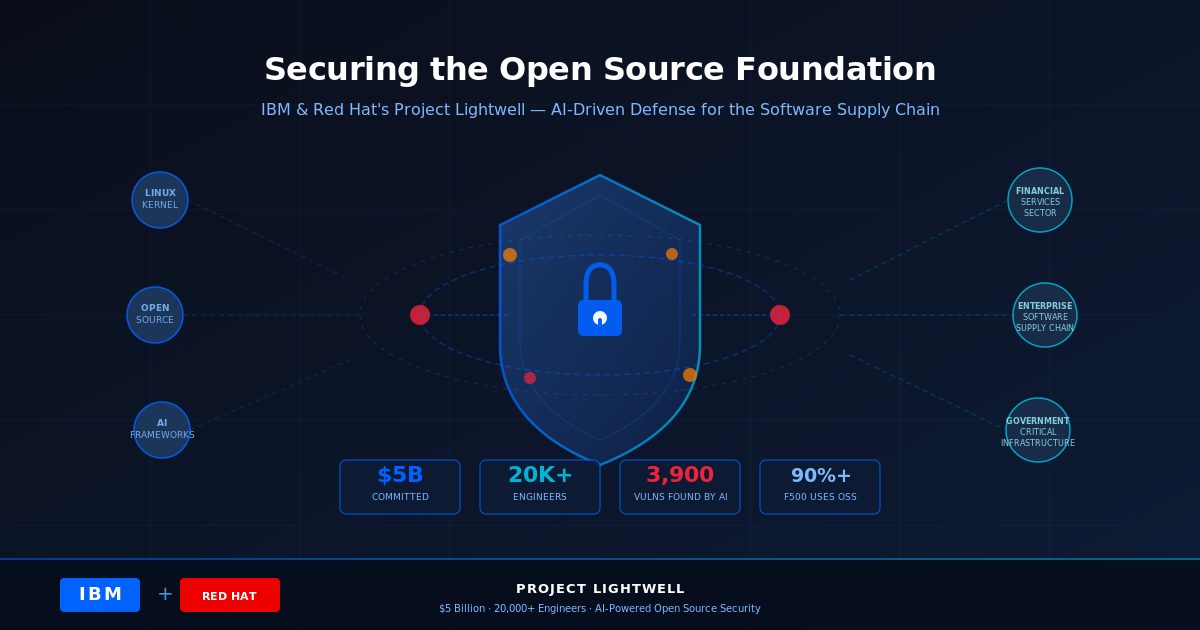
Project Lightwell aims to fix the gaping security hole at the heart of modern software infrastructure — before AI-powered attackers do it for us.
Open source software powers the modern world. From the Linux kernels running cloud servers to the Java libraries quietly processing trillions of financial transactions, the digital economy depends on a vast, interconnected web of freely shared code. It’s one of humanity’s most impressive collaborative achievements — and one of its most exploited security vulnerabilities.
On May 28, 2026, IBM and Red Hat announced they intend to do something about it. The initiative is called Project Lightwell, and the companies are backing it with a $5 billion commitment, more than 20,000 engineers, and a roster of early adopters that reads like the guest list for a Wall Street power lunch: Bank of America, Citi, Goldman Sachs, JPMorganChase, Mastercard, Morgan Stanley, Visa, and others.
The timing is not accidental.
The AI Vulnerability Acceleration Problem
For years, cybersecurity professionals have operated under a manageable, if uncomfortable, reality: attackers find vulnerabilities faster than defenders can patch them. AI has now broken that equation entirely.
Anthropic recently disclosed that its Mythos Preview model — an AI system designed to evaluate offensive security capabilities — identified nearly 3,900 high- or critical-severity vulnerabilities in open source software alone during a single research exercise. That number would have taken traditional security teams months or years to surface. An AI-powered adversary could theoretically work through a similar list in days, or hours, hunting for unpatched systems to exploit.
More than 90% of Fortune 500 companies rely on open source software. The exposure is almost universal — and it’s growing as AI accelerates both the creation of new code and the discovery of flaws within it.
“We are at an inflection point in how it is built, secured, and scaled,” said Arvind Krishna, IBM’s Chairman and CEO, in the Project Lightwell announcement. “This is about strengthening trust in the systems that power business, government, and society.”
What Project Lightwell Actually Does
At its core, Project Lightwell is an attempt to industrialize open source security. IBM and Red Hat are building what they call a “trusted enterprise clearinghouse” — a coordination layer that sits between the chaotic world of upstream open source development and the buttoned-up requirements of enterprise production environments.
Here’s how it works in practice. When an enterprise organization discovers a vulnerability in an open source component they depend on — say, a critical library that isn’t part of any official Red Hat product but that their engineers have been quietly relying on for years — they currently have limited options. They can report it publicly (risking exploitation before a patch is ready), attempt to fix it themselves (requiring specialized expertise they may not have), or quietly hope someone else notices and fixes it first.
Project Lightwell offers a fourth path: report the issue confidentially to the clearinghouse, receive a validated, enterprise-grade patch, and have IBM and Red Hat coordinate upstream disclosure with the open source community — all without exposing the vulnerability prematurely.
The model extends far beyond Red Hat’s existing product portfolio. IBM says it will apply its engineering discipline to independent libraries, language toolchains, AI frameworks, and data streaming platforms — the kind of sprawling, unofficial software dependencies that represent some of enterprise IT’s most significant blind spots. IBM itself uses more than 62,000 open source packages internally, with deep expertise in over 10,000. That institutional knowledge is a significant asset.
A Different Bet on AI and Engineering
Project Lightwell arrives at an interesting moment in the broader AI and technology industry. Many companies are using AI as justification to shrink engineering headcount — automating code review, test writing, and routine maintenance tasks that previously required human effort.
IBM and Red Hat are making a conspicuously different argument. Rather than treating AI as a replacement for engineers, they’re positioning a massive human engineering workforce — 20,000+ people — as a premium strategic asset, augmented by AI rather than supplanted by it. The AI handles high-volume vulnerability triage, prioritization, and initial analysis; the engineers handle the nuanced judgment calls, the upstream community diplomacy, and the complex patch engineering that automated systems can’t reliably manage.
It’s a bet that in a world where AI can surface thousands of vulnerabilities in minutes, the scarce resource isn’t the ability to find problems — it’s the human expertise to fix them correctly, at scale, without breaking things downstream.
The financial services partners on Project Lightwell clearly share this view. Banks and financial institutions operate some of the most complex, regulated, and targeted software environments on the planet. Their early adoption is a meaningful signal that the clearinghouse model addresses a genuine enterprise need, not just a theoretical one.
The Broader Context: Open Source Security at a Crossroads
Project Lightwell doesn’t exist in a vacuum. It builds on learnings from several earlier initiatives, including Anthropic’s Project Glasswing — which focused on evaluating AI’s offensive security capabilities — and OpenAI’s Trust Access for Cyber program. The open source security problem has been receiving increasing attention from both the private sector and government agencies, which have pushed companies to take software supply chain security more seriously since the SolarWinds attack exposed how catastrophically a compromised open source dependency can cascade through enterprise environments.
What makes Project Lightwell different is its scale and its commercial model. IBM and Red Hat aren’t proposing a nonprofit or a government-funded initiative — they’re building a subscription-based business around enterprise-grade open source security. Enterprises pay for validated patches, lifecycle management, and the peace of mind that comes from knowing a team of 20,000 engineers has your dependency graph under surveillance.
What Comes Next
Project Lightwell is launching with a select group of early adopters and is expected to expand its clearinghouse model more broadly over the coming months. IBM has published additional details at ibm.com/products/lightwell, and the company will be sharing more technical specifics about how the AI-assisted triage system works as the program matures.
For the broader technology industry, the initiative raises a question worth watching: if IBM and Red Hat can make enterprise open source security a profitable, scalable business, will other major vendors follow? The vulnerability discovery problem isn’t going away — if anything, AI is making it worse. The race is now on to see whether defense can keep pace with offense, and whether the open source community that built the modern internet can stay one step ahead of the AI-powered attackers trying to dismantle it.
Project Lightwell is IBM’s answer. The world’s banks appear to be betting it’s the right one.
Sources: IBM Newsroom | Red Hat Press Release | SecurityWeek


