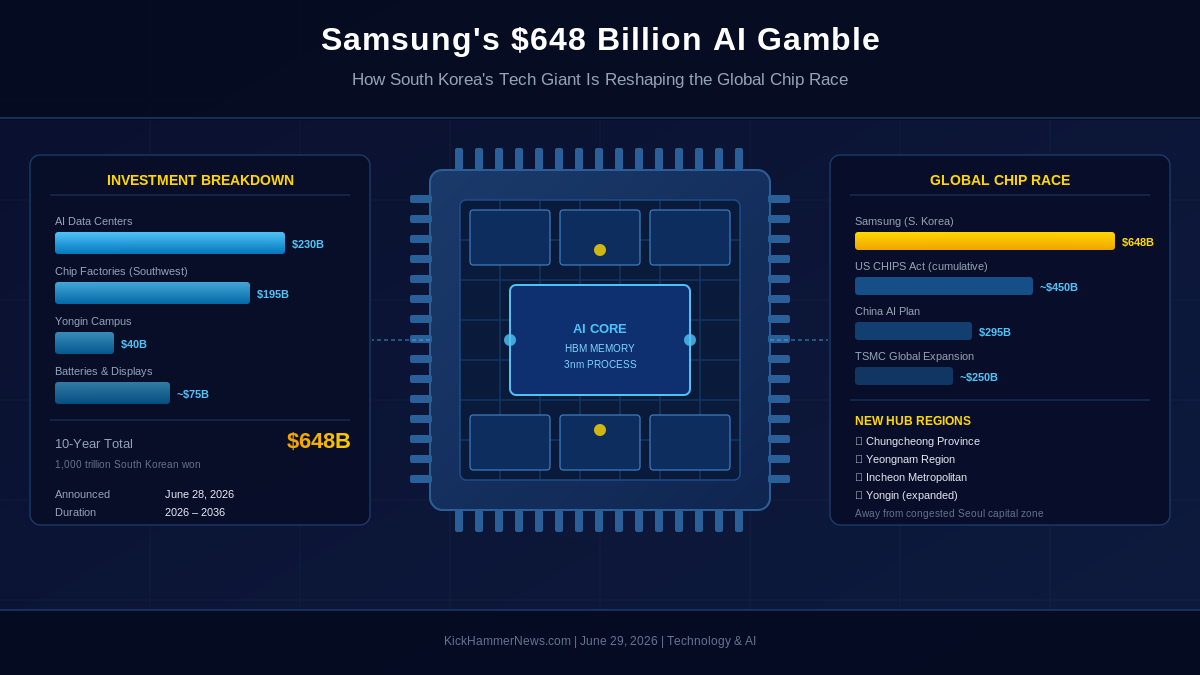
In a move that may be the largest single corporate investment commitment in South Korean history, Samsung Group is preparing to announce a staggering 1,000 trillion won — roughly $648 billion — investment package to be deployed over the next decade. The capital will flow into AI data centers, semiconductor fabrication plants, battery production lines, and advanced display facilities spread across multiple regions of South Korea. The announcement, formally unveiled at a government briefing attended by President Lee Jae Myung on June 28, 2026, signals that the global AI infrastructure race has entered a new and even more expensive chapter.
The Scale of the Commitment
To put $648 billion in perspective, it dwarfs the GDP of many mid-sized nations. Samsung’s plan earmarks more than 350 trillion won — roughly $230 billion — specifically for AI infrastructure, with a heavy emphasis on data centers. An additional 300 trillion won is slated for new chip factories, potentially centered in South Korea’s southwestern regions. The Yongin semiconductor complex will receive roughly 60 trillion won in new investment, while Samsung is also reaching into Chungcheong, Yeongnam, and Incheon to build entirely new technology corridors.
Why Now? The AI Pressure Cooker
The global AI boom — driven by large language models, autonomous agents, and AI-accelerated scientific research — has created insatiable demand for hardware. High-bandwidth memory chips, logic processors, and power-hungry data centers have become the new oil wells of the digital economy. Samsung’s HBM products are essential components in AI accelerators built by Nvidia, AMD, and a growing roster of custom silicon designers. Demand has outpaced supply at every turn, putting enormous pressure on Samsung to expand capacity and accelerate development.
Geopolitics and the Chip Race
This investment comes amid the most intense period of geopolitical competition over semiconductor supply chains in history. The US has invested hundreds of billions through the CHIPS Act. China has committed comparable sums to break free of Western chip dependencies. Taiwan’s TSMC continues to expand globally. Samsung, anchored in South Korea, is doubling down on its home-court advantage. President Lee Jae Myung has made regional economic development a cornerstone of his administration, and Samsung’s plan to build outside the capital region aligns with those goals.
The Friction Points
Not everyone is celebrating. Opposition lawmakers accuse the Lee administration of pressuring conglomerates to invest in politically favorable regions. Established tech manufacturing cities fear being left behind if capital flows to new mega-clusters. Academics question whether elite engineering talent can be convinced to relocate from Seoul to secondary cities — a challenge money alone cannot solve. Industry analysts also note that Samsung has struggled with yield issues in its foundry division, and a capital injection only helps if accompanied by the process discipline to use it effectively.
What This Means for the Global Tech Ecosystem
The Samsung announcement underscores that the AI infrastructure buildout has decades of runway remaining. It confirms that the competitive landscape for AI chips is becoming more geographically distributed, with no single country or company set to dominate. It also highlights the growing importance of energy and water infrastructure as limiting factors — Samsung’s geographic spread is partly a story about securing the resources to sustain next-generation manufacturing.
Looking Ahead
Whether Samsung can execute on this vision remains to be seen. A decade is a long time in technology. Samsung’s bet is ultimately that the physical substrate of computing — the silicon, the memory, the data centers — will remain as strategically valuable in ten years as it is today. Given the trajectory of the past five years, that seems like a reasonable wager.
Sources: Reuters, Business Standard, Android Headlines, Yahoo Finance