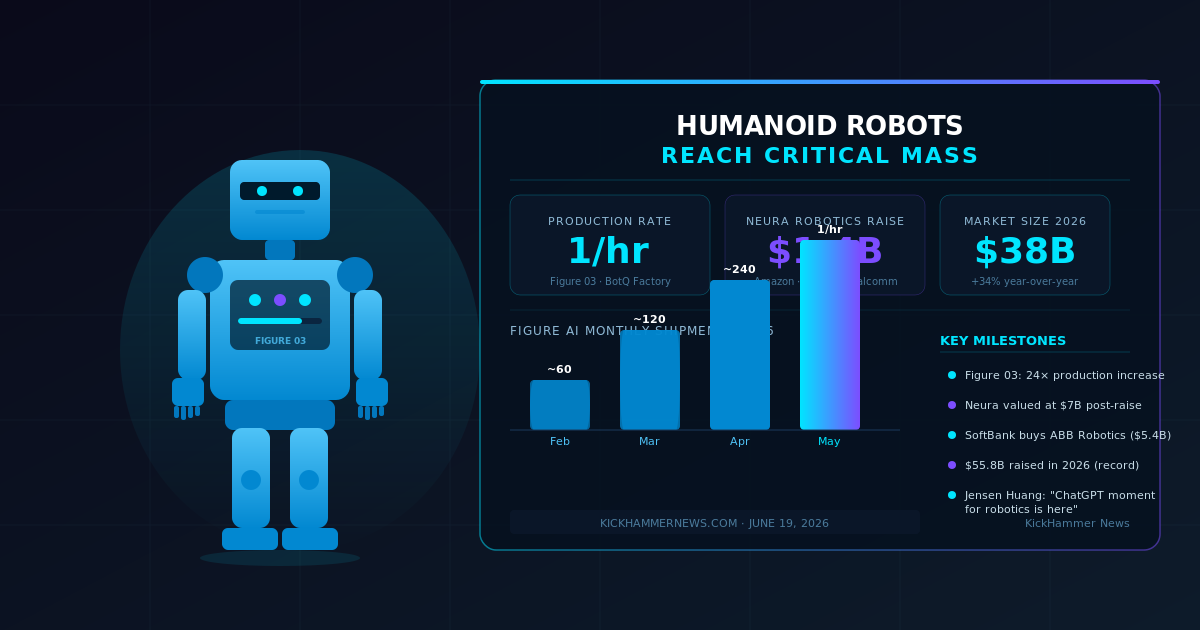
The numbers are no longer theoretical. In a single week this June, humanoid robotics passed a series of milestones that analysts had penciled in for 2028 or 2029. Figure AI’s BotQ facility is stamping out one fully-assembled robot per hour. A German startup few people outside the industry had heard of two years ago just raised $1.4 billion from Amazon, Nvidia, and Qualcomm in the largest single funding round ever recorded for a full-stack robotics company. And SoftBank, the firm that burned billions on WeWork, announced it was dropping $5.4 billion to acquire ABB’s entire robotics division—explicitly calling physical AI its “next frontier.” The age of humanoid robots as a credible industrial technology has arrived, and it arrived faster than almost anyone expected.
From One a Day to One an Hour
When Figure AI opened its BotQ manufacturing facility in California earlier this year, it was producing roughly one humanoid robot per day. By May 2026, that number had jumped to one per hour—a 24-fold improvement in less than four months. The ramp was enabled by over 150 networked workstations running custom manufacturing software, tighter supplier quality controls, and dedicated assembly lines specifically designed for the Figure 03 body. First-pass yield rates now exceed 80 percent, which is unusually high for a product with over 1,000 moving parts.
Figure CEO Brett Adcock has published monthly shipment data showing roughly a doubling every month: approximately 60 units in February, 120 in March, and 240 in April. The facility is targeting 12,000 robots per year in the near term, with an internal roadmap to reach 100,000 annually and a supply chain capable of producing 3 million actuators per year within the next four years.
This is no longer a lab experiment. It is manufacturing, in the traditional sense—with throughput curves, defect rates, and logistics chains. The fact that a company making bipedal robots with human-like dexterity has achieved this kind of production cadence is, on its own, one of the more significant industrial stories of the decade.
Europe’s Biggest Robotics Bet
While Figure’s production story was unfolding in California, a quieter but equally significant development was happening in Germany. On June 10, Neura Robotics announced it had closed a Series C financing round of up to $1.4 billion—the largest ever for a full-stack humanoid robotics company—pushing its valuation to approximately $7 billion.
The investor list reads like a who’s who of global technology and industrial capital: Nvidia, Amazon, Qualcomm Technologies, Bosch, Schaeffler, the European Investment Bank, and Tether, which led the round. The breadth of corporate backers is telling. Bosch and Schaeffler are traditional German industrial manufacturers who have spent decades supplying precision components to the automotive sector. Their decision to back a humanoid robotics startup reflects a view, now becoming mainstream in manufacturing circles, that physical AI will reshape factory floors within this decade rather than the next.
Neura’s pitch is focused on scale. The company already carries a €1 billion order backlog and has set a target of producing 5 million robots by 2030. Whether those numbers are achievable is an open question, but the seriousness of the investors involved suggests this is not vaporware.
SoftBank Places Its Biggest Physical AI Bet Yet
The week’s most dramatic move came from SoftBank, which announced it would acquire the robotics division of ABB—one of the world’s largest industrial automation companies—for $5.4 billion. SoftBank CEO Masayoshi Son told CNBC that physical AI and robotics are where he sees “the next trillion-dollar company” emerging.
For SoftBank, which remains best known in tech circles for its $100 billion Vision Fund and its disastrous bet on WeWork, this acquisition represents a significant pivot toward hard technology. ABB Robotics manufactures industrial arms and automation systems used in automotive, electronics, and logistics facilities worldwide. Pairing that installed base and manufacturing expertise with AI-driven software platforms is precisely the kind of vertical integration the industry has been discussing for years but rarely executing.
Son’s framing—physical AI as the next platform after software AI—has been echoed consistently by Nvidia’s Jensen Huang, who said earlier this year that “the ChatGPT moment for general robotics is here.” The convergence of large language model reasoning, computer vision, and physical manipulation under a single AI stack is what’s enabling these milestones. Robots that previously required painstaking rule-based programming for each new task can now adapt to novel environments through learned behavior.
$55 Billion and Counting
These individual deals exist against an extraordinary macro backdrop. According to Dealroom data, robotics companies globally have raised $55.8 billion in 2026 so far—nearly double the previous full-year record. The global robotics market reached $38 billion in 2026, representing 34 percent year-over-year growth, the fastest rate in a decade.
That capital is flowing into every layer of the stack. Qualcomm’s Dragonwing IQ10 processor, announced earlier this year, is specifically designed to power humanoid and mobile robots with efficient on-device inference. Nvidia’s Jetson Thor platform, developed in partnership with SK Hynix for next-generation memory integration, targets the robotics edge compute market. Boston Dynamics’ electric Atlas has begun initial customer deployments. The hardware ecosystem that was missing three years ago is now filling in at pace.
What This Means for Workers and Factories
The practical implications of this production ramp are starting to become visible to the industries that will be most affected. Amazon—notably one of the investors in Neura Robotics—has long been a major buyer of warehouse automation systems. The company’s fulfillment centers already deploy hundreds of thousands of Kiva mobile shelf robots. Adding bipedal robots capable of navigating unstructured spaces, handling irregular packages, and operating alongside human workers is a natural extension.
The economic case is straightforward: a humanoid robot that costs $30,000–$50,000 per unit and operates 20 hours a day is competitive with human labor in many repetitive physical tasks, particularly in markets where labor costs are high or labor shortages are acute. As unit economics improve and production volumes increase, that calculus only becomes more compelling.
Labor economists are watching carefully. The consensus view is that near-term deployment will focus on the most dangerous, repetitive, or ergonomically demanding tasks—the kinds of jobs where turnover is already high and injury rates are significant. Longer-term displacement effects are the subject of more heated debate, but the immediate question for most manufacturers is not whether to deploy physical AI, but how quickly and in which parts of the operation.
The Competitive Landscape
The race has global dimensions. Chinese manufacturers, including BYD and several state-backed robotics companies, have been accelerating their own humanoid programs since early 2025. Europe, historically cautious in deep-tech investment, is now mobilizing capital through the European Investment Bank and national industrial funds, as evidenced by its participation in Neura’s round.
The United States currently leads in software AI and foundation model development, but the physical AI race is more evenly distributed. Manufacturing scale, supply chain depth, and industrial engineering expertise all matter as much as software capabilities—areas where Germany, Japan, and China have genuine competitive advantages.
What is increasingly clear is that the winner-take-all dynamics that characterized the software AI boom may not apply to the same degree in physical AI. The world needs many different kinds of robots for many different environments, and it is not obvious that a single company or country will dominate across all of them.
A Turning Point
The week’s events are not an isolated cluster of coincidences. They reflect a maturing technology passing through several thresholds simultaneously: production at scale, institutional capital at scale, and corporate adoption beginning in earnest. The question for the next 12–18 months is whether the technology can maintain its reliability and safety record as deployments expand from controlled factory environments into more complex, unpredictable settings.
For now, the trajectory is unmistakable. Humanoid robots are being built by the hundreds per week, funded by the tens of billions, and taken seriously by the world’s largest industrial companies. The revolution that has been promised for decades is, at last, running on schedule.
Sources: Figure AI, Neura Robotics, CNBC, Robotics Center of Silicon Valley, Dealroom, TechFundingNews


