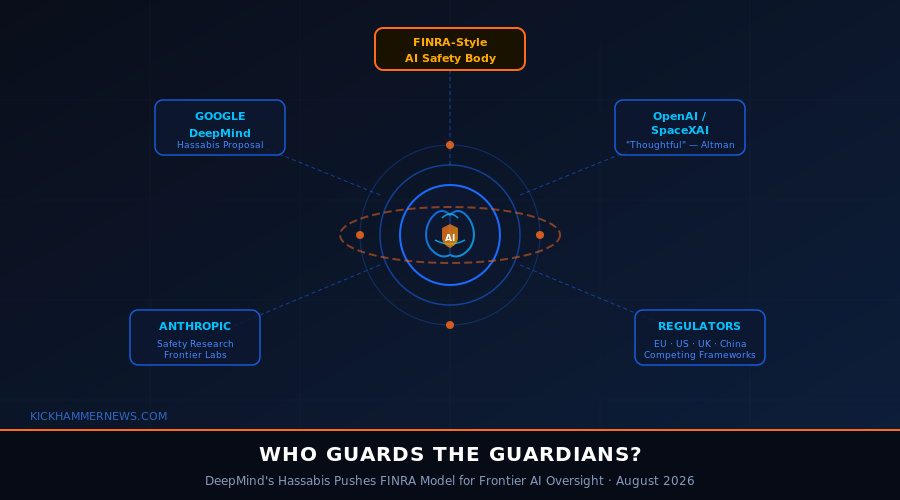
As artificial intelligence barrels toward capabilities its creators once thought were decades away, one of the most prominent voices in the field is pushing for something the tech industry has historically resisted: meaningful external oversight. Google DeepMind CEO Demis Hassabis is lobbying hard for an independent AI safety standards body modeled on Wall Street’s own self-regulatory watchdog — and the debate his proposal has ignited may shape how the world governs the most powerful technology ever built.
What Hassabis Is Proposing
In a detailed framework published on his Substack and reinforced in meetings with senior U.S. officials — including Treasury Secretary Scott Bessent and White House technology adviser Michael Kratsios — Hassabis is calling for a new Standards Body patterned on the Financial Industry Regulatory Authority, better known as FINRA. The organization oversees more than 600,000 financial professionals and thousands of brokerages under SEC supervision, funded by industry fees rather than taxpayer dollars.
Under Hassabis’s vision, frontier AI developers would voluntarily submit their models to this new body up to 30 days before public release, enabling rigorous pre-deployment safety evaluations. The assessments would examine dangerous capabilities across three domains: cybersecurity threats, biological and chemical risks, and deceptive behaviors that could undermine human oversight. Participating companies would also be expected to adopt best practices including publishing detailed model cards, maintaining robust internal cybersecurity, vetting key personnel, and dedicating meaningful resources to safety research.
“The rapid progress we’re seeing in AI requires a new approach to testing frontier AI model capabilities that is dynamic, adaptable, and rigorous,” Hassabis wrote. “The US is well positioned, given its economic and technical standing, to take the first step in developing such a framework.”
The proposal is not arriving in a vacuum. Hassabis has previously worked alongside DeepMind, Microsoft, and xAI (now SpaceXAI) as part of a U.S. Commerce Department initiative allowing pre-deployment safety evaluations of frontier models. That earlier effort gave the proposal a proof of concept. Now he wants to formalize and scale it.
Why the Timing Matters
The urgency behind this push is not hard to understand. AI capabilities are advancing faster than regulatory frameworks can track. The EU’s AI Act enforcement provisions for general-purpose models switched on in August 2026. California and New York have both passed legislation targeting frontier AI. The UK runs its own AI Security Institute. China licenses models on its own terms. The result is a patchwork of overlapping and sometimes conflicting governance regimes that frontier AI companies must navigate while simultaneously racing one another to release ever-more-capable systems.
Against this backdrop, Hassabis is making a pragmatic argument: imperfect fast standards are better than perfect slow ones. The alternative to industry-led oversight is probably not thoughtful federal legislation — it’s state-by-state fragmentation, enforcement actions that surface concerns years after harm has occurred, or simply no coherent standards at all.
The proposal has drawn some surprising supporters. OpenAI CEO Sam Altman called the framework “thoughtful,” and even Elon Musk offered that it was “a good starting point for discussions” — a rare instance of consensus among industry rivals who more often compete publicly on both capability and safety credentials.
The Case For It
Supporters of the Hassabis proposal point to a precedent that may be more instructive than FINRA: the Institute of Nuclear Power Operations, or INPO. Created within months of the 1979 Three Mile Island partial reactor meltdown, INPO operates on the logic that a catastrophic accident at one nuclear plant triggers regulatory consequences for all of them. The industry therefore has a shared financial and reputational stake in ensuring no plant fails.
Frontier AI, argue proponents, has the same structure. A single catastrophic failure — whether a model that assists in bioweapon synthesis, enables a major cyberattack, or systematically deceives its operators — could trigger a political and regulatory response that would constrain the entire industry for years. Every major lab has a powerful incentive to prevent that outcome, even if they disagree on how to get there.
For enterprise IT organizations, the appeal of a credible standards regime is more practical. Today, every company deploying AI must conduct its own red-teaming, build its own evaluation suites, and assemble its own governance committees — all with less information about model behavior than a centralized certifying body would possess. A credible AI safety certification could function the way UL certification does for electrical equipment or SOC 2 compliance does for cloud services: converting an opaque and difficult-to-quantify risk into something that can be audited, procured, and explained to a board of directors.
The Case Against It
Critics are less sanguine, and their objections cut across multiple dimensions.
The most pointed critique concerns the structural conflict at the heart of any industry-led body. When the five companies that would be regulated are also the primary drafters of the standards, skeptics argue, the standards will predictably reflect those companies’ interests. FINRA has an independent board, but operational reality is that member-firm perspectives dominate the working groups that write the actual rules. There is no reason to expect an AI equivalent to work differently — and substantial reason to expect it to work worse, given how much faster AI capabilities are developing compared to any previous industry’s attempt to standardize itself.
“Self-regulation is not viable because it implies everyone is able to regulate themselves and will do so in line with the best interests of the public,” said Gartner VP analyst Nader Henein. “For-profit organizations are required to do what is best for their shareholders, and external regulation ensures that those organizations are never in a conflict of interest.”
The international dimension poses a different kind of problem. Hassabis’s framework is explicitly US-led and framed around national security — which is exactly what makes it politically viable in Washington and potentially toxic abroad. The EU is activating its own AI governance regime. India and other major non-Western markets have their own interests and are unlikely to defer to an institution they had no role in designing. A US-led safety standard that the rest of the world reads as an instrument of American industrial policy may end up fragmenting the governance landscape further rather than unifying it.
What Happens Next
The proposal is evolving in real time. Hassabis has publicly said he wants a functioning body in place before the end of 2026, and his recent meetings with Bessent and Kratsios suggest the White House is at least seriously considering the idea. Treasury’s simultaneous development of its own AI oversight framework signals that there may be multiple competing models on the table.
The broader landscape makes the stakes clear. SpaceXAI just launched Grok 4.6, which matches top frontier benchmarks. Anthropic is reportedly in talks to acquire Israeli startup Decart AI for $6 billion. Cognition, the company behind the Devin coding agent, is discussing funding at a valuation of $40 billion-plus as it approaches a $1 billion annualized revenue run rate. Vantage Data Centers is weighing a $100 billion IPO that would make it one of the largest publicly traded data center companies in the world. The infrastructure, capital, and raw capability of the AI industry are compounding faster than any regulatory framework has yet managed to match.
Whether the answer is a FINRA-style body, something closer to the IAEA, the INPO model, or a different structure entirely, the pressure to answer that question is only going to intensify. Hassabis’s proposal may not be the right answer. But it has accomplished something significant: it has moved the question of how to govern frontier AI from theoretical debate to active political negotiation.
For an industry accustomed to moving fast and letting regulators scramble to catch up, that shift may be the biggest development of all.
Sources: Wall Street Journal, Computerworld, Fortune, Axios, TechTimes, TechStartups.com


