For decades, quantum computing has been confined to carefully controlled laboratory environments — rooms chilled to temperatures colder than deep space, shielded from every vibration, every stray photon, every electromagnetic whisper that could disturb the fragile quantum states at its heart. The idea of sending such a machine into the brutal chaos of low-Earth orbit — with its cosmic radiation, wild thermal swings, and violent launch forces — seemed almost absurd. Until now.
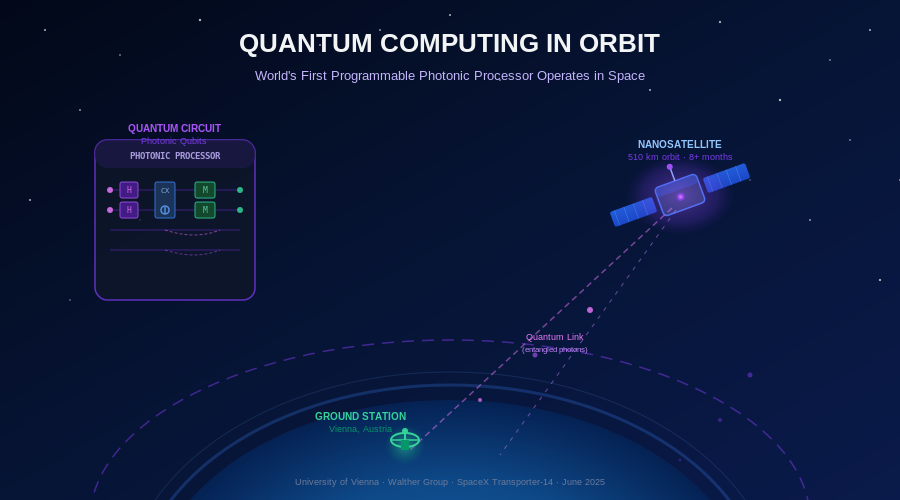
A team of physicists led by Professor Philip Walther of the University of Vienna’s Walther Group has done the seemingly impossible: they built a programmable photonic quantum processor small enough to fit inside a nanosatellite, launched it into space aboard a SpaceX Falcon 9 rocket on June 23, 2025, and kept it running in orbit for over eight months. A preprint published in late September 2026 confirming the prolonged operational success has sent shockwaves through the quantum computing and aerospace communities alike.
What Was Launched — and Why It Worked
The processor at the center of this milestone is not your typical quantum computer. Rather than relying on superconducting qubits — the technology favored by IBM, Google, and most of the major players in the field — the Vienna team chose photonic quantum computing, a fundamentally different approach that encodes quantum information into particles of light rather than electrical circuits.
This choice was no accident. Superconducting qubits require operating temperatures close to absolute zero (roughly -273°C), which demands massive, power-hungry dilution refrigerators that would be utterly impractical aboard a small satellite. Photonic qubits, by contrast, operate at room temperature. They are also naturally resistant to many forms of environmental interference, and photons — being massless particles of light — interact weakly with their surroundings, making them far more resilient to the radiation bombardment that regularly fries conventional electronics in orbit.
The processor was integrated into a compact nanosatellite — roughly the size of a shoebox — and launched as part of SpaceX’s Transporter-14 rideshare mission. It now orbits Earth at approximately 510 kilometers altitude, passing over ground stations multiple times per day. Despite the harsh radiation environment at that altitude and the punishing thermal cycles as the satellite moves between sunlight and shadow every 90 minutes, the quantum processor continued to function — running quantum circuits, executing gate operations, and transmitting results back to Earth — for more than eight months.
Eight Months That Changed Everything
The results, documented in the preprint, are remarkable not just for what they demonstrate about photonic hardware, but for the implications they carry for quantum communication and the future of a global quantum internet.
For years, physicists have known that quantum key distribution (QKD) — a method of transmitting cryptographic keys with security guaranteed by the laws of physics — would be vastly more powerful if satellites could relay quantum signals between continents. Ground-based quantum networks are limited by fiber optic losses; a photon carrying quantum information can only travel so far through fiber before the signal degrades beyond recovery. Satellites, operating above the atmosphere, could theoretically link quantum ground stations separated by thousands of kilometers, enabling truly global quantum-secure communications.
What the Vienna team has now shown is that the quantum hardware needed for such a network can survive in space. Over eight months of continuous operation, the photonic processor executed a series of benchmark quantum circuits — including two-qubit entanglement operations and multi-photon interference experiments — with fidelities that remained consistent with laboratory performance. Cosmic ray impacts caused occasional single-event upsets in the classical control electronics, but the quantum optical components themselves proved extraordinarily robust.
“This is the key result,” said Professor Walther in a statement accompanying the preprint. “We did not just launch a quantum device into space — we demonstrated that programmable quantum computation is viable in the space environment over operationally meaningful timescales. That changes the equation entirely.”
Why This Matters Beyond the Lab
The implications of this milestone ripple outward in several directions.
Quantum Cryptography at Global Scale. Today’s most advanced quantum key distribution satellites — like China’s Micius satellite — can distribute quantum keys between ground stations separated by over 1,000 kilometers, but they use single-photon sources for key distribution rather than running programmable quantum circuits. The Vienna processor adds a new capability: the ability to perform quantum computation directly in orbit, which is essential for quantum repeater networks and more sophisticated quantum communication protocols. A true quantum internet requires not just photon transmission but active quantum processing in the relay nodes — and that is exactly what Walther’s team has now proven can be done in space.
Quantum Sensing From Orbit. Photonic quantum processors are also powerful quantum sensors. A space-based quantum sensor could detect minute gravitational variations with extraordinary precision, enabling new forms of Earth observation — mapping subsurface geological formations, detecting aquifer depletion, monitoring ice sheet mass loss — with a sensitivity that no classical instrument can match. The 8-month operational data suggests that photonic quantum sensors could realistically be deployed on long-duration space missions.
Opening the Flood Gates for Quantum Space Programs. Perhaps most importantly, the Vienna mission serves as existence proof: the thing can be done. Within days of the preprint’s publication, three separate space agencies and a handful of quantum computing startups had reportedly reached out to the Walther Group to discuss future collaboration. The commercial quantum satellite market — estimated at barely a rounding error today — may be about to experience explosive growth.
The Road Not Taken — and Why That Matters
It is worth pausing to appreciate how counterintuitive this breakthrough actually is. The quantum computing industry’s mainstream narrative has been almost entirely dominated by the race to build ever-larger superconducting quantum processors — machines that live in laboratory basements, surrounded by miles of dilution refrigerator tubing, consuming kilowatts of power just to stay cold. IBM recently announced a 2,000-qubit processor. Google is racing toward fault-tolerant quantum computation with its superconducting Willow line. The implicit assumption has been that quantum computing would always be a centralized resource, accessible only through cloud APIs, never something that could venture beyond the controlled confines of a data center.
The Vienna nanosatellite upends that assumption. It does not have 2,000 qubits. Its photonic processor operates with a handful of entangled photon pairs. But it works in space — and that opens a category of applications that superconducting machines will likely never be able to address, no matter how many qubits they accumulate.
What Comes Next
The immediate next step for the Walther Group is to upgrade the in-orbit processor with higher-fidelity components and additional photonic modes, increasing its computational capacity while maintaining the compact, radiation-hardened design. A follow-on mission is reportedly in planning, targeting a 2027 launch window with a more capable processor designed to demonstrate genuine quantum advantage for satellite-to-ground quantum key distribution.
Further out, the vision is grander: a constellation of quantum-processing nanosatellites forming the backbone of a global quantum internet — nodes capable of storing, routing, and computing with quantum information at speeds and distances that would be impossible with fiber alone. The theoretical proposals for such a network have existed for years. What was missing was proof that the hardware could survive in space. Now, that proof exists.
The quantum internet has been a staple of physics roadmaps since the early 2000s. For most of that time, it has existed somewhere between “promising” and “perpetually ten years away.” The Vienna nanosatellite has just moved the needle. Quantum computing has left the building — and the planet. What comes next is anyone’s guess, but for the first time, it feels genuinely inevitable.
Sources: University of Vienna Walther Group preprint (September 2026); Quantum Computing Report; ScienceAlert; Phys.org; Interesting Engineering; Nature World News