Canonical’s latest interim release arrives in nine days, shipping the newest Linux kernel, a revamped desktop experience, and the clearest preview yet of where Ubuntu 28.04 LTS is headed.
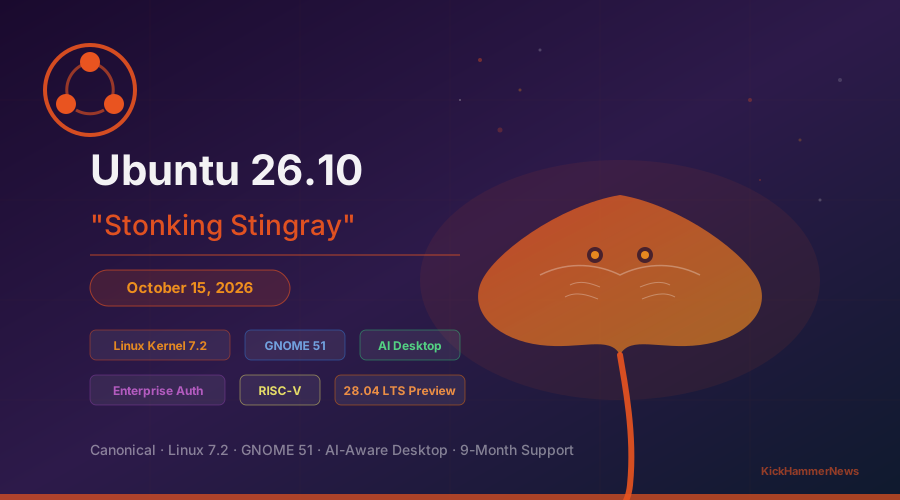
Ubuntu 26.10, codenamed “Stonking Stingray,” is on track for an October 15, 2026 release — and it may be the most consequential interim release the project has shipped in years. Packed with Linux kernel 7.2, GNOME 51, a dramatically rethought onboarding experience, and privacy-respecting AI capabilities baked directly into the desktop layer, Stonking Stingray is far more than a routine six-month bump. It is an architectural preview of Ubuntu 28.04 LTS, the next long-term support release due in April 2028, and Canonical is using it to lay the plumbing that enterprise customers will rely on for years.
Linux Kernel 7.2: New Hardware, New Horizons
At the foundation of Ubuntu 26.10 sits Linux kernel 7.2, the mainline release that was finalized in late August. For users on cutting-edge hardware, that matters immediately. Kernel 7.2 improves driver coverage for the latest-generation AMD and Intel GPU architectures, extends power management depth on ARM-based platforms, and refines the memory management subsystem in ways that are expected to improve latency on workloads with large working sets — including AI inference pipelines running locally on consumer hardware.
The kernel bump also brings updated Wi-Fi and Bluetooth stack improvements targeting Intel BE200 and MediaTek Filogic 860 adapters, making 26.10 a meaningful upgrade for users who received new laptops in 2026 and found them imperfectly supported on earlier Ubuntu releases.
From a security standpoint, Kernel 7.2 inherits a substantial set of hardening patches that landed in 6.19 and 7.0, including continued improvements to speculative execution mitigations and expanded Landlock LSM support for user-space sandboxing.
GNOME 51: Refinement Meets Purpose
Ubuntu 26.10 ships GNOME 51, which reached its stable milestone in September 2026. GNOME 51 is a focused release rather than a headline-grabbing feature drop — it concentrates on finishing the work begun in GNOME 47 and 48 around the new Files app design, improved app permissions management, and accessibility compliance targeted at WCAG 2.2 AA standards.
One infrastructure change that will be invisible to most users but significant to distributions is the completion of the migration from dbus-daemon to dbus-broker. The broker architecture delivers lower latency for inter-process communication and better behavior under process-limit pressure — which matters on systems handling many concurrent containerized workloads or Flatpak applications.
Multimedia gets a boost from GStreamer 1.30, which ships with an expanded set of Rust-based plugins. These plugins are generally more memory-safe than their C predecessors and benefit directly from GStreamer’s ongoing Rust rewrite strategy. Hardware-accelerated video decoding improvements land for both Intel Gen12+ and AMD RDNA 3 GPUs.
A Context-Aware, Privacy-First AI Desktop
The most philosophically interesting part of Ubuntu 26.10 is what Canonical calls the “context-aware desktop” — and it is worth pausing on what that phrase actually means here, because it is not the chatbot-in-a-sidebar approach that other operating systems have taken.
Canonical’s roadmap for 26.10 frames the goal as building systems that understand user intent across the operating system without requiring a persistent cloud connection or the surrender of personal data to an external service. The first visible manifestation is on-device speech-to-text, which works entirely offline using a locally-hosted model. Users can dictate into any application without audio leaving the device.
The broader vision — of a desktop that knows which documents are relevant to your current task, which applications you are likely to need next, and how to surface actions contextually — is being built incrementally. Ubuntu 26.10 plants the client-side foundations: model inference infrastructure, the APIs that applications will call, and the privacy controls that let users see exactly what the system is doing and turn it off at any level of granularity.
This positioning is deliberate. At a moment when AI-enabled operating systems are drawing scrutiny from privacy advocates and regulators in the EU and UK, Canonical is betting that “local by default, transparent by design” is a durable competitive position. For enterprise deployments subject to data residency requirements, that framing matters enormously.
Enterprise Authentication Gets Serious
Ubuntu 26.10 extends Authd — Canonical’s modern authentication daemon — with support for Microsoft password and MFA workflows. That means Ubuntu machines can now authenticate directly against Entra ID (formerly Azure Active Directory) using the same credentials and multi-factor authentication flows as Windows devices, without requiring additional middleware.
PKCS#11 and smart-card support is expanding, and administrators gain finer-grained control over authentication policies through the updated Group Policy Object layer. These additions close a gap that has kept some security-conscious organizations on Red Hat Enterprise Linux or Windows-only estates; the 26.10 improvements bring Ubuntu closer to feature parity for identity and access management in hybrid enterprise environments.
The RISC-V platform also reaches a milestone: Ubuntu Desktop on RISC-V hardware is now considered complete, targeting boards like the StarFive VisionFive 2 and the Milk-V Jupiter. As RISC-V gains traction in edge computing and some enterprise segments, having a fully supported desktop brings Ubuntu’s reach into territory it previously occupied only partially.
GRUB Security Hardening: A Necessary Trade-Off
One change that will surprise users attempting to use non-standard boot configurations is the tightening of signed GRUB for Secure Boot systems. Canonical is removing support for btrfs, hfsplus, XFS, and ZFS as /boot filesystems in signed GRUB builds, along with JPEG and PNG image rendering in the bootloader. The retained filesystems are ext4, FAT, ISO9660, and squashfs for snaps.
The motivation is attack-surface reduction. Signed GRUB images that ship with broad filesystem support represent a larger target for Secure Boot bypass exploits. By narrowing what signed GRUB can parse, Canonical reduces the potential for a crafted partition to subvert the boot chain.
Users who rely on ZFS or XFS for their /boot partition on Secure Boot-enabled systems will need to migrate to ext4 before upgrading, or disable Secure Boot. This affects a small but vocal segment of advanced users, and the Ubuntu community forums will almost certainly surface migration guidance in the days following release.
Building Toward 28.04 LTS
Much of what makes Ubuntu 26.10 interesting is not what it ships today but what it enables in 2028. The rearchitected installer — focused on guided workflows for both individual and enterprise deployments — is being developed in 26.10 with the expectation that it reaches production quality in the 27.04 and 27.10 cycles before becoming the standard for 28.04 LTS. Similarly, the first-boot personalization redesign, which moves account setup and preferences out of installation and into the initial login experience, is prototyped in Stonking Stingray.
Canonical’s engineering cadence here is deliberate. Interim releases absorb breakage and feedback; LTS releases lock in stability. Stonking Stingray is doing exactly what a strong interim release should do: taking calculated risks and building the muscle memory the project needs before the next long-term commitment.
For Linux users willing to live on the six-month cycle, October 15 is marked. For everyone waiting for 28.04 LTS, Stonking Stingray is the surest signal yet that the wait will be worth it.
Ubuntu 26.10 “Stonking Stingray” releases October 15, 2026, with nine months of security updates and support. Upgrade paths from Ubuntu 26.04 LTS will be available at launch.