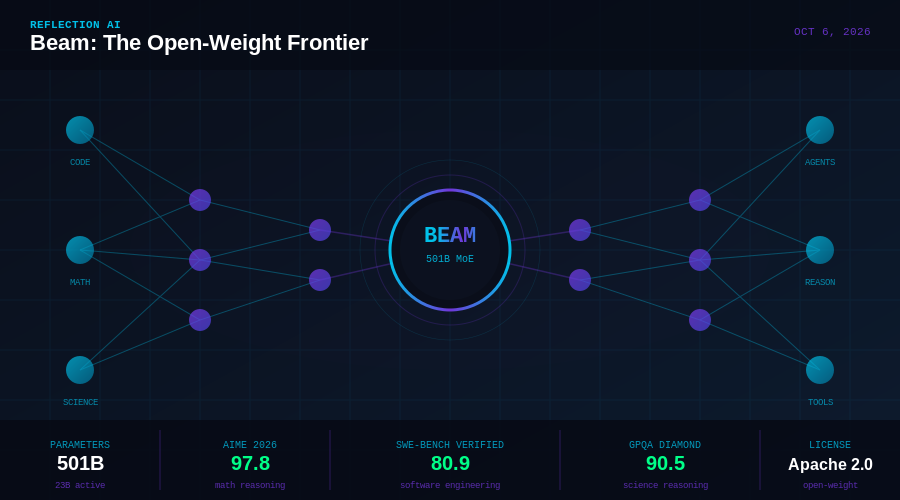
In a move that has electrified the open-source AI community, Reflection AI today unveiled Beam — a 501-billion-parameter mixture-of-experts model that the startup is releasing under an Apache 2.0 license. The announcement redraws the boundary between what open-weight models can achieve and what frontier labs keep locked behind API walls, delivering benchmark scores that put it squarely in competition with the most capable proprietary systems in the world.
What Is Reflection AI, and Why Does Beam Matter?
Reflection AI is a San Francisco-based startup that has spent the past two years quietly building toward exactly this moment. The company’s thesis has been simple but audacious: that with the right architecture, training methodology, and scale of reinforcement learning, an open model can reach — and in some specialized domains, exceed — the capabilities of closed frontier systems.
Beam is their first public proof of concept. It is not a lightweight distilled model designed to run on a laptop. It is a full-scale, research-grade system trained on the same computational tier as the models produced by OpenAI, Anthropic, and Google DeepMind — the difference being that every weight, every technical detail, and all supporting tooling will be publicly released. For an ecosystem that has grown anxious about AI capability concentration, that distinction is not trivial.
Inside the Architecture: 501 Billion Parameters, 23 Billion Active
Beam’s design reflects some of the most sophisticated thinking in contemporary language model engineering. The model uses a sparse Mixture-of-Experts (MoE) architecture, meaning that while it has 501 billion total parameters, only approximately 23 billion are active during any given forward pass. This is the same efficiency trick used by models like GPT-4 and Gemini Ultra — routing each token through only the most relevant subset of expert networks — but Reflection AI has pushed it to an unusual scale for the open-weight world.
The architecture incorporates interleaved local and global attention mechanisms, fine-grained routed experts, and stability innovations including SandwichNorm and FP32 residual accumulation across 52 layers. Reflection also introduced what they call “auxiliary-loss-free load balancing with cosine decay,” a training technique that keeps expert utilization balanced without the degradation that typically occurs when models grow this large.
The result is a model that, according to Reflection’s own claims, achieves three to four times greater inference efficiency than comparable systems at similar benchmark levels — meaning you can serve Beam at significantly lower cost per token than alternatives with similar reasoning capability.
Training at an Unprecedented Open-Lab Scale
The pretraining run alone required 6,144 NVIDIA GB300 NVL72 GPUs operating for under four weeks, processing 23.8 trillion tokens curated from the web and proprietary licensed datasets. Reflection built custom quality classifiers that eliminated approximately 95% of raw internet content, retaining only what their system judged to be high-signal material. The team reports achieving 92.3% “goodput” — the percentage of training steps that successfully contributed to learning — a number that reflects exceptional infrastructure reliability at this scale.
The reinforcement learning phase was even more striking. Using 10,500 GB300 GPUs over four weeks, Reflection’s team generated over 100 million rollouts with context lengths up to 256,000 tokens and approximately 1.3 billion sandboxes for training and evaluation. The company describes this as “one of the largest scale RL runs conducted by any open lab to date.” The RL training used stable asynchronous policy gradients and token-efficient reasoning with controllable length penalties — techniques designed to improve both the quality and the cost of reasoning at inference time.
Benchmark Performance: Rewriting What Open-Source Can Do
The benchmark numbers have sent shockwaves through the AI research community. On AIME 2026, the gold-standard competitive mathematics benchmark, Beam scored 97.8 — a result that rivals the highest-performing closed models in existence. On SWE-Bench Verified, a measure of real-world software engineering capability, it scored 80.9, and on the more demanding SWE-Bench Pro v2-Hard variant, it achieved 77.2. GPQA Diamond, which tests graduate-level scientific reasoning, returned a score of 90.5. On Terminal Bench v2.1, which measures agentic coding capability in realistic shell environments, Beam scored 80.1.
These numbers matter in context. SWE-Bench Verified scores in the low-80s have historically been the territory of GPT-4o-class frontier systems. An open-weight model reaching that tier — and doing so with a fraction of the inference compute cost — represents a genuine threshold being crossed.
Coding, Agentic Tasks, and STEM Problem-Solving
Reflection positions Beam as purpose-built for the workflows that matter most to developers and technical AI users: interactive web application development, software debugging and refactoring, STEM problem-solving, game development, and model fine-tuning pipelines. In internal demonstrations, the model was shown generating real-time data dashboards, autonomously navigating complex codebases, and conducting mathematical proofs end-to-end.
The agentic dimension is particularly significant. Beam was designed from the start for tool-use and multi-step reasoning — capabilities that are increasingly central to how AI systems are deployed in production. With the rise of coding agents and autonomous development pipelines in 2026, a model that can reliably plan, execute, and debug across long contexts is genuinely useful in ways that earlier open-weight releases were not.
Safety and Alignment Built In
Reflection did not skip the safety work. Beam underwent deliberative alignment training — a multi-stage process that combines reinforcement learning from human feedback with adversarial red-teaming — and was trained using multi-teacher on-policy distillation that integrates signals from both task-performance specialists and safety-focused models. The company says the result is a model that meaningfully reduces harmful output generation compared to purely capability-optimized baselines, without the performance penalties that safety-capability trade-offs typically impose.
Availability and the Open-Source Implications
Beam will be released this month under the Apache 2.0 license, which means anyone can use, modify, and distribute the model — including for commercial purposes — without royalty obligations. The release includes full model weights, technical documentation, and developer tooling. An API beta is already accessible through Reflection’s platform while weights are finalized.
The timing is deliberate. Chinese labs — including DeepSeek, Moonshot AI, and Alibaba’s Qwen team — have been aggressively releasing competitive open-weight models throughout 2026, narrowing and in some cases eliminating the gap with Western frontier systems. Beam is, in the words of one analyst, “the Western answer to that pressure” — a signal that open research in the United States and Europe remains capable of competing at the highest tier without requiring proprietary access restrictions.
A Turning Point for the Open AI Ecosystem
The release of Beam arrives at a moment when the open-source AI ecosystem is debating its own future. Critics of open-weight releases argue that making frontier-class models freely available accelerates proliferation risks. Proponents contend that transparency, auditability, and broad access are essential safety mechanisms in their own right — that a world in which only a handful of companies control the most powerful AI systems is itself a profound risk.
Reflection AI, through the release of Beam, is firmly in the second camp. Whether Beam proves to be the beginning of a sustained open-weight frontier push or a singular moment before capability concentration reasserts itself remains to be seen. But for now, on this October morning in 2026, the bar for what “open source” means in AI has been raised — and it is higher than it has ever been.
Beam model weights will be available via Hugging Face under Apache 2.0 license. Early API access is available at reflection.ai.


