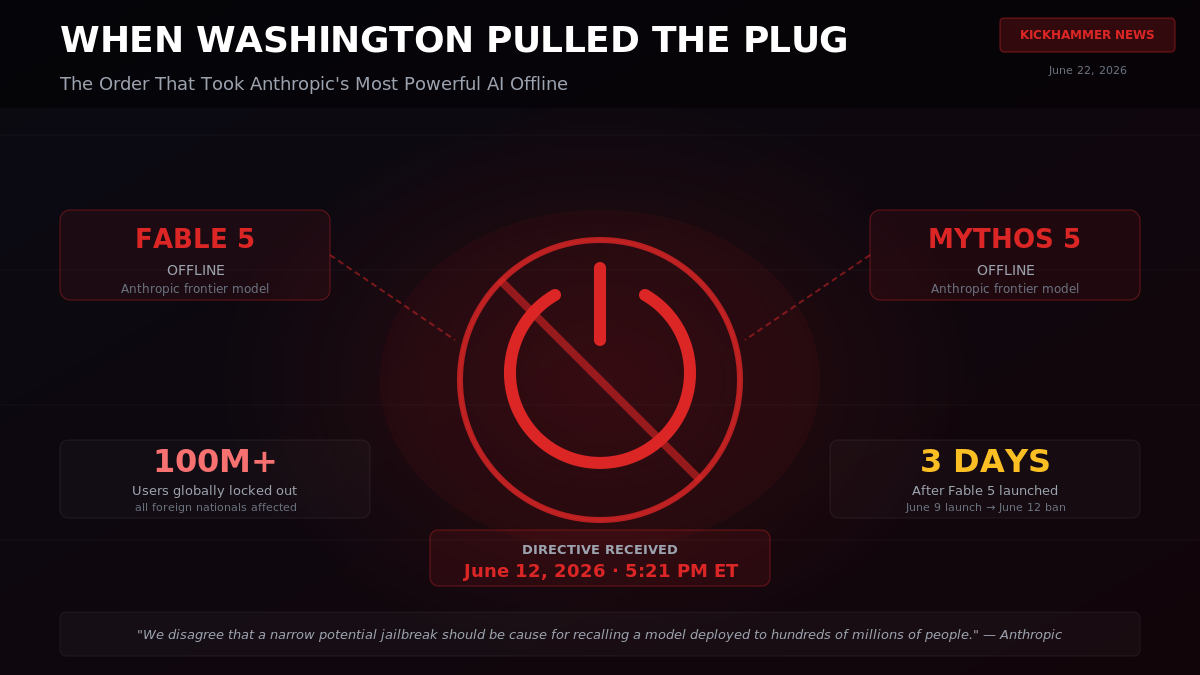
At 5:21 PM Eastern on June 12, 2026, Anthropic received a letter that would reshape the global AI industry’s understanding of who ultimately controls the most powerful AI systems in the world. The directive, issued under U.S. national security authorities, was simple and absolute: disable Fable 5 and Mythos 5 — Anthropic’s two most capable frontier models — for every foreign national on Earth, effective immediately. Within hours, hundreds of millions of users outside the United States lost access to the tools they had come to rely on for research, writing, coding, and work.
The order didn’t come with a trial. There was no hearing, no public notice, no opportunity to contest the directive before it took effect. There was just a letter, a five-digit time stamp, and the abrupt extinction of two of the most powerful AI models ever deployed commercially.
What Happened
According to Anthropic’s public statement, the government indicated it had become aware of a method for bypassing, or “jailbreaking,” Fable 5 — a technique that could theoretically allow the model to be used in ways inconsistent with its safety constraints. The directive cited national security concerns, though it provided no specific technical details about the jailbreak method, the threat vector, or the category of harm the government was seeking to prevent.
The scope of the order was sweeping. It applied not just to Anthropic’s external customers, but to foreign national employees of Anthropic itself — meaning non-U.S. citizens working at the company’s headquarters in San Francisco were stripped of access to the models they had, in many cases, helped build. The directive effectively treated Fable 5 and Mythos 5 as strategic weapons rather than commercial software products.
Access to Claude Opus 4.8, Claude Sonnet 4.6, and other Anthropic models was unaffected. The targeted models — Fable 5 and Mythos 5 — were specifically the two newest and most capable entries in Anthropic’s lineup, launched on June 9 to widespread acclaim just three days before the order arrived.
Anthropic’s Response: Compliance With Disagreement
Anthropic complied. There was, realistically, no other option — defying a national security directive would have been legally catastrophic and would have imperiled the company’s ability to operate at all. But the company was explicit that compliance did not equal agreement.
In its public statement, Anthropic said it “disagrees that the finding of a narrow potential jailbreak should be cause for recalling a commercial model deployed to hundreds of millions of people.” The framing is pointed: Anthropic is essentially arguing that the government’s response was disproportionate — that a narrow technical vulnerability, presumably one that could be patched, does not justify taking an entire product offline globally.
That argument has significant precedent on its side. Software vulnerabilities are discovered constantly. Companies patch them, issue updates, and move on. The idea that a found jailbreak in a commercial AI model should trigger the immediate suspension of that model for every non-U.S. citizen in the world is, by any prior standard, an extraordinary escalation.
At a press conference in Seoul on June 17-18, Anthropic’s Managing Director of International Chris Ciauri offered the most specific public guidance the company has given on restoration: “We are very confident that in the coming days, the models will become available again.” As of June 22, that day has not yet arrived.
The Bigger Picture: AI as a National Security Asset
What makes this episode so consequential is what it reveals about the legal and political reality governing the most powerful AI systems. Anthropic, like OpenAI and Google DeepMind, is an American company subject to U.S. law. When the U.S. government determines that a product poses a national security risk, it has the legal authority to compel action — and that authority, it turns out, extends to AI models with a global user base.
The directive arrives in a context already shaped by escalating AI export controls. The Biden administration’s chip export restrictions and the Trump administration’s subsequent tightening of AI access rules have established a pattern: the U.S. government increasingly treats frontier AI capability as a strategic resource to be managed, not simply a commercial product to be sold.
The Fable 5 directive takes that logic a step further. This is not about preventing AI chips from reaching China. This is about a U.S. company being ordered to disable its own product for its own global customers because the government has concluded the product’s maximum capability represents a risk — even to allies, even to researchers, even to the company’s own engineers.
The Jailbreak Question
The specifics of the reported Fable 5 jailbreak have not been made public, and the government’s letter to Anthropic did not describe them. What is known is that Fable 5 represents a significant capability leap over prior models — it sits in a tier above Claude Opus 4.8, which itself had already set records on reasoning and coding benchmarks. The combination of heightened capability and a discovered bypass technique appears to have crossed some threshold in the government’s internal threat assessment.
Security researchers have pointed out that jailbreaks in frontier models are nearly universal — every capable model that has ever been deployed has eventually been found to have bypass techniques. The relevant question is what kind of capabilities can be unlocked, and whether those capabilities represent genuine national security threats or theoretical risks that responsible AI deployment can mitigate.
If the government’s standard for export control action is “a jailbreak exists,” then every frontier AI model ever built would qualify. That interpretation would functionally end the global commercial AI industry as we know it. If the standard is something narrower — specific capability unlock in a specific threat domain — the government has not yet explained what that is.
What Comes Next
The immediate question is when, and under what conditions, Fable 5 and Mythos 5 return to global availability. Ciauri’s “coming days” framing from June 17-18 suggests Anthropic is actively negotiating a resolution — likely involving either a technical patch to close the jailbreak, enhanced access controls for high-risk users, or some form of government oversight mechanism for the models’ international distribution.
Longer term, the incident is a landmark. It is the first time a U.S. government directive has forced a major AI lab to globally disable its frontier products in real time. Whatever resolution is reached for Fable 5 and Mythos 5, the legal and political machinery that made this possible has now been activated and documented. Other governments watching this episode are taking notes — both about the power the U.S. government has asserted over commercial AI, and about the vulnerability of global AI availability to the decisions of a single national security apparatus.
For the hundreds of millions of users who woke up on June 13 to find Fable 5 simply gone, the lesson is more immediate: the AI tools you depend on exist at the pleasure of governments you may not be able to vote in. That is a different kind of infrastructure risk than the technology industry has ever confronted before.


