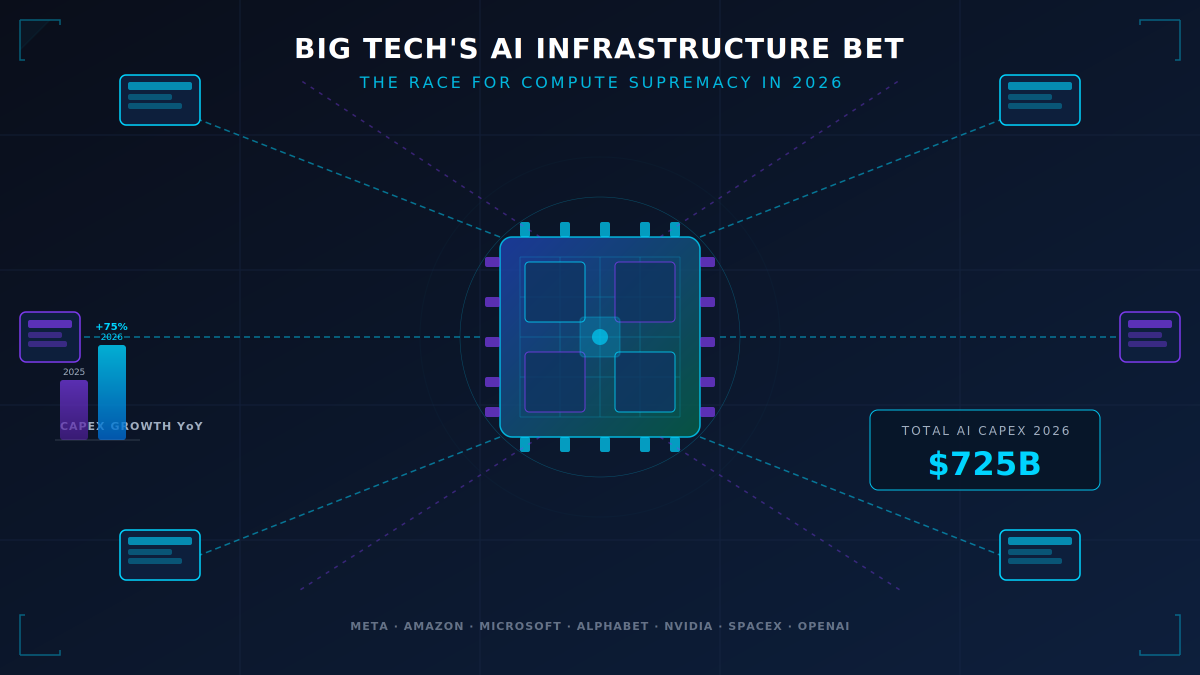
The numbers are staggering. Meta, Amazon, Microsoft, and Alphabet have collectively committed roughly $725 billion in capital expenditures for 2026 — an increase of more than 75 percent compared to the prior year — with nearly every dollar earmarked for data centers, custom chips, GPUs, and the AI models that consume them. At the same time, these same companies have been quietly eliminating tens of thousands of jobs, laying bare a profound reshaping of how the technology industry values humans versus machines.
This is no ordinary investment cycle. What is unfolding right now is a full-scale restructuring of the global technology stack, one in which compute infrastructure has become the single most strategically important asset in the world.
When Capital Expenditure Becomes Arms Race
For most of the last decade, Big Tech competed on software, talent, and platform reach. The race to recruit the best engineers, acquire the hottest startups, and build the most compelling consumer products defined the era. That era is over. Today, the decisive advantage is measured in gigawatts, racks, and chips.
Meta plans to lay off roughly 8,000 employees in May 2026 alone. Amazon has shed approximately 30,000 roles in recent months. Microsoft extended voluntary buyout offers to around 125,000 employees. The message could not be clearer: payroll is out, petaflops are in.
The strategic logic is compelling even if the human cost is sharp. Training a state-of-the-art AI model requires vast amounts of compute — measured in GPU hours that cost millions of dollars per training run. Deploying those models at scale requires inference infrastructure running continuously across hundreds of thousands of servers. Companies that own that infrastructure own the economics of AI. Those that do not are permanently dependent on someone else’s margins.
Nvidia, IREN, and the 5-Gigawatt Frontier
Nowhere is this dynamic clearer than in Nvidia’s latest infrastructure play. The company has agreed to invest up to $2.1 billion in IREN as part of a deal targeting up to 5 gigawatts of data center capacity. That number — five gigawatts — is worth pausing on. A single gigawatt can power roughly 750,000 homes. The AI industry is now building data centers that could theoretically power entire cities, just to run models.
For Nvidia, the move is about more than chips. It is about securing access to the physical infrastructure layer: power, land, cooling systems, and network connectivity. As the AI training and inference market grows, chip supply alone no longer guarantees dominance. The bottleneck is increasingly about who can provide enough electricity and physical rack space to run the chips.
The broader data center boom has triggered its own geopolitical complications. In Michigan, a farm town voted down plans for a massive 21-million-square-foot OpenAI-Oracle AI data center, citing concerns about farmland loss, power grid strain, and traffic. Weeks later, after a lawsuit and settlement, construction equipment arrived anyway. The $16 billion Stargate project is proceeding — illustrating both the enormous financial stakes involved and the political pressures that hyperscale AI projects are beginning to generate in local communities.
SpaceX Enters the Chip Business: The Terafab Vision
Perhaps the most audacious move in the AI infrastructure race belongs not to any of the traditional tech giants, but to Elon Musk’s SpaceX. Recent filings point to a proposed $55 billion Terafab facility in Texas — a massive AI chip manufacturing plant designed to support Tesla’s self-driving systems, humanoid robot programs, AI data centers, and potentially space-based compute infrastructure.
If the Terafab project proceeds, it would represent one of the most dramatic examples of vertical integration the tech industry has ever seen. Rather than simply purchasing compute from Nvidia or AMD, Musk’s empire would control the full stack: from raw silicon to chips, to data centers, to the AI models themselves, to the products those models power. It is a vision that echoes the kind of industrial integration last seen in the era of large manufacturing conglomerates — but applied to the infrastructure of the digital age.
The Terafab plan also signals a deeper shift: the AI race is increasingly pulling in actors from outside the traditional technology sector. Aerospace companies, defense contractors, energy utilities, and even real estate developers are all becoming stakeholders in the AI infrastructure ecosystem.
OpenAI’s $18 Billion Chip Headache
Not every attempt to break free of Nvidia’s dominance is going smoothly. OpenAI’s effort to develop custom AI chips in partnership with Broadcom has reportedly hit an $18 billion financing obstacle. The deal was designed to reduce OpenAI’s long-term dependence on Nvidia and bring down the cost of running its models at scale — an entirely rational strategy given that GPU supply has been tight and expensive.
But the financing challenge illustrates just how capital-intensive the path to chip independence truly is. Even the world’s best-funded AI company is struggling to raise enough capital to build its own silicon supply chain. Custom chip development requires years of engineering work, enormous upfront investment, and the willingness to absorb major losses before any returns materialize. It is a bet that only the very largest players can seriously make — and even they are finding it harder than expected.
This puts the broader chip landscape into stark relief. Nvidia remains the dominant supplier, and the combination of its technical lead, software ecosystem (CUDA), and supply chain position makes it extraordinarily difficult to displace, even for companies spending billions of dollars to try.
The Human Cost of the Compute Boom
It would be a mistake to discuss the $725 billion AI infrastructure wave without acknowledging what it means for the people being displaced. The workforce reductions at Meta, Amazon, and Microsoft are not random cost-cutting exercises — they are, by the companies’ own admission, strategic reallocations from human labor to automated infrastructure.
This is the central tension of the current AI era. The same technology that is attracting hundreds of billions in investment is also making large categories of knowledge work more automatable. Customer service, software development, content moderation, data analysis — all of these fields are seeing AI substitution accelerate. The $725 billion being spent on infrastructure is, in part, an investment in replacing the functions that previously required large human teams.
The economic implications are still being debated by policymakers and researchers, but the directional trend is unmistakable. Companies are making a bet that the long-run economics of AI-powered operations are superior to human-staffed ones — and they are making that bet with unprecedented capital commitments.
What This Means for the Future of AI
The AI infrastructure investment cycle of 2026 is best understood not as a short-term spending surge, but as the laying of foundational rails for the next decade of the digital economy. The data centers being built today will train and serve the AI models of 2028 and beyond. The custom chips being designed now will underpin applications that do not yet exist. The power grid negotiations happening in local governments will determine which regions become AI manufacturing hubs.
For enterprises and developers watching from the sidelines, the key implication is this: access to frontier AI is increasingly tied to relationships with the handful of hyperscalers who own the infrastructure. Startups that can run on open-source models on commodity hardware retain independence. Those that need the largest, most capable proprietary models are increasingly dependent on platforms controlled by companies spending $725 billion a year on compute.
The AI arms race is no longer metaphorical. It is a very real competition for physical resources — power, land, chips, and capital — and the companies winning that race are betting that whoever controls the infrastructure controls the future.
With $725 billion on the table in 2026 alone, they may be right.
Sources: TechStartups.com, Reuters, The Verge, Fortune, AP News, The Information


