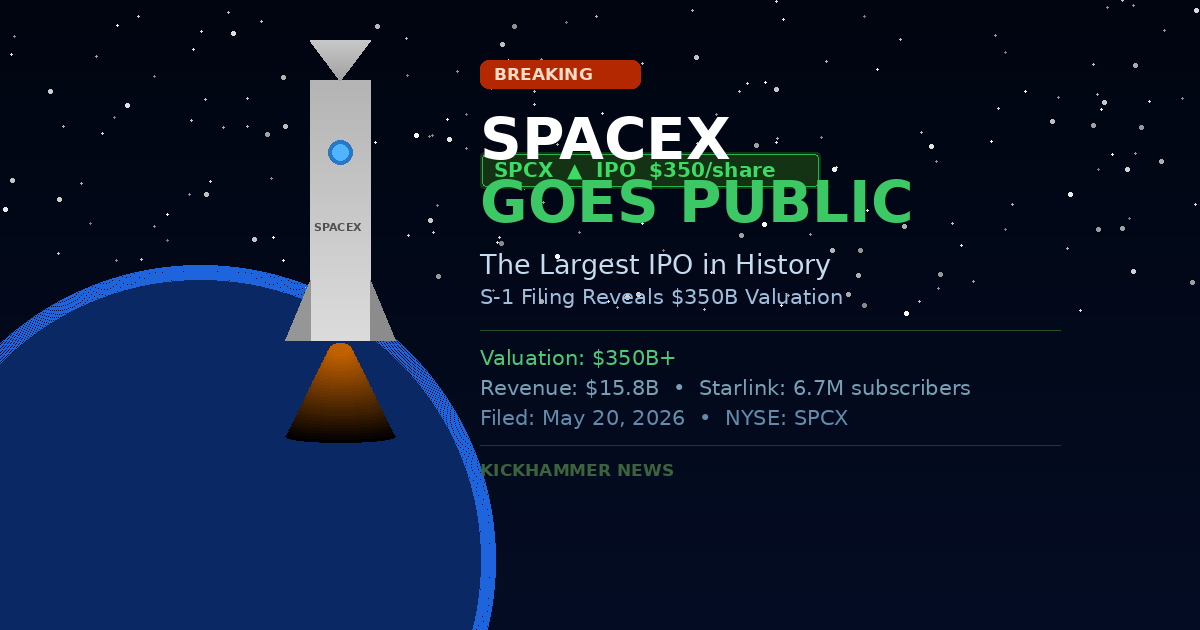
When SpaceX quietly filed its S-1 registration statement with the Securities and Exchange Commission on May 20, 2026, it drew back the curtain on a company that has quietly transformed from a scrappy rocket startup into one of the most complex and consequential technology conglomerates on the planet. Set to trade on the Nasdaq under the ticker SPCX, the offering is expected to raise approximately $75 billion — making it the largest initial public offering in market history — at a valuation north of $1.75 trillion. To put that number in perspective: it would rank SpaceX among the five most valuable publicly-traded companies on Earth from day one of trading.
But the real story is not the headline valuation. It is what the hundreds of pages of the S-1 reveal about where SpaceX has been, where it is bleeding money, and where it is betting its future.
From Rockets to Conglomerate: The Business SpaceX Has Become
SpaceX was founded 24 years ago with an almost cartoonishly audacious mission: make humanity a multi-planetary species. That mission remains enshrined in the S-1 opening pages. But the business that surrounds it has grown into something early investors could not have imagined. The filing describes a company operating across four distinct segments: launch services, satellite broadband (Starlink), artificial intelligence (via xAI, merged into SpaceX in February 2026), and a social media platform (X Holdings). By the time SPCX begins trading on June 12, 2026, investors will be buying a vertically integrated technology empire spanning low-Earth orbit, frontier AI, global internet infrastructure, and one of the world’s most trafficked social platforms.
Starlink: The Engine That Funds Everything Else
The financial backbone of SpaceX today is Starlink, its satellite internet constellation. The S-1 reveals that Starlink generated more than half of the company’s 2025 revenue of $18.7 billion — growing 33% year-over-year. As of March 31, 2026, Starlink had 10.3 million active subscribers across 164 countries and territories, with approximately 9,600 satellites in low-Earth orbit. Starlink generated a quarterly profit of $1.2 billion, making it the sole reliably profitable division. SpaceX has launched more than 80% of all mass to orbit globally every year since 2023, with a 99%-plus mission success rate across its Falcon rockets.
The xAI Problem: Burning Cash at AI Speed
After absorbing xAI in February 2026, SpaceX inherited a division spending at extraordinary scale while producing disappointing revenue growth. SpaceX directed approximately 60% of its 2025 capital spending to its AI division, or roughly $20 billion, funding COLOSSUS and COLOSSUS II compute clusters. The AI division grew revenue by only about 22% in 2025 — far below frontier AI competitors posting 100%+ growth. One notable bright spot: SpaceX signed Cloud Services Agreements with Anthropic worth $1.25 billion per month through May 2029.
Dual-Class Shares: Musk Stays in Control
SpaceX will issue Class A shares (one vote each) and Class B shares (ten votes each). Musk will hold sufficient Class B shares to maintain a voting majority and retain the right to elect a majority of the board for as long as any Class B shares exist. For investors, this is the known trade-off of founder-led visionary companies — extraordinary upside potential paired with concentrated control.
The Losses Are Real. So Is the Momentum.
The S-1 does not soft-pedal SpaceX’s financial history. The company has accumulated more than $37 billion in total losses since inception, and lost approximately $4.9 billion in 2025 on revenue of $18.7 billion. Yet context matters. These are the losses of a company building infrastructure — launch facilities, satellite constellations, GPU farms, and rocket reusability technology — that would have cost nation-states hundreds of billions more to replicate. Starlink already generates profit at scale. The Starship program, now in its 12th test flight cycle, promises to reduce per-kilogram launch costs by another order of magnitude once fully operational.
What Comes Next
With the IPO targeted for June 12, SpaceX will spend the coming weeks on a roadshow, presenting to institutional investors who will set the final offering price. The $75 billion raise, if achieved, would eclipse the previous record IPO — Saudi Aramco’s $29.4 billion offering in 2019 — by more than 2.5 times. For the broader technology industry, the SPCX debut will be a moment of reckoning. It will test whether public markets are ready to assign values once reserved for the most dominant software companies to a business that builds rockets, runs satellites, trains AI models, and hosts a global social media platform — all under one roof, all controlled by one man. Twenty-four years after Elon Musk founded SpaceX with the conviction that a private company could make it to orbit, the market is about to give its verdict. The price will be measured in the trillions.


