June 5, 2026
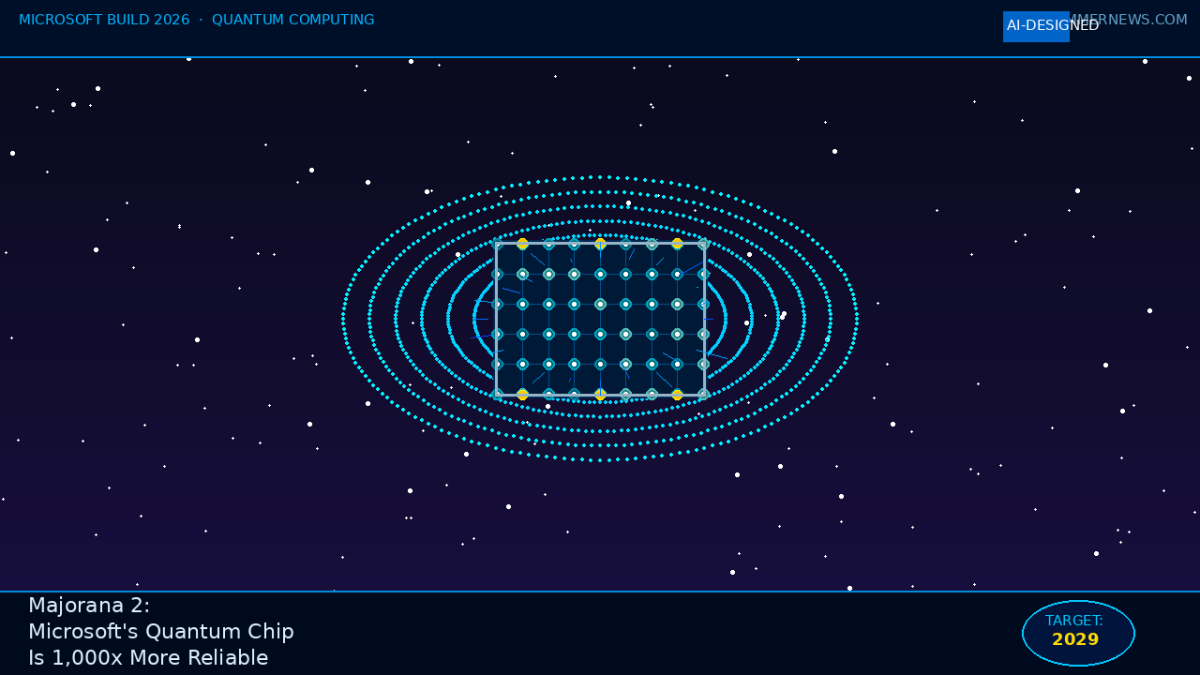
Microsoft has unveiled Majorana 2, a next-generation topological quantum chip that the company says is 1,000 times more reliable than its predecessor. The breakthrough, announced at Microsoft Build 2026 on June 2nd, is significant enough that the company has cut its target for delivering a scalable quantum computer from 2033 all the way to 2029 — a four-year acceleration that would have seemed implausible just twelve months ago.
What makes the story even more unusual is how Microsoft got there: agentic AI did much of the heavy lifting.
A New Chip Built by Artificial Intelligence
Microsoft’s quantum team used its Microsoft Discovery platform — which deploys autonomous AI agents to accelerate scientific research — throughout the design and fabrication of Majorana 2. The agents automated complex measurement workflows that previously required weeks of manual work, reducing cycle times by orders of magnitude. They sifted through nearly two decades of experimental data spread across multiple formats and research silos, identifying correlations no individual researcher could have spotted. They also caught something human reviewers had missed entirely: an uncalibrated temperature sensor introducing noise into the fabrication process.
“Agentic AI has permeated almost everything we do,” said Chetan Nayak, Microsoft Technical Fellow and the researcher leading the quantum effort. “It’s just become a very natural part of our workflow.”
The application of AI to quantum hardware development represents a feedback loop with significant implications. Better AI systems help build better quantum computers, and quantum computers — once viable — could in turn run more powerful AI. Microsoft is positioning itself at both ends of that loop.
What Changed in the Hardware
Majorana 2 follows the same topological quantum computing approach introduced with Majorana 1 in February 2025, but with a critical materials upgrade. The original chip used aluminum as its superconductor, sandwiched with an indium arsenide semiconductor to form a topoconductor — a hybrid material capable of producing Majorana zero modes at the ends of nanowires when cooled near absolute zero and exposed to a magnetic field.
Topological qubits store information across two or more Majorana particles rather than in the properties of a single particle, making them inherently resistant to localized disturbances. That architectural advantage has always been Microsoft’s bet against the superconducting qubit approach used by IBM, Google, and most of the rest of the industry.
The key change in Majorana 2 is swapping aluminum for lead as the superconductor. Lead is better at shielding qubits from external environmental disturbances — cosmic noise, electromagnetic interference, thermal fluctuations — that cause the errors which make quantum computation unreliable. The semiconductor active region has also been updated to a combination of indium arsenide and indium arsenide antimonide.
The results are striking. Majorana 1 could achieve qubit lifetimes of five to ten seconds. Majorana 2 achieves a mean lifetime of 20 seconds per qubit, with some qubits maintaining coherence for as long as a full minute. Most competing quantum approaches from IBM, Google, and IonQ measure qubit lifetimes in microseconds. Microsoft’s analogy: the improvement is comparable to a phone battery that lasts three years on a single charge rather than dying in a day.
Combined with operation speeds reduced to one microsecond and qubit dimensions of 1/100th of a millimetre, Majorana 2 gives Microsoft a credible path to the million-qubit-on-a-chip goal that the company has said is required for commercially useful quantum computing.
The 2029 Target — And Why It Matters
Microsoft’s revised timeline is the number that will face the most scrutiny. The company has shortened its window for a scalable quantum computer by four years, based on a single generational improvement to the chip. Skeptics — and there are credentialed ones — will point to the history.
In 2018, Microsoft claimed to have observed Majorana zero modes, the exotic quantum phenomenon the entire topological approach depends on. That paper was later retracted after independent researchers could not replicate the findings. Majorana 1, introduced in 2025, re-established some credibility with peer-reviewed results, but the quantum computing community has remained cautious about Microsoft’s claims. A peer-reviewed paper accompanies the Majorana 2 announcement, and that paper will be the real test.
What has changed is the broader competitive context. The quantum computing sector is in the middle of a capital boom that rivals the early days of cloud computing. Quantinuum, backed by Honeywell, saw its IPO massively oversubscribed this week, valuing the company at $14.3 billion. The U.S. government committed $2 billion to quantum firms in May, including $1 billion to IBM for its Anderson quantum chip foundry. Investors are pricing in the expectation that quantum will follow AI’s trajectory from laboratory curiosity to commercial infrastructure within the decade.
Against that backdrop, Microsoft’s 2029 target is a competitive positioning statement as much as an engineering forecast. Being first to demonstrate a scalable topological quantum computer — if it happens — would represent one of the largest platform shifts in the history of computing.
Microsoft Discovery Goes Public
Alongside the Majorana 2 chip announcement, Microsoft made its Discovery platform generally available to enterprise customers. The platform provides organizations with the same agentic AI research infrastructure that Microsoft’s own quantum team used: a Discovery Engine for orchestrating research and reasoning workflows, enterprise-grade security and governance controls, and integration with Azure.
Microsoft also released a free Discovery app in early preview that individuals can run locally with a GitHub Copilot account. Chemical company Syensqo is already using the platform to develop next-generation fluids for semiconductor manufacturing, demonstrating that the AI-accelerated R&D workflow is not limited to quantum physics. Any industry where materials science, fabrication optimization, or data-intensive experimentation plays a role is a potential customer.
The commercial launch of Microsoft Discovery matters independently of the quantum story. If the platform delivers even a fraction of the research acceleration it produced on the Majorana 2 project, it represents a new category of enterprise software — autonomous AI that does scientific work rather than business process automation.
What Comes Next
The immediate question for Majorana 2 is peer review. Microsoft’s paper will be examined closely by quantum physicists who have previously found the company’s experimental results difficult to replicate. The 20-second qubit lifetime, if confirmed, would represent a genuine milestone. The 1,000x improvement figure over Majorana 1 needs context: Majorana 1’s qubits lasted five to ten seconds, not microseconds, so the comparison is against a chip that was already significantly more stable than most competitors.
The longer-term question is whether the 2029 timeline survives contact with the engineering challenges still ahead. Building a quantum computer that fits on a chip and can be manufactured at scale involves materials science, error correction, and systems integration problems that remain unsolved. Agentic AI can accelerate the work, but it cannot eliminate the physics.
What Microsoft has demonstrated is that the combination of topological qubits and AI-driven research automation is a credible path — not a guaranteed one, but a credible one. In a sector where most credible paths have eventually hit walls, that distinction matters. The next milestone will be a demonstration of error-corrected logical qubits, which Microsoft has not yet publicly achieved. When that demonstration comes — if it does — the 2029 deadline will start to look either ambitious or inevitable.
For now, Majorana 2 is the most significant quantum hardware announcement Microsoft has made since Majorana 1, and the involvement of agentic AI in its creation may ultimately prove as important as the chip itself. The company is betting that AI and quantum computing are not parallel bets on the future, but the same bet.
Sources: The Next Web, SiliconANGLE, Tom’s Hardware, Scientific American, Microsoft Build 2026