When BYD built its first electric car, critics said a battery company had no business making automobiles. When it launched into smartphones and semiconductors, the same skeptics scoffed. Now, with executive vice president Stella Li confirming the company’s entry into humanoid robotics, BYD is once again daring the world to underestimate it — and the consequences for the global tech industry could be enormous.
From the Assembly Line to the Living Room
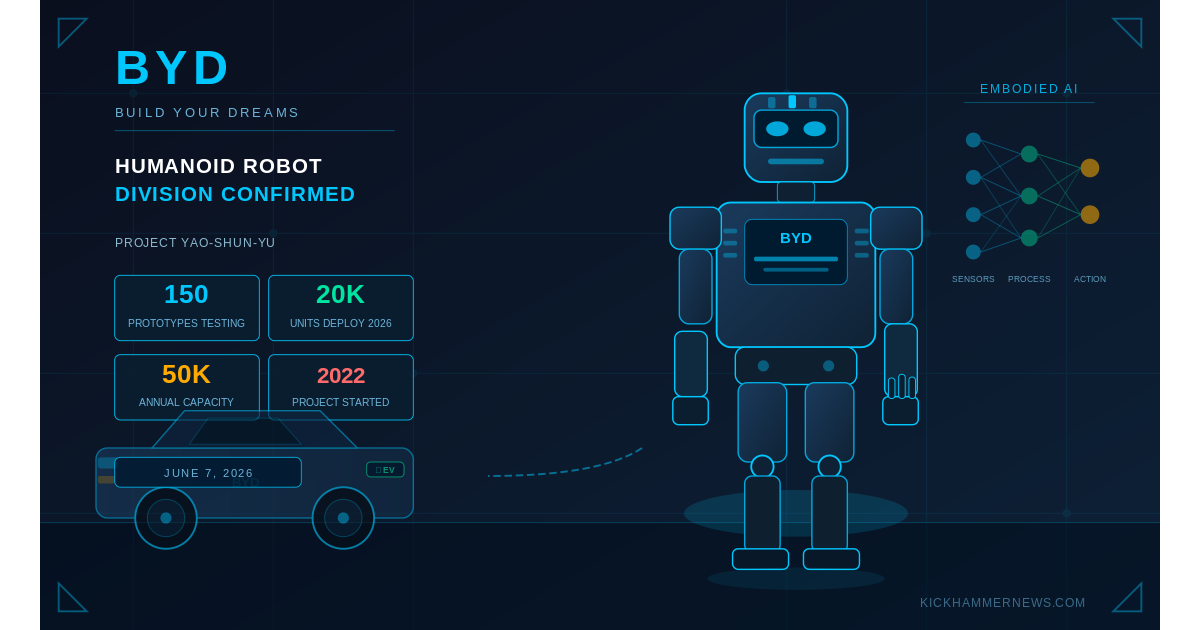
The announcement came quietly by BYD standards. In a recent interview, Stella Li confirmed that BYD has been secretly developing humanoid robots under a project codenamed “Yao-Shun-Yu,” a reference rooted in ancient Chinese philosophy suggesting wisdom, virtue, and transformative leadership. The project operates within BYD’s 15th Business Unit — the division dedicated to electronic integration and intelligence — and has been active since 2022.
As of now, approximately 150 prototypes are being tested across BYD’s own manufacturing facilities. The company plans to deploy 20,000 units internally by the end of 2026, using its own factories as both proving grounds and showcases. A dedicated industrial park is under construction in Xi’an with an eventual annual production capacity of 50,000 robots.
These aren’t just internal numbers. BYD has already begun imagining these robots serving as sales guides in its European showrooms, addressing hiring pressures and language barriers in markets from Germany to France. The company’s vast global dealer network — originally built for cars — may soon double as a distribution channel for humanoid machines.
The Automotive Advantage in Embodied AI
What distinguishes BYD’s entry from pure robotics startups is the technological inheritance it carries. “Automotive software is complex, and porting it into robots is very easy for us,” Li stated, underscoring a key competitive insight: the AI systems that manage real-time sensor fusion, adaptive cruise control, pedestrian detection, and battery management in a modern EV are structurally similar to the perception and actuation pipelines needed in a humanoid robot.
BYD’s proprietary “DiLink” and “DiPilot” platforms represent years of investment in real-world AI deployment at scale. Unlike a startup building from scratch in a lab, BYD has millions of vehicles on the road collecting sensor data, refining neural networks, and stress-testing edge cases in conditions that no controlled environment can replicate.
Li’s own diagnosis of the competitive landscape is pointed: Chinese robots currently “lack a developed brain” — meaning software intelligence, reasoning, and adaptability — while American robots “face the problem of underdeveloped limbs,” struggling with the mechanical precision and manufacturing quality needed for robust physical operation. BYD’s stated goal is to bridge both gaps simultaneously: robots with brains and bodies that work equally well.
China’s Automaker Robotics Boom
BYD is not alone in this pivot. China’s automakers are rushing into embodied AI with a speed and scale that has few parallels in industrial history.
Chery’s incubated brand Aimoga recently became one of the first companies in the world to sell a humanoid robot directly to ordinary consumers, pricing its flagship model at 285,800 yuan (approximately $42,260). SAIC-GM has deployed wheeled humanoid robots on its Buick battery assembly lines, using machines to handle repetitive tasks while its human workforce focuses on quality control and exception management. Xpeng’s humanoid robot “Iron” has been on public display since April, garnering significant media attention at the company’s Guangzhou headquarters.
Meanwhile, BYD-backed robotics startup PaXini — which completed a funding round exceeding 1 billion yuan ($148 million) in March, pushing its valuation above 10 billion yuan — is reportedly weighing a Hong Kong IPO. The company represents exactly the kind of strategic ecosystem play BYD excels at: back a specialized partner, absorb the learning, then move in with full vertical integration when the market is ready.
Not every Chinese automaker is moving at the same pace. Nio’s founder William Li said in March that the company would remain focused on selling more vehicles for now, deliberately staying out of the robot race until the economics are clearer. It’s a sensible hedge, but one that risks leaving Nio behind if humanoid robots prove as disruptive to manufacturing and consumer markets as proponents believe.
The Open Platform Bet
Perhaps the most strategically interesting element of BYD’s approach is its plan to build an open robot platform — one that can host both BYD’s own in-house humanoid designs and products developed in partnership with other companies. This mirrors the platform strategy that transformed the smartphone industry, where Android created an ecosystem that ultimately dwarfed any single device maker.
If BYD can pull off a similar maneuver in robotics, it wouldn’t just be selling robots. It would be setting the standards, supplying the components, training the algorithms, and owning the distribution rails for an entire industry category. Given that BYD is already the world’s leading manufacturer of rechargeable batteries — the single most critical component in any electric robot — the vertical integration potential is staggering.
What This Means for Global Competitors
The United States robotics landscape, anchored by companies like Boston Dynamics, Figure AI, and Tesla’s Optimus program, has focused heavily on software sophistication and elegant mechanical design. Tesla CEO Elon Musk has claimed Optimus will eventually be worth more than the entire car business — an audacious prediction that now faces a more credible adversary.
BYD’s competitive advantages — manufacturing scale, component self-sufficiency, cost discipline, and an enormous domestic market to absorb early products — are precisely the factors that enabled it to outcompete Western automakers on electric vehicles. The robotics battle may unfold along similar lines: Western companies win on raw capability at launch, then watch as Chinese manufacturers close the gap at a fraction of the price.
The difference, as Li herself notes, is that the brain problem is harder to solve through manufacturing efficiency alone. Humanoid robots require contextual reasoning, safe interaction with humans, and the ability to generalize from training data to novel real-world situations. That challenge favors companies with deep software expertise and access to diverse, high-quality training data — advantages that currently tilt toward the United States.
A Race Without a Clear Finish Line
What makes the humanoid robot race so fascinating — and so difficult to predict — is that nobody yet knows what the killer application is. Is it factory automation? Elderly care? Last-mile logistics? Retail? Or something no one has thought of yet?
BYD’s decision to test robots in its own factories first is tactically shrewd. The company controls the environment, understands the tasks intimately, and can measure productivity gains directly against human workers. Lessons learned in Xi’an and Shenzhen will inform product iterations that eventually reach consumers and third-party buyers.
If BYD’s history in EVs is any guide, the world should resist the temptation to underestimate it. The company that was once dismissed as a budget battery maker is now the world’s most valuable automaker by units sold. The company that once seemed hopelessly behind Tesla’s software-first philosophy now leads it in many markets on features, price, and reliability.
Humanoid robots are the next front in a technology competition that shows no signs of slowing down. And with Yao-Shun-Yu preparing to leave the test floor, BYD is once again playing a longer game than almost anyone else in the room.


