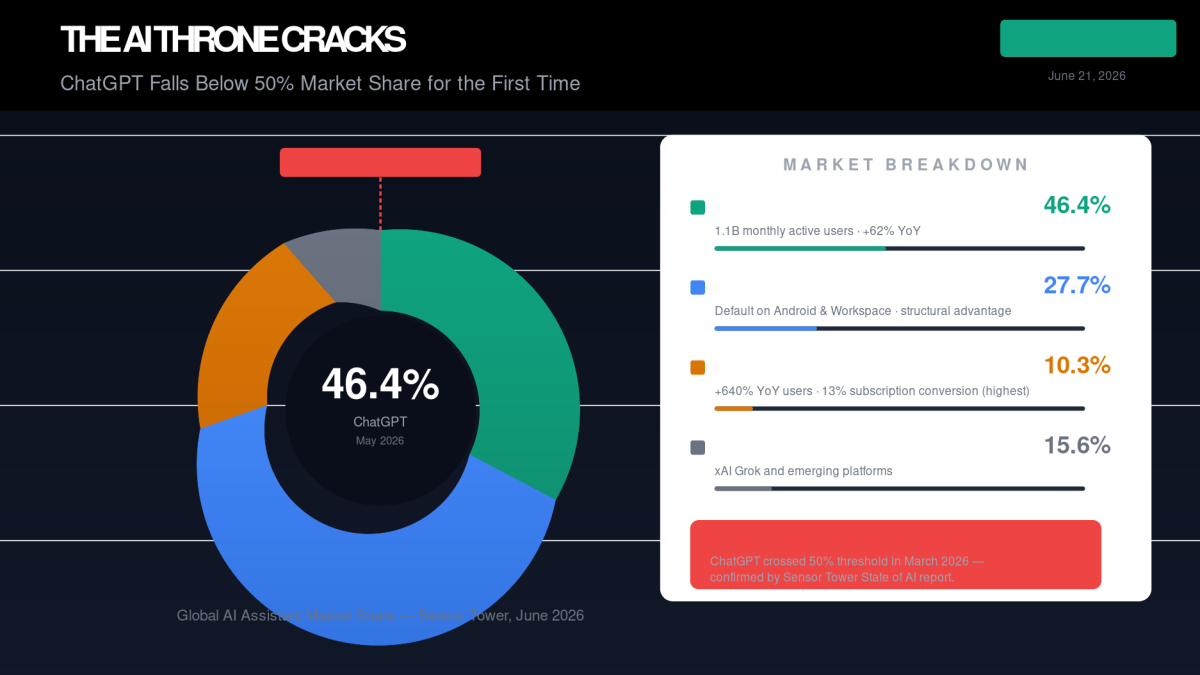
For nearly four years, ChatGPT was synonymous with AI. It launched the modern era of large language models, turned generative AI into a household phrase, and dominated the AI assistant market with a market share that competitors could only envy. But a new report has confirmed what industry insiders have been whispering for months: the crown is slipping. ChatGPT has fallen below 50% of the global AI assistant market for the first time in its history and the forces pulling it down are structural, political, and commercial all at once.
The Numbers Do Not Lie
According to Sensor Tower State of AI 2026 report, released on June 16, ChatGPT share of global AI assistant users fell to 46.4% by the end of May. That figure crossed below the 50% threshold back in March. ChatGPT has surpassed 1.1 billion monthly active users, a growth rate of 62% year-over-year. But in a market exploding at the speed of AI, 62% growth can feel like standing still when your nearest competitor is posting triple-digit gains.
The Challengers Are Real
Google Gemini has emerged as the most formidable challenger, capturing 27.7% of global AI assistant market share. Gemini is the default AI assistant baked into Android, Google Workspace, Gmail, Google Docs, and Google Search. That distribution advantage does not come from better marketing. It comes from owning the operating system and the productivity suite.
Anthropic Claude holds 10.3% of the market, but the growth rate behind that number is extraordinary: 640% year-over-year in monthly active users. Claude leads the entire industry in subscription conversion, with 13% of its users choosing to pay for premium access, the highest rate across all AI platforms.
Why Users Are Leaving
In February 2026, OpenAI announced a partnership with the U.S. Department of Defense for military AI applications. The announcement triggered an immediate spike in ChatGPT uninstalls among researchers, academics, and privacy-conscious consumers. Then came advertising: OpenAI quietly introduced ads to a portion of its free-tier user base, fundamentally altering the relationship between the platform and its users.
The Competitive Landscape Reshapes Around Values
What is striking about the current AI market fracture is how much of it is driven by values and trust, not just capability comparisons. Users are making choices based on which company they trust with their data. Anthropic has leaned hard into this dynamic. The 13% subscription conversion rate suggests Anthropic has found a user segment willing to pay specifically because they trust the platform.
What This Means for the Industry
The fracturing of ChatGPT majority market share signals that the AI assistant market is maturing from a winner-take-all monopoly into a genuinely competitive landscape. GPT-5.6 is expected to launch imminently with a 1.5 million token context window and sharper agentic capabilities. The question now is whether OpenAI can reinvent its value proposition fast enough to stop the slide, or whether the AI throne will be replaced by something more fragmented and ultimately more interesting: a genuine market.


