Adobe has officially moved enterprise AI from a line item on a budget sheet to a performance contract. With the general availability of Adobe CX Enterprise Coworker, announced June 10, the company is betting that businesses are ready to pay for AI the way they pay for results—not licenses. It is a quiet but seismic shift in how enterprise software gets priced, and it may set a template that the rest of the industry follows.
From Experience Cloud to CX Enterprise
For years, Adobe’s marketing technology stack lived under the “Experience Cloud” umbrella—a broad portfolio of analytics, content, and journey tools used by more than 20,000 global brands. With the launch of CX Enterprise Coworker, Adobe has effectively retired that branding in favor of something more directional. The new umbrella, Adobe CX Enterprise, signals that the company is no longer selling tools that support customer experience—it is selling the orchestration of the entire customer lifecycle itself.
That is more than a naming exercise. Adobe Experience Platform, the data spine that runs beneath all of it, now powers over one trillion customer experiences annually. That scale gives CX Enterprise Coworker a contextual layer that would take years for a startup to replicate: real-time customer profiles, cross-channel journey data, consent rules, and brand governance logic all built in from day one.
What the Coworker Actually Does
CX Enterprise Coworker is Adobe’s answer to a question that has frustrated enterprise marketers for the past two years: AI tools are impressive in demos, but how do you turn them into business results on a quarterly timeline?
The product works as a central intelligence layer—or, in Adobe’s framing, a “coworker”—that coordinates AI agents and human workflows across analytics, content creation, and journey orchestration. The interaction model is natural language. A marketer can describe a goal—launch a seasonal promotion, re-engage at-risk customers, accelerate a retention campaign—and the Coworker will build a campaign plan, generate on-brand creative, and design cross-channel journey flows in a single workflow.
Three use cases anchor the product. For marketing campaigns, the Coworker handles the full arc from ideation through execution, pulling relevant audiences, generating creative assets, and launching across channels. For customer engagement, it monitors performance signals in real time and adjusts workflows to surface personalized offers or intervene before customers churn. For marketing operations, it handles the unglamorous work: enforcing brand governance, managing approval cycles, and coordinating cross-functional review processes that typically burn weeks of calendar time.
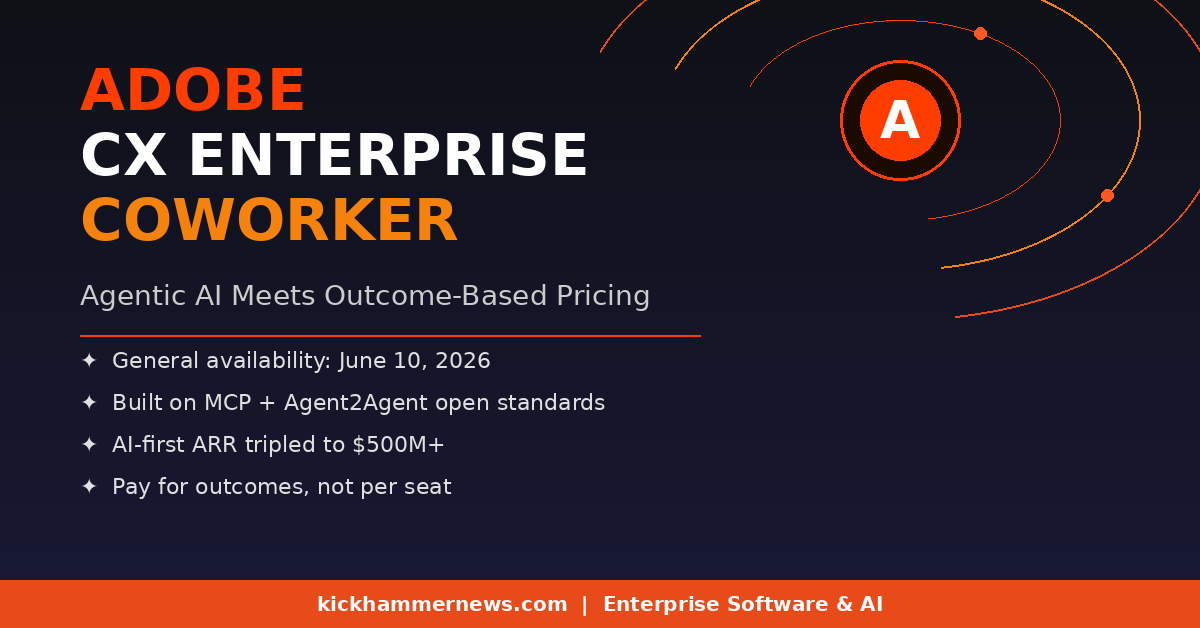
Critically, the product is not locked inside Adobe’s own ecosystem. CX Enterprise Coworker is built on open standards—specifically, Model Context Protocol (MCP) and Agent2Agent (A2A)—and can interoperate with AI platforms from Amazon Web Services, Anthropic, Google Cloud, Microsoft, and OpenAI. For enterprise technology buyers who have spent the past year anxious about vendor lock-in in the AI era, that interoperability commitment matters.
The Pricing Shift That Changes Everything
The technical capabilities are significant, but the pricing model may be the more consequential story.
CX Enterprise Coworker is offered as a standalone solution or as an add-on to existing Adobe investments. It introduces no per-seat component. Instead, pricing is tied to measurable business outcomes—completed campaign launches, conversion lift, engagement metrics—and scales with the value organizations realize. Adobe describes the initial access price as introductory, with usage expanding as customers see results.
This is a deliberate departure from the subscription model that has defined enterprise software for the past decade. Per-seat and per-user pricing made sense when AI was an assistant feature bolted onto productivity tools. It makes less sense when AI is the primary driver of business outcomes across an entire marketing organization. Adobe is arguing that its value proposition is now closer to performance marketing than to software licensing, and it wants to be compensated accordingly.
The implications extend well beyond Adobe’s balance sheet. Oracle has been exploring similar outcome-based pricing frameworks for its AI-enhanced ERP and supply chain products. Salesforce introduced consumption-based tiers for its Agentforce platform in late 2025. Microsoft has been testing agent-based pricing for Copilot Studio. The CX Enterprise Coworker launch puts a major player firmly on record: the per-seat model is not the right mechanism for agentic AI, and the industry is moving on.
Adobe’s AI Revenue Signal
The commercial stakes are not theoretical. In Adobe’s Q2 fiscal 2026 results, also reported on June 11, the company disclosed that AI-first annual recurring revenue has tripled year over year and exceeded $500 million. Inside the Customer Experience Orchestration business specifically, AI-first revenue grew fourfold year over year.
Those numbers validate the strategic direction. They also put pressure on Adobe’s critics, who have spent the past two years arguing that generative AI threatens the company’s core creative tools business. The CX Enterprise play addresses that critique by moving Adobe into territory—agentic workflow orchestration for enterprise marketing—where generative image tools are just one component of a much larger value chain.
What Comes Next
CX Enterprise Coworker is the opening product in what Adobe describes as an end-to-end agentic AI system for managing the full customer lifecycle. Expect subsequent announcements to extend the orchestration logic further into sales enablement, commerce, and customer service—areas where Adobe’s data assets and content generation capabilities could compete directly with Salesforce, ServiceNow, and Oracle.
The bigger test, as with any outcome-based model, is whether the outcomes are actually measurable and whether customers accept Adobe’s methodology for calculating them. That negotiation will define whether this pricing shift is a genuine market transition or a rebranding of what used to be called professional services.
For now, Adobe has done something rare in enterprise software: it has tied its compensation to its customers’ results. In an industry where AI promises have consistently outpaced AI delivery, that is either very confident or very brave—and possibly both.
*Sources: Adobe newsroom, Adobe Q2 FY2026 earnings report, CX Today, CXM World, Let’s Data Science*