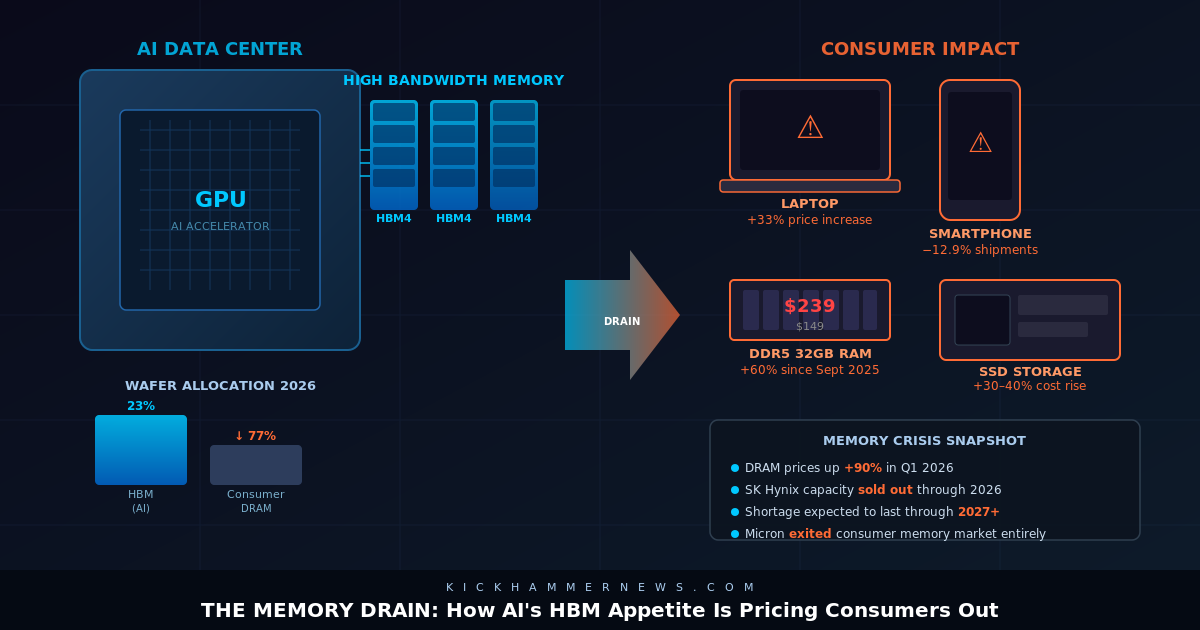
The laptop you’re about to buy is more expensive than it should be. So is your next smartphone. The extra cost isn’t driven by new features or even inflation it’s being siphoned away by the artificial intelligence industry’s voracious hunger for a specialized type of memory that most consumers have never heard of: High Bandwidth Memory, or HBM.
A once-obscure component used primarily in gaming GPUs, HBM has become the petroleum of the AI era. As data centers race to build ever-larger clusters of AI accelerators the chips that train and run models like GPT-5, Gemini Ultra, and Claude Opus demand for HBM has exploded beyond any projections made just two years ago. And the three companies that make virtually all of the world’s DRAM Samsung, SK Hynix, and Micron have responded by systematically converting their factories to produce it, starving the consumer market in the process.
What Is HBM and Why Does AI Need So Much of It?
High Bandwidth Memory is, as the name suggests, memory engineered for speed above all else. Traditional DDR5 RAM what sits inside your PC or phone moves data at a few hundred gigabytes per second. HBM4, the latest generation, moves data at over ten terabytes per second. When you’re running a model with hundreds of billions of parameters, that difference isn’t academic. It’s the reason an AI inference cluster can respond in milliseconds instead of minutes.
AI accelerators like NVIDIA’s Blackwell Ultra and AMD’s Instinct MI400 consume HBM in massive quantities. A single high-end AI server rack can incorporate more than 100 HBM dies. And with hyperscalers Amazon, Google, Microsoft, Meta each ordering tens of thousands of such systems, the math quickly becomes staggering.
According to IDC’s latest market analysis, data centers will consume roughly 70% of all high-end memory produced in 2026. That represents a complete inversion from just three years ago, when consumer devices smartphones, laptops, tablets were the dominant force in memory procurement.
The Factory Pivot That Changed Everything
The problem isn’t just demand; it’s manufacturing economics. HBM generates three to five times more revenue per silicon wafer than conventional DDR5. For Samsung, SK Hynix, and Micron, the business calculus is straightforward: convert as many production lines as possible to HBM, and let the margin gains roll in.
By mid-2026, HBM now consumes approximately 23% of total DRAM wafer output globally up from 19% in 2025 and roughly 8% in 2023. SK Hynix, which supplies HBM to NVIDIA and reported record profits in Q1 2026, announced that its entire HBM, DRAM, and NAND capacity is essentially sold out for the year. Micron has gone further, quietly exiting the consumer memory market entirely to focus on enterprise and AI customers.
Samsung’s memory division chief Kim Jaejune stated bluntly that significant shortages across memory product lines are expected to persist through at least 2027. The reason is structural: building a new semiconductor fab takes three to five years and costs upward of $20 billion. No amount of urgency can compress that timeline.
Prices Are Already Rising Sharply
The supply crunch has translated directly into price increases that are now rippling through the consumer electronics market. DRAM prices rose approximately 90% in Q1 2026 compared to Q4 2025. Samsung’s price list for 32GB DDR5 modules now sits at $239, up from $149 just nine months ago a 60% increase.
PC makers including Lenovo, Dell, HP, Acer, and ASUS have all warned enterprise clients of 15-20% price hikes and contract resets for memory-intensive products. For consumers buying off-the-shelf laptops, the increases are baked into sticker prices that have climbed quietly but unmistakably over the past two quarters.
Smartphone makers have fared no better. Apple, which typically commands favorable pricing through its sheer purchasing volume, has been forced to absorb memory cost increases it cannot fully offset through supplier negotiations alone. IDC projects global smartphone shipments will decline 12.9% in 2026, with memory pricing cited as a primary headwind alongside weakening consumer demand in key markets. The PC market faces a similar contraction of 11.3%.
The Cascade Effect
The crisis extends beyond DRAM into NAND flash the storage technology inside your phone’s internal memory and your laptop’s SSD. Chip manufacturers chasing HBM margins have also reduced NAND investment, contributing to SSD prices that have climbed 30-40% in some segments since late 2025.
This creates a compounding effect: devices that were already becoming more expensive due to tariff pressures and supply chain reshoring initiatives are now facing a second wave of cost inflation driven entirely by the AI sector’s appetite for specialized silicon.
Cloud storage pricing has also begun to edge upward as hyperscalers face higher infrastructure costs. While increases have been modest so far Google One and iCloud plans have seen 10-15% adjustments analysts expect further upward pressure if the shortage persists through 2027 as projected.
An Industry Divided
Not everyone sees the HBM shortage as a crisis. NVIDIA’s Jensen Huang has argued that the memory constraints affecting consumer devices are a temporary market correction and that investment in new capacity will eventually balance supply and demand. Analyst firm Bernstein Research broadly agrees, projecting that new HBM-capable fab capacity coming online in 2028 will begin easing the shortage.
Harvard semiconductor expert Lindiwe Maseko takes a more cautious view. The current HBM premium is extraordinary, and it’s incentivizing exactly the kind of capacity buildout that will create an oversupply problem in three or four years, she told Fortune in May. This too will pass the question is whether the consumer market survives the squeeze intact.
What It Means for You
For anyone buying electronics in 2026, the practical implication is clear: expect to pay more for less, or wait. A mid-range laptop that cost $900 in early 2024 now runs $1,100 to $1,200 for equivalent specs. Upgrading a desktop PC’s RAM has gone from a $60 afternoon project to a $130 exercise in frustration.
The irony is acute. The AI revolution sold to the public as a productivity miracle that will make technology more accessible is, through its enormous resource demands, making the basic devices most people rely on meaningfully less affordable. The algorithms are getting smarter while the hardware they run on, and the hardware the rest of us use, is getting more expensive.
Until new manufacturing capacity comes online, that tension isn’t going away.


